

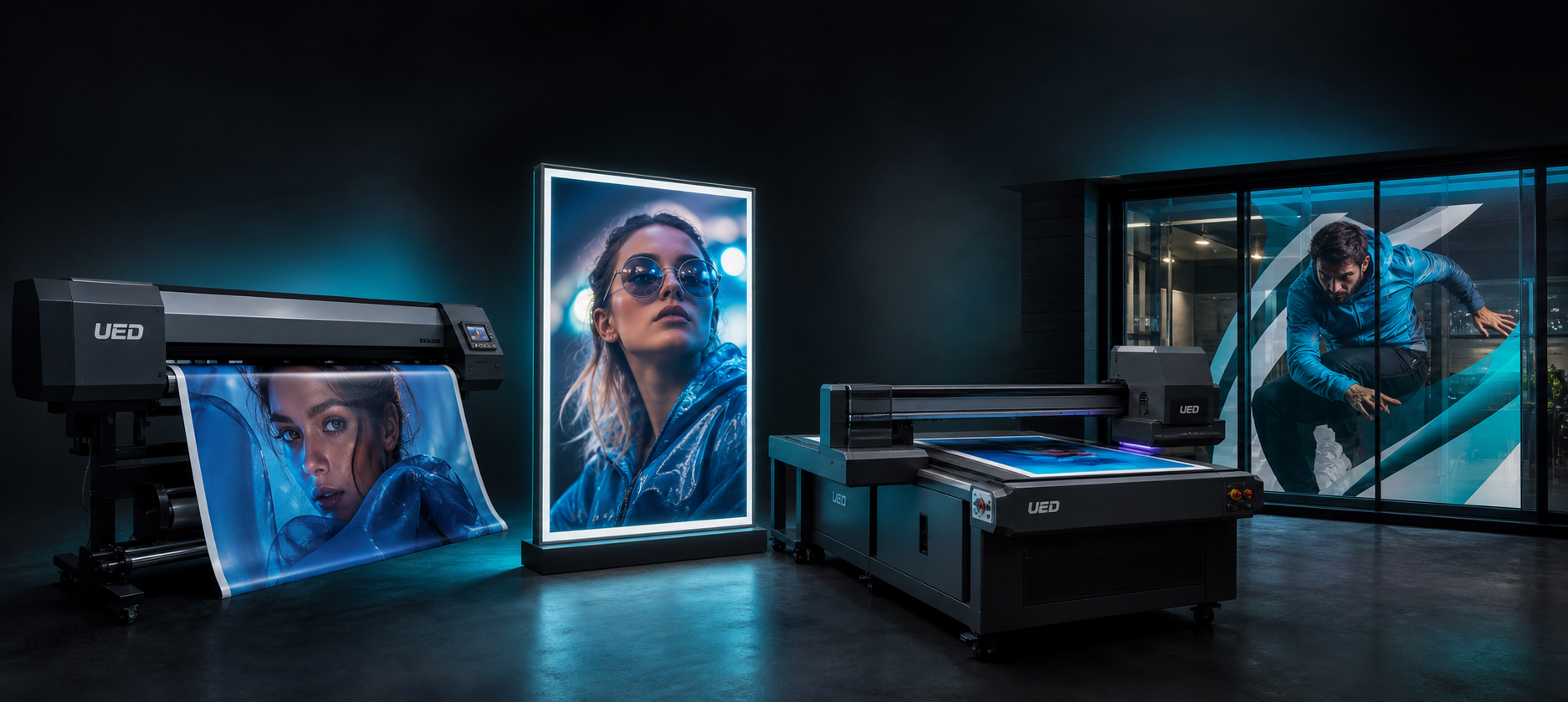
An advertising business lives on attention — shopfronts, hoardings, vehicles, lightboxes, retail spaces — and UV printing now produces nearly all of it. This guide lists what an advertising business should print on UV machines, which machine (roll-to-roll, flatbed or both) makes each product, and how to package these into profitable service lines, so a UV investment translates directly into advertising revenue.
The advertising product map on UV
Advertising work splits into flexible media (the roll-to-roll’s domain) and rigid media (the flatbed’s domain). Flexible: frontlit and backlit banners, hoardings, vehicle graphics, window films, stickers and labels, backlit films, canvas. Rigid: acrylic and ACP shop signs, foam board campaigns, lightbox panels, POS and display units, wayfinding, menu boards, floor graphics, event and exhibition stands. Knowing which machine makes which product lets you quote the full advertising job instead of losing half of it.
Flexible products: the roll-to-roll advertising line
- Frontlit banners and hoardings for outdoor campaigns.
- Backlit flex and film for lightboxes and glow signage.
- Self-adhesive vinyl for vehicle graphics and fleet branding.
- Window and glass graphics for retail promotions.
- Stickers and labels for product and promo campaigns.
- Canvas and photo media for displays.
UV adds white ink for clear-vinyl and day-night graphics and removes lamination on many jobs, giving same-day turnaround that advertising clients pay for.
Rigid products: the flatbed advertising line
- Acrylic and ACP shop boards and fascia signs.
- Backlit acrylic lightbox panels for malls and retail.
- PVC foam board campaign panels and site signage.
- POS displays, standees and retail display units.
- Wayfinding and directional signage for campuses and malls.
- Menu boards and price displays for QSR and retail.
- Floor graphics for in-store promotions.
- Event and exhibition stands and backdrops.
The flatbed’s white and varnish make these premium and durable, and rigid signage is where advertising margins are fattest.
Packaging the products into service lines
Advertising clients buy outcomes, not substrates. Package the products into named service lines: Shopfront Branding (fascia, window, lightbox), Fleet & Vehicle Branding, Retail Campaigns (POS, floor, menu boards), Events & Exhibitions, and Corporate Wayfinding. Each line bundles flexible and rigid products with design, production and installation, giving a higher ticket and a single accountable supplier. Service lines also make marketing simple: you advertise solutions, and the machines quietly supply them.
Which machine for an advertising business first
If your book is banner and hoarding volume, start with a UV roll-to-roll printer; it is the cash-flow engine of advertising. If your book is retail branding, lightboxes and rigid signage, start with a UV flatbed printer for the margin. Most advertising businesses eventually need both, because clients buy flexible and rigid together; a hybrid can bridge the gap where one machine must do. The order should follow your dominant enquiry type.
Turnaround as the advertising product
Advertising is deadline-driven: launches, festivals, elections, sales. UV’s instant cure is a commercial weapon here — print, finish and install same-day. Build service levels around it: a same-day banner promise, a 48-hour lightbox promise, a weekly campaign refresh for retail chains. Reliably meeting deadlines is what wins advertising accounts and keeps them, more than any single product. Price the speed in; clients pay for certainty.
Pricing advertising work for margin
Price flexible volume competitively but not suicidally, and price rigid and premium work on value. Bundle installation and design into packages so you capture the whole job margin. Use quantity breaks for chains and retainers for recurring retail campaigns. Track contribution per job type and quietly steer sales toward the lines that earn — typically lightboxes, rigid signage and vehicle graphics over plain banners.
Common mistakes advertising shops make with UV
- Buying only one machine and losing half of every advertising job.
- Under-pricing same-day speed that clients value highly.
- Not offering installation, then losing the job to a full-service rival.
- Ignoring white ink, then missing backlit and clear-vinyl premiums.
- Treating campaigns as one-offs instead of building retainer relationships.
Frequently asked questions
Can UV handle vehicle wraps?
UV roll-to-roll prints vehicle-grade vinyl well; wraps still need skilled installation and, for long life, lamination. It is a strong advertising line with the right finishing.
Is backlit work profitable on UV?
Yes — backlit lightbox panels and films carry premium prices and UV’s white-ink control makes them a signature product for malls and retail.
Do advertising clients care about UV vs eco-solvent?
They care about quality, speed and durability, not the chemistry. UV’s advantages (white ink, same-day, premium finish) are what you sell as client benefits.
A deeper look: winning retail chain and franchise accounts
Retail chains and franchises are the ideal advertising accounts: they refresh campaigns across many outlets on a calendar, buying banners, window graphics, menu boards and POS together. Win one outlet, prove consistency and turnaround, then roll out. Offer a campaign kit per outlet with standardised templates and variable store details, and a retainer for the refresh cycle. One chain account can anchor a machine’s utilisation for years and generates predictable, recurring revenue across both flexible and rigid lines.
A deeper look: the election and festival season playbook
Advertising demand spikes at elections and festivals, and UV’s speed is decisive in these windows. Prepare in advance: stock popular media, pre-book installation crews, and offer packages (hoarding + banner + vehicle) at quantity pricing. Because deadlines are absolute, premium pricing is accepted. The shops that plan the season — capacity, stock, staffing — capture outsized revenue in a few weeks; the ones that improvise miss it. Treat each season as a project with its own P&L and post-mortem.
Spotlight: lightboxes and backlit retail
Backlit work is the premium heart of advertising on UV: lightbox panels for malls, menu lightboxes for QSR, and backlit films for retail glow signage. UV’s white-ink control makes day-night graphics that look vivid lit and unlit, and the product commands strong prices because it is highly visible and specified by brands. Build a sample lightbox for the showroom; a glowing panel sells the job better than any quote, and backlit accounts tend to be recurring as campaigns refresh.
Spotlight: vehicle and fleet branding
Vehicle graphics turn every van and car into moving advertising, and fleets rebrand on schedules, making this a recurring line. UV roll-to-roll prints vehicle-grade vinyl with the colour and white needed for bold wraps; skilled installation and, for long life, lamination complete the product. Sell it as a fleet programme with a maintenance and refresh plan rather than a one-off wrap, and a single logistics or service client can anchor steady volume.
Spotlight: window and glass graphics
Window graphics are retail’s fastest refresh cycle: seasonal promotions, sales, launches and festive dressing, changed weekly or monthly by chains and independents alike. UV prints clear and opaque vinyl with white for double-sided and high-opacity effects, and the jobs are quick and frequent. Because windows are visible to footfall, retailers treat them as essential marketing, giving you a dependable, high-frequency product that builds routine client relationships.
Spotlight: POS displays and retail units
Point-of-sale displays, standees and display units are where rigid advertising margin lives: brands pay well for campaign displays that sit in-store, and each launch or promotion needs fresh units. A flatbed plus a cutter produces these fast in short runs that traditional display printing cannot serve economically. Offer design, print and die-cut as a package and you become the retail-activation supplier, a high-value, relationship-driven line that recurs with every campaign.
Spotlight: wayfinding and mall programmes
Wayfinding and mall signage are systems business: directories, directional and informational signs across a campus or mall, standardised yet variable per location. UV flatbed printing handles the mix of rigid panels and variable data, and the durability suits long-life installation. Landing one programme anchors years of replacement and expansion work, and it positions you as a specification partner rather than a one-off printer.
Measuring and steering your advertising product mix
Track contribution per advertising line monthly and steer sales toward the earners — typically backlit, rigid signage and vehicle graphics over plain banners. Use the volume lines to win the account and the premium lines to make it profitable, and review the mix each quarter so pricing and marketing follow the real economics. An advertising shop that knows which products earn, and sells deliberately toward them, compounds margin while competitors chase volume alone.
Design and prepress as part of the product
Advertising clients often arrive with a logo, not artwork. Offering design and prepress as a paid, fast part of the package lifts both margin and quality: your files are built for UV (correct white layers, bleed, colour) and the client gets one accountable supplier. A small in-house design capability, or a reliable freelance bench, therefore multiplies the value of the machines, because great print of poor artwork still loses the account.
Installation and the full-service advantage
In advertising, the job is not done until it is up. Offering installation — banners at height, lightboxes wired, vehicle wraps fitted, displays erected — captures the final margin and removes the client’s coordination burden, which is often the deciding factor against a print-only rival. Build or partner a competent installation capability, specify fixing methods and warranties clearly, and price installation as a real product, because it is both revenue and reputation.
Retainers and campaign calendars
The most valuable advertising relationships are calendared: a retail chain refreshing windows monthly, a QSR updating menu lightboxes quarterly, a fleet rebranding annually. Propose retainers that reserve capacity and guarantee turnaround in exchange for committed volume, and manage each account against its campaign calendar so you pitch the next refresh before the client thinks of it. Retainers convert lumpy advertising demand into predictable revenue and keep the machines planned rather than reactive.
Colour consistency as an account-keeper
Advertising is brand work, so colour consistency across sites and reorders keeps accounts. Profile your machines, hold brand colour standards per client, and print campaign runs in one session where possible so every outlet matches. When a chain sees identical colour across fifty locations, trust compounds and the account sticks; when it sees mismatch, the account is one tender away from leaving. Consistency is therefore not a technical nicety but a revenue defence.
The advertising shop as a media-neutral partner
Ultimately the strongest advertising shops stop selling printing and start selling attention: they advise clients on the right mix of hoarding, window, lightbox, vehicle and in-store media for the budget, then produce and install it all. UV gives them the range to say yes to nearly any element of that mix. When you are the partner who plans the campaign as well as produces it, price becomes secondary and the relationship becomes strategic — the most durable position in the advertising trade.
Begin with the products your enquiries already demand, package them into service lines with installation and design, and let retainer and chain accounts turn seasonal advertising into steady revenue. The machines supply the range; your packaging of it supplies the profit.
That is the difference between owning printers and running an advertising business: the former sells square feet, the latter sells attention — and attention, produced reliably, is what clients keep paying for.
Review the advertising mix each quarter, keep the earners front and centre, and let the calendar of campaigns — not chance — fill the machines; done consistently, this turns a print shop into the media partner its clients rely on.
Package the range, sell the outcome, keep the calendar full, and the advertising business compounds.
Do that and UV becomes not just a print technology but the engine of the whole advertising offering.
Start with your strongest advertising line, prove it, then expand across the map.
Conclusion
An advertising business can print nearly its entire product range on UV: flexible banners, vinyl and backlit on a roll-to-roll; rigid signs, lightboxes, POS and wayfinding on a flatbed. Package these into service lines, sell turnaround and installation as part of the product, price rigid work on value, and build retainer and chain accounts for recurring revenue. Explore the digital UV printer range or talk to us about configuring an advertising production line.
