

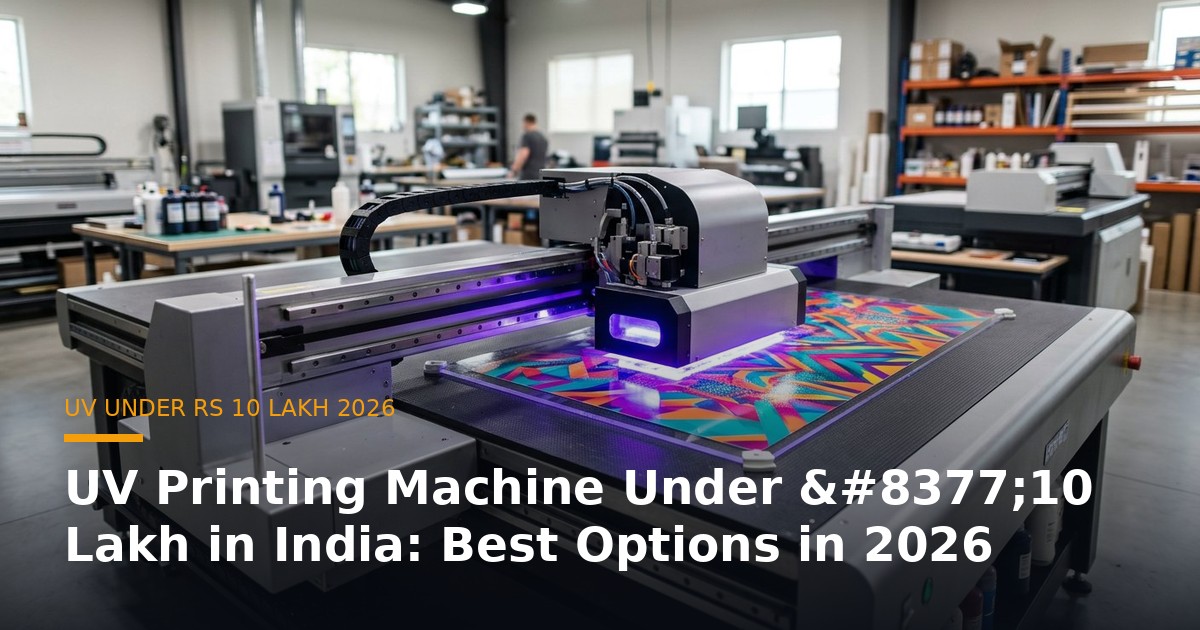
UV printing has transformed what Indian print businesses can offer, because it prints directly onto rigid and specialty substrates — acrylic, glass, wood, metal, PVC board, tiles and more — with instant curing and excellent durability. The good news for 2026 is that capable UV machines are now within reach of small and mid-size businesses. This guide covers the UV printing machine price under ₹10 lakh in India, the best options in this budget, and what each configuration can do for your business.
Until recently, UV printing was the preserve of larger operations, but falling costs and compact machines have opened the segment. Under ₹10 lakh you can now buy a UV flatbed or roll-to-roll machine that adds a high-margin, differentiated product line to your printing business.
UV Printing Machine Price Under ₹10 Lakh in India 2026 — Snapshot
| Machine Type | Typical Spec | Indicative Price (2026) |
|---|---|---|
| Small UV flatbed (A3–A2) | i3200 / XP600 head | ₹4.0L – ₹7.0L |
| Mid UV flatbed (larger bed) | i3200 / Konica | ₹6.0L – ₹10.0L |
| UV roll-to-roll (entry) | i3200 / Konica | ₹5.0L – ₹10.0L |
Under ₹10 lakh, most buyers choose a compact UV flatbed for rigid-substrate work or an entry UV roll-to-roll machine for flexible media with UV durability.
What You Can Do with a UV Machine Under ₹10 Lakh
A UV machine in this budget opens up a wide range of high-margin products: printed acrylic and glass signage, wood and MDF decor panels, PVC board displays, tiles and stone printing, metal nameplates and awards, phone cases and promotional gifts, packaging prototypes and short-run packaging, and rigid point-of-sale displays. Because UV inks cure instantly and adhere to almost any flat surface, you can offer products that eco-solvent and flex machines simply cannot — a powerful way to differentiate and increase margins.
UV Flatbed vs UV Roll-to-Roll
The two main types serve different needs. A UV flatbed prints directly onto rigid sheets and objects, making it ideal for signage, decor, gifts and industrial printing on acrylic, glass, wood, metal and board. A UV roll-to-roll machine prints on flexible media with UV-cured inks, offering superior scratch and weather resistance for banners, backlit film, vinyl and textiles. Some businesses benefit from both, but under ₹10 lakh you will typically choose one based on whether your focus is rigid substrates (flatbed) or durable flexible media (roll-to-roll).
What Affects UV Machine Price?
Price is driven by the printhead (Epson i3200 and Konica heads are common), bed size or print width, the number of ink channels (including white and varnish for special effects), automation features, and the bundled RIP software. Machines with white ink capability cost more but can print on transparent and dark substrates, which is essential for glass, acrylic and backlit work. As always, compare the full configuration and prioritise a supplier with genuine heads, good service and ready spares.
Return on Investment for a UV Machine
UV printing commands premium prices because it produces durable, high-value products on substrates other machines cannot handle. Margins on acrylic signage, decor panels, gifts and industrial printing are typically much higher than on commodity flex work. Even at moderate volume, a UV machine under ₹10 lakh can repay itself quickly by adding a differentiated, high-margin product line to your existing business. The key is to market these new capabilities to retail, corporate, interior-design and gifting customers who will pay for quality and uniqueness.
Why Buy Your UV Machine from UED?
Unified Engineering Dynamics (UED) supplies, installs and services UV printing machines across India, including flatbed and roll-to-roll models under ₹10 lakh. We help you choose the right type, bed size and ink configuration for your target products, provide genuine printheads and inks, professional installation and training, and dependable after-sales support — so your UV investment adds a profitable, differentiated product line from day one.
White Ink and Varnish: The UV Advantage
One of the most valuable capabilities of a UV machine is white ink, which lets you print on transparent substrates like glass and acrylic and on dark materials, producing vivid, opaque colours that would otherwise be impossible. Many UV machines also offer a varnish channel for gloss, matte or textured spot effects that add a premium, tactile finish to signage, gifts and packaging. These capabilities are exactly why UV printing commands higher prices: it produces effects and substrates that eco-solvent and flex machines cannot match. When choosing a UV machine under ₹10 lakh, consider whether white and varnish capability is worth the modest premium for the products you want to offer, because it significantly expands what you can sell.
UV Printing Applications That Pay Well
UV printing serves several high-margin markets. Interior designers and architects specify printed glass, acrylic and wood panels for decor. Retail brands need premium point-of-sale displays and signage on rigid board. Corporate clients order awards, nameplates and branded gifts. The packaging industry uses UV for prototypes and short-run premium packaging. Event and exhibition companies need durable rigid graphics. Each of these customers values quality and uniqueness over price, which means healthier margins than commodity flex work. Adding a UV machine lets you serve these markets and position your business as a premium, full-service printing partner rather than a price-driven flex shop.
Choosing the Right UV Machine for Your Budget
Under ₹10 lakh, match the machine to your target products and volume. If you want to print signage, decor and gifts on rigid substrates, a compact UV flatbed with white ink is the right choice. If you need durable flexible media for banners, backlit and vinyl, an entry UV roll-to-roll machine suits you better. Consider bed size or print width against the job sizes you expect, and whether you need white and varnish channels. Prioritise a genuine printhead with Indian spares support, a good RIP, and a supplier with responsive service. Buying the right configuration for your actual products ensures your UV investment earns quickly rather than sitting underused.
UV Machine Maintenance and Running Costs
UV machines reward careful maintenance. UV printheads must be kept clean and protected from stray UV light, which can cure ink inside the head and cause blockages, so follow the manufacturer’s capping and cleaning routines and use recommended UV inks. Keep the curing lamps or LED array performing correctly, and the media platform clean and level. UV ink costs more per litre than eco-solvent, but because UV products sell at premium prices, margins remain strong. Budget for periodic servicing and genuine spares. With disciplined care, a UV machine under ₹10 lakh delivers reliable, high-margin output and a strong return on investment for years.
Understanding UV Print Quality and Durability
One of the biggest reasons businesses invest in UV printing is the exceptional quality and durability of the output. Because UV inks cure instantly under ultraviolet light rather than soaking into the material, the print sits crisply on the surface with sharp detail, vivid colour and no drying time. This means you can handle printed items immediately after printing, with no smearing or waiting, which speeds up production and reduces waste. The cured ink layer is highly resistant to scratching, fading and moisture, so UV-printed signage, decor panels and industrial parts withstand handling, cleaning and outdoor exposure far better than many alternative methods. For products that must look premium and last — retail displays, architectural glass, branded gifts, awards and nameplates — this combination of instant quality and durability is exactly what customers pay a premium for, and it is something a conventional eco-solvent or flex machine simply cannot deliver on rigid substrates.
Adding UV to an Existing Printing Business
For an established flex, eco-solvent or signage business, adding a UV machine under ₹10 lakh is one of the smartest ways to increase revenue and margins without abandoning your existing work. Your current customers already trust you for banners and signage; a UV machine lets you offer them premium rigid products — acrylic signage, printed glass, wood decor, corporate gifts and displays — at much higher margins, turning one-off signage buyers into recurring, multi-product clients. It also opens entirely new markets, such as interior designers, architects, retail brands and corporate gifting, that conventional printing cannot serve. Because UV products are differentiated and less price-sensitive than commodity flex work, they improve your overall profitability and reduce your dependence on competitive banner pricing. Many printers find that a single compact UV flatbed pays for itself within months by adding a high-margin product line to the business they already have, making it one of the highest-return investments available under ₹10 lakh.
UV Printing on Different Substrates
One of the most exciting aspects of UV printing is the sheer variety of materials it can handle. On acrylic and glass, UV inks produce vivid, opaque graphics — especially with white ink underneath — for signage, partitions and decorative panels. On wood and MDF, UV printing creates custom decor, wall panels and furniture accents that interior designers love. On metal, it produces durable nameplates, awards, industrial labels and branded panels. On PVC board and foam board, it delivers lightweight, rigid displays and point-of-sale units. It even prints on tiles, stone, leather and many plastics. This versatility means a single UV machine can serve signage, interior design, corporate gifting, retail display and industrial marking markets from one asset, which is why it adds such strong, diversified revenue to a printing business.
UV Ink Types and Curing Explained
UV inks contain pigments and resins that polymerise instantly when exposed to ultraviolet light, forming a hard, durable film on the surface rather than soaking in. Most UV machines use LED curing, which is energy-efficient, cool-running and long-lasting, though some use traditional UV lamps. Machines with multiple ink channels can lay down white ink for opacity on transparent or dark substrates, and a clear varnish for gloss, matte or textured spot effects that add a premium finish. Understanding these options helps you choose a configuration that matches your products: if you plan to print on glass, acrylic or dark materials, white ink capability is essential, and varnish opens up high-value decorative and packaging effects. Good UV inks and correct curing settings are key to durable, scratch-resistant output.
Marketing Your UV Printing Services
Because UV printing produces premium, differentiated products, marketing it is about showcasing quality to the right customers. Build a portfolio of sample pieces — printed acrylic signage, glass panels, wood decor, corporate gifts and displays — and display them prominently, because UV output sells itself when customers can see and touch it. Target interior designers, architects, retail brands, corporate clients and event companies who value quality and uniqueness over price. Use social media and a Google Business Profile to reach local buyers searching for custom signage and gifting. Offer design assistance and short runs, which larger printers often avoid. Positioning yourself as a premium, full-service UV printing partner — rather than competing on commodity prices — lets you command the healthy margins that make a UV machine such a strong investment.
Frequently Asked Questions
What is the UV printing machine price under ₹10 lakh in India in 2026?
Under ₹10 lakh you can buy a compact UV flatbed (around ₹4–7 lakh) for rigid-substrate work or an entry UV roll-to-roll machine (around ₹5–10 lakh) for durable flexible media, depending on head, size and ink configuration.
What can I print with a UV machine?
Acrylic, glass, wood, metal, PVC board, tiles, phone cases, gifts, packaging and rigid displays — almost any flat substrate, with instant curing and excellent durability.
Is a UV flatbed or roll-to-roll better?
Choose a flatbed for rigid substrates like acrylic, glass and wood, or a roll-to-roll for durable flexible media like banners, backlit film and vinyl. It depends on your target products.
Do these prices include GST and installation?
Usually not. Prices are typically ex-GST and may exclude installation and training. Always request a written, configuration-specific quotation.
Want an exact, configuration-specific quote? Talk to UED’s printing specialists — share your requirements and budget, and we’ll recommend the right machine with transparent pricing. Request a quote →
Prices on this page are indicative 2026 market ranges (ex-GST) and vary with configuration, accessories, installation and location. Always confirm a written, configuration-specific quotation before purchase.
