

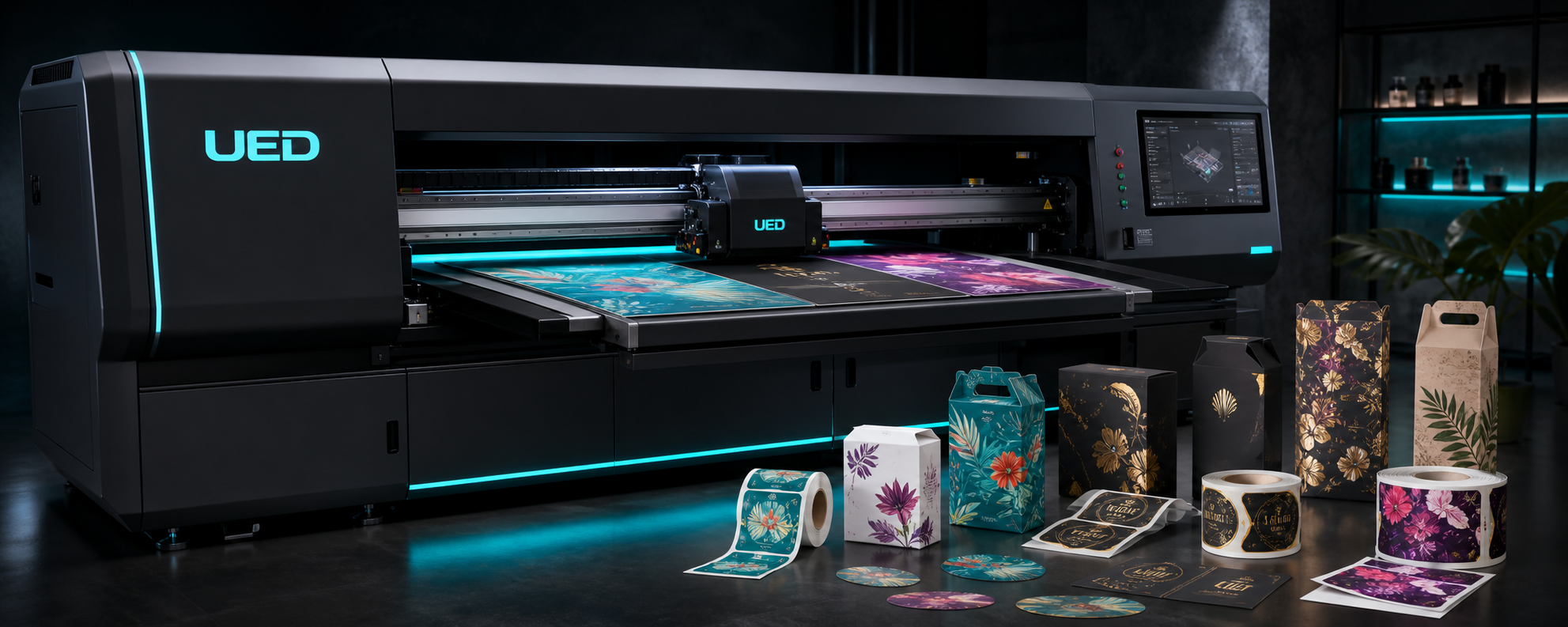
Packaging is packaging’s quiet revolution: UV printing lets a brand produce short-run, personalised and prototype packaging — premium boxes, rigid set-up boxes, display units, labels and mockups — without the plates, minimums and lead times of offset or flexo. It is not a replacement for million-unit runs, but it captures exactly the market those processes cannot serve economically: limited editions, test batches, personalised and regional variants, sampling, and premium low-volume packaging. This guide explains where UV fits in packaging, the technology choices, food-contact cautions and the business opportunity.
Where UV fits in the packaging world
Traditional packaging — folding cartons and corrugated — is dominated by offset, flexo and gravure for long runs. UV fits the short-run, high-value end: small-batch premium boxes, personalised and limited-edition packaging, brand prototypes and mockups, point-of-sale display units, and labels. It also serves the fast-growing need for market testing and regional or seasonal variants, where a brand wants fifty or five hundred units, not fifty thousand. UV’s plate-free, no-minimum, instant-cure model is the only digital way to serve that demand economically, and it is a market offset never addressed.
Substrates: rigid packaging, display and labels
UV flatbeds print directly on rigid packaging materials: greyboard and set-up box boards, foam and acrylic display units, and even assembled box faces for short runs. UV roll-to-roll prints labels and flexible packaging on a wide range of label stocks and films, with white ink for clear and metallic materials. Corrugated display and point-of-sale units are a particularly strong UV application — one-off, large-format, full-colour displays produced in hours. Understanding which packaging job is rigid (flatbed) versus roll (label/film) is the first specification decision.
White ink, varnish and premium effects
Packaging sells on shelf appeal, and UV delivers the effects brands pay for: white ink on clear and metallic substrates, spot and full varnish in gloss, matte and textured finishes, and soft-touch effects that add perceived value. These finishes used to require separate processes; a UV printer applies them in-line, in short runs, without plates. A premium limited-edition box with textured varnish and metallic detail, produced in a run of two hundred, is exactly the kind of job UV makes profitable and offset cannot.
Prototyping and brand mockups: an underrated market
Before committing to a long-run production, brands need physical prototypes and mockups to test design, structure and shelf presence. UV printing produces accurate, full-colour packaging prototypes in hours, letting designers iterate cheaply and present real objects to clients and buyers. This prototyping work is high-margin, relationship-building and often the gateway to the eventual production run or to ongoing short-run work. Position your shop as the place that turns a packaging design into a tangible prototype fast, and you insert yourself at the start of the packaging decision chain.
Food-contact and regulatory caution
Packaging touches products and sometimes food, so regulatory awareness is essential. Standard UV inks are generally not certified for direct food contact; for food packaging, use inks and varnishes that are certified food-safe, or print on the outside of a liner or secondary package. Be explicit with customers about what is and is not food-safe, and never imply a food-contact claim without certification. Getting this right protects both the brand and your reputation, and it is a mark of a professional packaging partner rather than a print shop experimenting.
Machine and process choices for packaging
Rigid packaging, display units and prototypes call for a UV flatbed printer sized to your board and display formats. Labels and flexible packaging call for a UV roll-to-roll printer with white ink and varnish. A UV hybrid printer can cover both for a mixed packaging business. Add a cutting plotter or flatbed cutter for die-cutting displays and box blanks to complete the chain. The critical specs are white and varnish reliability, media handling across board and film, and registration for die-cut alignment.
Pricing and the short-run economics
Price packaging on value, not just area: short-run and personalised packaging carries a premium because it eliminates the customer’s plate costs and minimums. Charge for prototyping as a design service, price limited editions per unit with setup amortised, and price display units on size and fabrication. The economics work because you are competing against the high fixed costs of traditional packaging, not its marginal cost — a brand needing two hundred boxes finds UV dramatically cheaper than offset, even at a healthy per-unit price.
Common packaging mistakes
- Claiming food-contact safety without certified inks and coatings.
- Using rigid ink on flexible film packaging and getting cracks.
- Skipping die-cut registration checks and shipping misaligned boxes.
- Quoting short runs against offset marginal cost instead of its fixed cost.
- Ignoring substrate testing on coated or metallic packaging boards.
Frequently asked questions
Can UV replace offset for packaging?
Not for million-unit runs. UV wins short-run, personalised, prototyping and premium limited editions, where offset’s plate costs and minimums make no sense.
Is UV-printed packaging food-safe?
Only with certified food-safe inks and coatings, or by printing on the outside of a food-safe liner. Never assume standard UV inks are food-contact safe.
Can UV print corrugated displays?
Yes — large-format UV flatbeds print full-colour point-of-sale and display units on corrugated and foam board in a single pass, a strong UV application.
Labels and the short-run economy
Labels are packaging’s highest-frequency item and a natural UV roll-to-roll application: short-run product labels, seasonal variants, batch and lot labels, and personalised or limited-edition labels. UV prints full colour with white ink on clear and metallic stocks and applies varnish in-line, all without plates, so a brand can run a few hundred labels as easily as a few thousand. The short-run label market — craft brands, boutique foods, cosmetics, seasonal SKUs — is exactly where UV undercuts flexo and offset, and it recurs constantly as products and seasons change. Labels are often the entry point that grows into full packaging work.
Point-of-sale displays and corrugated
Point-of-sale and retail display units are a strong UV application: one-off, large-format, full-colour displays on corrugated and foam board, produced in hours rather than weeks. Brands need displays for launches, promotions and seasonal pushes in quantities too small for traditional display printing, and UV flatbed printing with a flatbed cutter delivers them fast. Because displays are visible in-store and tied to specific campaigns, they command good margins and recur with each promotion. Offering design, print and die-cut as a package makes you the go-to for retail activation, which is a high-value, relationship-driven line.
Regional, seasonal and test-market variants
Modern brands constantly need packaging variants: regional editions, seasonal designs, co-branded runs and market-test batches. Traditional processes make these uneconomical below large minimums, but UV produces a variant run of fifty or five hundred profitably. This capability lets brands experiment with new designs and markets without the risk and cost of full production tooling, and it keeps you inside the brand’s product development cycle. Position yourself as the partner that makes small, fast variants possible, and you become part of the brand’s ongoing packaging decisions rather than a one-off print vendor.
Packaging mockups and photography for brands
Brands need realistic packaging mockups for marketing, e-commerce imagery and buyer presentations long before production. UV-printed prototypes photographed professionally serve this need, and offering the mockup-plus-photography service adds margin and deepens the relationship. A physical, accurately printed box shot in studio light sells a product online and in pitch decks better than a 3D render. By providing the physical mockup and its imagery, you insert yourself early in the brand’s process and become the natural choice for the eventual short-run or limited-edition production.
Building brand relationships in packaging
Packaging work is relationship-driven: brands choose a partner they trust for consistency, confidentiality and reliability, then stay for years. Win that trust through accurate prototypes, honest food-contact and durability guidance, consistent colour across runs, and discretion with unreleased designs. Offer to hold brand standards — colours, varnish specs, templates — so every run matches. Because packaging is central to a brand’s identity, the supplier who becomes the trusted packaging partner enjoys sticky, recurring work that is far more valuable than chasing individual jobs on price.
Choosing a packaging-ready machine
Specify a packaging machine against the jobs you target. Rigid packaging, displays and prototypes need a UV flatbed printer sized to your boards and display formats; labels and flexible packaging need a roll-to-roll with white and varnish. A hybrid covers a mixed business. Prioritise white and varnish reliability, registration for die-cut alignment, and media handling across board and film. Add a flatbed cutter or plotter for die-cutting. Confirm food-safe ink options if you will serve food brands, and check local service support, because packaging deadlines are driven by product launches.
Return on investment in packaging
Packaging UV work returns well because it commands value pricing against the high fixed costs of traditional processes. Short-run boxes, premium limited editions, displays and prototypes all carry healthy margins, and the relationships they build generate recurring work. Start with prototyping and labels to get inside brand cycles, then grow into displays and short-run production. Keep accurate cost-per-job records including waste and finishing, and reinvest in the capabilities — cutter, food-safe inks, varnish effects — that unlock higher-value work. Packaging is a slower sell than signage but among the stickiest and most valuable lines a UV shop can build.
Sustainability and material selection
Brands increasingly specify sustainable packaging, and material choice is part of the specification. UV printing works across a wide range of boards and films, including recycled and recyclable substrates, and lets brands produce smaller, right-sized runs that reduce waste from overproduction. Where a brand wants an eco-claim, print on appropriate recyclable or recycled stock and be accurate about the ink and coating system, avoiding vague green claims that cannot be substantiated. Offering sustainable short-run options aligns you with the direction of the market and differentiates you from shops that only serve conventional long runs.
Workflow: from dieline to die-cut
Packaging production is a chain: a dieline defines the structure, artwork is placed and registered to it, the piece is printed, then die-cut or routed to shape. Registration between print and die-cut is where packaging quality is won or lost, so use registration marks, verify alignment on a proof piece before the run, and keep the cutter calibrated to the printer. For displays, design for the board’s grain and fold characteristics so the finished unit stands correctly. A disciplined print-to-die-cut workflow, with a proof checked at every stage, is what lets you ship short-run packaging and displays that fit, fold and present exactly as intended.
Getting started with packaging work
Enter packaging through its easiest door: prototyping and short-run labels. Offer brands fast, accurate physical mockups and small label runs, which are low-risk, high-value and get you inside their product cycle early. Prove consistency and confidentiality on those jobs, then grow into displays, limited-edition boxes and short-run production as trust builds. Keep accurate cost records, learn the die-cut and registration workflow on smaller jobs first, and only invest in food-safe inks and cutters once the demand justifies them. Packaging is a relationship business that compounds slowly, so start small, deliver impeccably, and let the brand relationships — not a big machine — carry the growth.
Packaging may be the least glamorous of the UV substrates, but it is among the most strategic. It sits at the start of a brand’s product journey, recurs with every SKU and season, and rewards the supplier who is accurate, discreet and dependable. Master the short-run, prototype and display work, honour the food-contact rules, and grow with the brand relationships you build, and packaging becomes a high-value line that few competitors can easily follow.
Start with prototypes and labels, grow into displays and short-run boxes, and let each reliable delivery deepen the brand relationship that carries the next order.
Conclusion
UV printing’s role in packaging is the short-run, personalised, premium and prototyping end of the market — the work offset and flexo cannot serve economically. Master the substrates, the white-and-varnish effects, die-cut registration and food-contact rules, and packaging becomes a high-value trade line. Review our digital UV printer range or contact us to configure a packaging-ready UV setup.
