

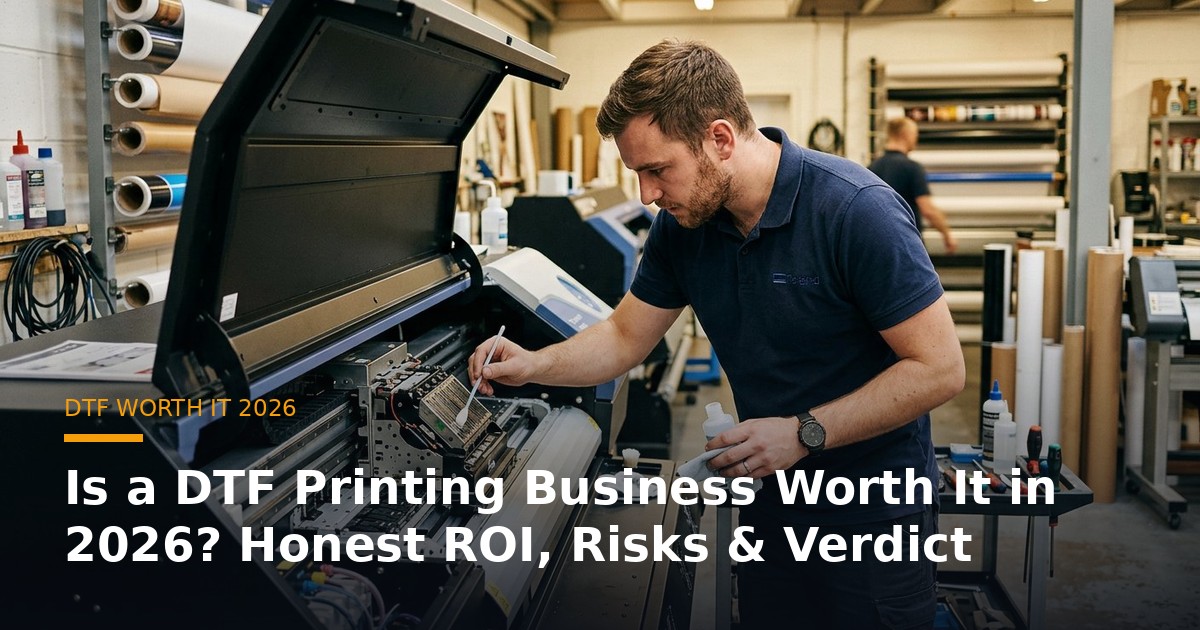
“Is a DTF printing business worth it?” It’s the question every prospective entrepreneur asks before investing. The honest answer is yes — for those who approach it as a real business — but it’s not a get-rich-quick scheme. This guide gives a balanced, honest look at whether a DTF business is worth it: the real profits, the real risks, and what separates successful operators from those who struggle.
DTF is one of the most accessible and profitable small printing businesses in India, with strong demand and healthy margins. But like any business, success depends on execution. This guide covers both sides honestly.
Why DTF Is Worth It
DTF offers several compelling advantages. Demand for custom apparel is strong and growing, from retail to teams to corporate orders. The investment is modest (₹3.5–6 lakh for a complete setup) relative to the earning potential. Margins are healthy at 50–70 percent on custom apparel. It works on all fabrics and colours, serving a vast market. Running costs are low. And it’s scalable from home to industrial. For entrepreneurs willing to learn the craft and market actively, DTF offers a genuine path to a profitable, growing business.
The Realistic Earning Potential
A realistic, well-run home-based DTF business in India can earn a net profit of roughly ₹40,000 to ₹1,50,000 per month, scaling much higher for industrial operations with multiple machines and strong order flow. These figures assume active marketing, consistent quality and efficient operation — not passive income. Earnings grow with volume, efficiency and value-added products. Entrepreneurs who treat it as a real business, market actively and deliver quality can build a solid, growing income; those who don’t will struggle regardless of the machine.
The Real Risks and Challenges
Honesty requires naming the challenges. Competition is growing as DTF becomes popular, so you must differentiate on quality, service or niche. Consistent quality takes skill and practice — early prints may disappoint until you master the process. Machines need maintenance and can have downtime. Demand fluctuates seasonally. You need to market actively to get orders — a machine alone doesn’t generate sales. And consumable costs and pricing pressure affect margins. None of these are deal-breakers, but ignoring them is a recipe for disappointment.
What Separates Success from Struggle
Successful DTF operators share common traits: they treat it as a real business, not a side hobby. They invest in learning the craft and deliver consistent quality. They market actively and build a customer base rather than waiting for orders. They price for profit, not just to win jobs. They control costs and manage cash flow. They find a niche or differentiate. Those who struggle typically underprice, neglect quality or marketing, or expect income without effort. The difference is rarely the machine — it’s the business discipline.
Is DTF Worth It for You?
DTF is worth it if you’re willing to treat it as a real business: learn the craft, market actively, deliver quality and price for profit. It’s ideal for entrepreneurs, custom apparel sellers, screen printers adding digital capability, and anyone with access to the garment market. It’s not worth it if you expect passive income, won’t market, or can’t invest the time to learn quality and build customers. For the right person with realistic expectations and business discipline, DTF is one of the most accessible, profitable small businesses in India.
How to Maximise Your Chances of Success
- Invest in quality equipment and learn to use it properly.
- Master the process — consistent, durable prints build reputation.
- Market actively — don’t wait for orders; go find customers.
- Price for profit — don’t race to the bottom.
- Find a niche or differentiate to stand out.
- Deliver great service to earn repeat customers.
The Verdict: Yes, With Realistic Expectations
DTF is worth it — for entrepreneurs who approach it seriously. The market is strong, the investment is modest, the margins are healthy and the business is scalable. But it rewards effort, skill and business discipline, not passive ownership. If you’re willing to learn the craft, market actively, deliver quality and price for profit, DTF offers a genuine path to a profitable, growing business. If you expect income without effort, no machine will deliver it. For the right person, DTF is one of the best small-business opportunities in India today.
Why Buy from UED?
Unified Engineering Dynamics (UED) supplies, installs and services DTF setups across India, and helps you build a business that works. We help you choose the right setup for your budget and volume, provide genuine printheads, inks and consumables, professional installation and training, and dependable after-sales support — so you start on the right footing with reliable equipment and the knowledge to succeed.
DTF vs Other Small Business Opportunities
Compared to many small-business options, DTF stands out for its combination of modest investment, strong margins and growing demand. A franchise might cost ₹10–50 lakh with ongoing royalties; a retail shop needs high rent and inventory; many service businesses need specialised qualifications. DTF needs ₹3.5–6 lakh, can start from home, serves a growing customisation market and offers 50–70 percent margins. It does require skill and active marketing, but its accessibility, scalability and profit potential make it one of the more attractive small-business opportunities in India for aspiring entrepreneurs.
Realistic First-Year Expectations
Setting realistic first-year expectations is key to not being discouraged. Expect a learning curve — your first prints won’t be perfect, and mastering quality takes weeks. Expect to work hard on marketing to build a customer base; orders don’t appear automatically. Expect some slow months alongside busy ones. But also expect to build a real, growing income if you persist. Many DTF entrepreneurs reach solid profitability within their first year and scale steadily thereafter. The key is treating year one as building a foundation of skill, customers and reputation, not expecting instant riches.
Common Reasons DTF Businesses Fail
Understanding why some DTF businesses fail helps you avoid the same traps. The most common reason is underpricing to win orders, eroding margins until the business isn’t viable. The second is neglecting quality, producing inconsistent prints that lose customers. The third is failing to market, so orders never materialise. The fourth is buying cheap, unreliable equipment that breaks down and wastes money. The fifth is treating it as passive income rather than a real business. Avoid these traps — price for profit, deliver quality, market actively, buy reliable equipment and work the business — and you dramatically improve your odds of success.
Is DTF Still Worth It as Competition Grows?
Yes, DTF remains worth it even as competition grows, because the customisation market itself is expanding faster than the number of printers. Demand for custom apparel from retail customers, brands, teams, corporates and events continues to rise. The key is to differentiate — compete on quality, service, niche products, fast turnaround or design capability rather than just price. Businesses that build a reputation for quality and reliability, serve a specific niche well, and market effectively continue to thrive. Those that compete only on price struggle. There is room for many profitable DTF businesses in India’s vast, growing market.
Making Your DTF Business Worth It
Whether DTF is worth it ultimately depends on how you run it. The opportunity is genuine — strong demand, modest investment, healthy margins and scalability. But it rewards real effort: learning the craft, delivering consistent quality, marketing actively, pricing for profit and building customer relationships. Approach it as a serious business with realistic expectations, and DTF can become a profitable, growing venture. Treat it as a passive side bet, and it will disappoint. For entrepreneurs willing to put in the work, DTF is one of the most rewarding small-business opportunities in India.
How Long Until a DTF Business Is Profitable?
Most well-run DTF businesses become profitable within their first few months, with the initial investment typically repaid within 6 to 12 months. The exact timeline depends on how quickly you build a customer base, your order volume, your pricing and your cost control. Businesses that market actively and deliver quality from the start reach profitability faster; those that wait for orders or underprice take longer. The key is to build steady order flow early — through local businesses, online sellers, events and repeat customers — and price for profit. With consistent effort, profitability within the first year is a realistic and common outcome.
Skills You Need to Succeed in DTF
DTF success depends on a few learnable skills. You need to master the printing process — colour management, film handling, powdering and curing — to produce consistent, durable prints. You need basic heat-press skill for quality transfers. You need design capability or the ability to work with customer artwork. And crucially, you need business skills: marketing, customer service, pricing and cash-flow management. None require a degree; all can be learned with practice and good training. Entrepreneurs who invest in learning these skills — rather than just buying a machine — are the ones who build profitable, lasting DTF businesses.
Building a DTF Business That Lasts
A lasting DTF business is built on more than a machine. It’s built on consistent quality that earns a reputation and repeat customers. It’s built on active marketing that keeps orders flowing. It’s built on fair pricing that sustains healthy margins. It’s built on reliable service and fast turnaround that customers value. And it’s built on adapting — adding new products, serving new niches and scaling capacity as demand grows. Entrepreneurs who focus on these fundamentals, rather than chasing the cheapest equipment or the lowest prices, build DTF businesses that not only survive but thrive and grow year after year.
Final Verdict: Is DTF Worth It?
Yes — DTF is worth it for entrepreneurs who approach it as a real business. The opportunity is genuine: strong and growing demand for custom apparel, a modest investment of ₹3.5–6 lakh, healthy 50–70 percent margins, low running costs and real scalability from home to industrial. But it rewards effort, skill and business discipline, not passive ownership. If you’re willing to learn the craft, market actively, deliver consistent quality and price for profit, DTF offers one of the most accessible and profitable small-business opportunities in India. Approach it seriously, and it can become a rewarding, growing venture.
Take the Next Step
If you’ve read this far, you’re seriously considering a DTF business — and the opportunity is real. The customisation market is growing, the investment is modest, the margins are healthy and the business is scalable. The entrepreneurs who succeed are those who commit to learning the craft, marketing actively, delivering consistent quality and pricing for profit. If that sounds like you, DTF is worth it. Start with a clear plan, invest in reliable equipment and training, build your customer base steadily, and treat it as the real business it can become. With realistic expectations and genuine effort, a DTF business can be a rewarding and profitable venture and beyond.
Frequently Asked Questions
Is a DTF printing business profitable in India?
Yes, for those who run it as a real business. A well-run home-based DTF business can earn ₹40,000–1,50,000 net per month, scaling higher industrially, with healthy 50–70 percent margins on custom apparel.
What are the risks of a DTF business?
Growing competition, the skill needed for consistent quality, machine maintenance and downtime, seasonal demand, and the need to market actively. None are deal-breakers, but ignoring them leads to disappointment.
How much does it cost to start?
A complete DTF setup costs ₹3.5–6 lakh in India, with payback typically in 6–12 months for a well-run business.
Do these prices include GST and installation?
Usually not. Prices are typically ex-GST and may exclude installation and training. Always request a written, configuration-specific quotation.
Want help choosing the right printing setup? Talk to UED’s specialists — share your budget and volume, and we’ll recommend the right machine with transparent pricing. Request a quote →
Figures on this page are indicative estimates and vary with configuration, consumables, location and volume. Always confirm a written, configuration-specific quotation.
