

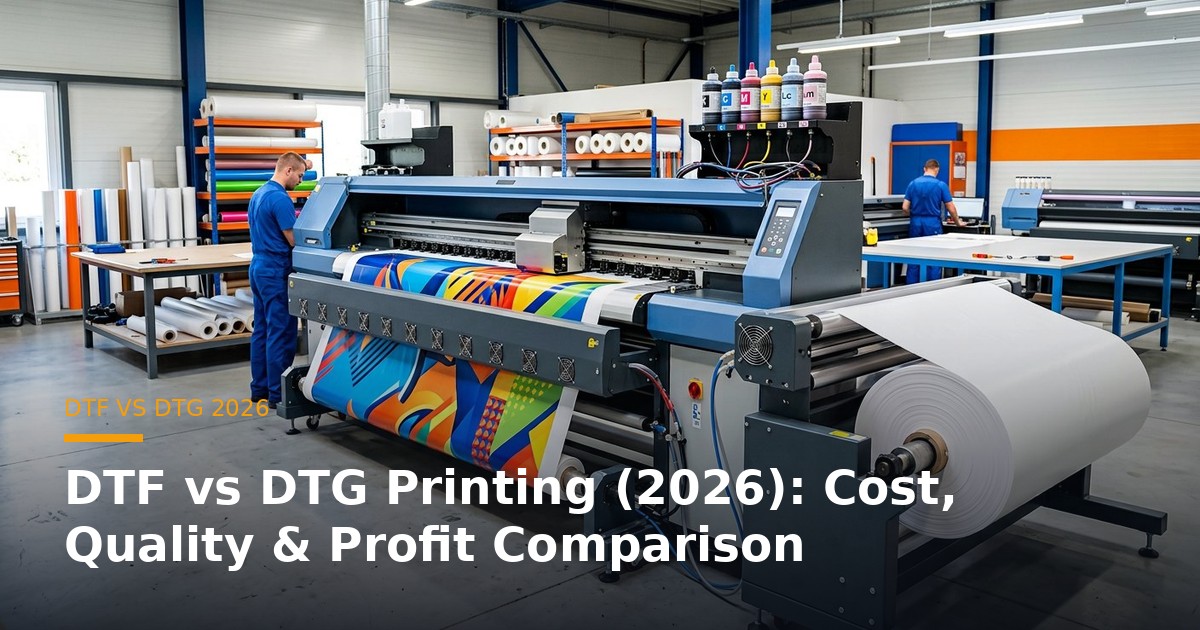
DTF and DTG (direct-to-garment) are both popular digital garment-printing methods, and entrepreneurs often ask which is better for their business. This guide compares DTF vs DTG on cost, quality, fabrics, speed and profit, so you can choose the right method for your custom apparel business in India.
Both print full-colour designs digitally, but they differ significantly in cost, fabric compatibility and running expenses. Understanding these differences helps you choose the more profitable option for your market.
DTF vs DTG: Quick Comparison
| Factor | DTF | DTG |
|---|---|---|
| How it prints | Film transfer, heat-pressed | Directly onto garment |
| Fabrics | Cotton, poly, blends, dark | Best on cotton, light |
| Setup cost | ₹3.5L – ₹6L | ₹4L – ₹15L+ |
| Running cost | Low (film, ink, powder) | Higher (ink, pre-treat) |
| Speed | Fast at volume | Slower per garment |
DTF is generally cheaper to run, works on more fabrics including polyester and blends, and prints faster at volume, while DTG prints directly onto the garment with a soft hand, best on cotton.
How Each Method Works
DTG prints ink directly onto the garment using a specialised inkjet printer, like a paper printer for fabric. It needs pre-treatment for dark garments and works best on cotton. DTF prints onto film with a white ink layer, applies adhesive powder, cures it, and heat-presses the transfer onto the garment — working on cotton, polyester, blends and dark fabrics without pre-treatment. The transfer approach gives DTF broader fabric compatibility.
Cost Comparison
DTF generally has a lower entry cost (₹3.5–6 lakh for a complete setup) than DTG (₹4–15 lakh+ for a quality printer plus pre-treatment and curing). More importantly, DTF’s running costs are lower — film, ink and powder are inexpensive, while DTG ink and pre-treatment are costlier per garment. For a business focused on cost-efficiency and volume, DTF typically offers better margins, while DTG’s premium is justified for high-end cotton apparel where its soft, direct print is preferred.
Fabric Compatibility
DTF works on almost any fabric — cotton, polyester, blends, nylon — and on any colour including darks, without pre-treatment. DTG works best on cotton and cotton-rich blends, and needs pre-treatment for dark garments; it struggles on polyester. Since much apparel is polyester or blended, DTF’s broader compatibility lets you serve more products and customers. For a business printing on varied fabrics, DTF is the more versatile choice.
Quality and Feel
DTG produces a soft, breathable print that dyes into cotton fibres with a minimal hand — ideal for high-end, photo-quality cotton apparel. DTF produces a flexible transfer layer that, done well, is soft and stretches with the fabric, though slightly more noticeable than DTG on large solid areas. For premium cotton tees, DTG’s soft hand is a selling point; for most custom apparel on varied fabrics, DTF’s quality is excellent and its versatility decisive.
Speed and Volume
DTF is faster at volume. It prints continuously onto film, which can be cured and pressed efficiently, and multiple transfers can be ganged and pressed in batches. DTG prints one garment at a time, more slowly, with pre-treatment and curing steps. For businesses handling higher volumes, DTF’s throughput is a significant advantage. For low-volume, high-end cotton printing, DTG’s per-garment approach is fine.
Which Is More Profitable?
For most custom apparel businesses in India, DTF is more profitable because of its lower running costs, broader fabric compatibility (including polyester and blends), no pre-treatment, and faster throughput at volume. DTG is more profitable in the specific niche of premium, high-end cotton apparel where customers pay for its soft, direct-to-fabric print. For a general custom apparel business serving varied fabrics and volumes, DTF offers better margins and versatility.
When to Choose DTG
Choose DTG if your focus is premium, high-end cotton apparel — boutique t-shirts, photo-quality prints on cotton, and low-volume, high-margin garments where the soft, breathable, direct-to-fabric print is a selling point. DTG excels here, and customers pay a premium for it. If your market is quality cotton apparel rather than volume and varied fabrics, DTG is the right choice.
When to Choose DTF
Choose DTF if your focus is volume, varied fabrics and broad custom apparel — t-shirts, hoodies, caps, bags, sportswear and team wear on cotton, polyester and blends, including dark garments. DTF’s lower running costs, fabric versatility, no pre-treatment and faster throughput make it the more profitable and practical choice for most custom apparel businesses in India.
Why Buy from UED?
Unified Engineering Dynamics (UED) supplies, installs and services DTF setups across India, and can advise on the best method for your products. We provide genuine printheads, inks and consumables, professional installation and training, and dependable after-sales support — so you get a cost-efficient, versatile setup matched to your market.
DTF vs DTG: Running Costs in Detail
Running costs are where DTF pulls ahead for most businesses. DTF consumables — film, ink and adhesive powder — are inexpensive per transfer, and there is no pre-treatment chemical. DTG uses costlier textile inks and requires pre-treatment solution for dark garments, plus more frequent maintenance to keep the printheads from clogging, since textile ink dries in them. Over thousands of garments, DTF’s lower consumable and maintenance costs translate into meaningfully better margins. For a business printing at volume across varied fabrics, this cost efficiency is a decisive advantage for DTF.
DTF vs DTG: Maintenance and Reliability
Maintenance differs significantly between the two. DTG printers print directly with textile ink that can dry and clog the printheads if the machine is not used regularly, requiring careful maintenance, cleaning cycles and occasional head replacement — a real cost and hassle. DTF prints onto film, and while white ink needs circulation and care, the transfer process is generally more forgiving and the workflow more robust for varied, on-demand production. For a business that may not print every single day, DTF’s more forgiving maintenance is an advantage that reduces downtime and cost.
DTF vs DTG: Which for a New Business?
For a new custom apparel business in India, DTF is usually the smarter first investment. It costs less to buy and run, works on the full range of fabrics and colours customers want, needs no pre-treatment, and prints faster at volume. DTG is a premium choice best suited to established businesses focused on high-end cotton apparel where customers pay for the soft direct print. Starting with DTF lets a new business serve the broad custom apparel market profitably and scale, adding DTG later only if a premium cotton niche justifies it.
DTF vs DTG: Print Longevity and Wash Performance
Both methods produce durable prints when done correctly. DTG ink soaks into cotton fibres and, with proper pre-treatment and curing, washes well and lasts the life of the garment, though it can fade over many washes. DTF transfers, with good film, powder and pressing, bond strongly and survive dozens of washes without cracking or peeling, stretching with the fabric. For most custom apparel, both are durable enough. The choice comes down to fabric, cost and volume rather than durability, since both withstand normal washing and wear when produced properly.
Summary: Choosing Between DTF and DTG
DTF and DTG both print full-colour designs digitally, but DTF is the more versatile and cost-efficient choice for most businesses. It costs less to buy and run, works on cotton, polyester, blends and dark garments without pre-treatment, and prints faster at volume. DTG offers a soft, direct-to-fabric print that excels on premium cotton apparel, justifying its higher cost in that specific niche. For a general custom apparel business in India serving varied fabrics and volumes, DTF offers better margins and flexibility. Choose DTG only if your focus is high-end cotton garments where its soft hand commands a premium.
DTF vs DTG: White Ink and Dark Garments
Printing on dark garments is a key differentiator. DTF handles darks effortlessly with its white ink layer, which is printed under the colours and transfers with the design — no pre-treatment needed. DTG can print on darks but requires a pre-treatment step and a white ink underbase, which adds time, cost and complexity, and can affect the hand and durability if not done well. Since a large share of custom apparel is dark — black tees and hoodies are hugely popular — DTF’s simpler, more reliable dark-garment printing is a practical advantage for most custom apparel businesses.
DTF vs DTG: Setup and Space Requirements
Both methods need a printer and finishing equipment, but their setups differ. DTG needs the printer plus pre-treatment application and a curing unit, with careful climate and maintenance to keep printheads from clogging. DTF needs the printer, a powder shaker-dryer (or curing oven) and a heat press. DTF’s transfer-based workflow is generally more compact and forgiving for varied, on-demand production, and transfers can be produced in advance and pressed later. For a small or home-based business, DTF’s setup is often more practical and flexible than a DTG line.
DTF vs DTG: Best for Print-on-Demand
For print-on-demand and on-demand custom orders, DTF has advantages. Transfers can be printed in batches, stored and pressed as orders come, decoupling printing from finishing and smoothing workflow. DTF also prints on the full range of fabrics and colours POD customers want, with no pre-treatment. DTG prints each garment individually, more slowly, and works best on cotton. For a print-on-demand business serving varied products and fabrics, DTF’s flexibility, batch printing and fabric range make it the more practical and scalable choice for on-demand fulfilment.
Can You Use Both DTF and DTG?
Some established businesses run both, using each where it excels. DTG handles premium, high-end cotton apparel where customers pay for its soft, direct-to-fabric print. DTF handles volume, varied fabrics, dark garments and on-demand orders more cost-efficiently. Together they cover the full custom apparel market. For most businesses, though, one method is enough to start — and for a general custom apparel business in India, DTF is usually the better single investment because of its lower cost, broader fabric compatibility and faster throughput. Add DTG later only if a premium cotton niche justifies it.
Summary: Choosing Between DTF and DTG
DTF and DTG both produce vibrant full-colour digital prints, but for most custom apparel businesses in India, DTF is the more profitable and practical choice. It costs less to buy and run, works on cotton, polyester, blends and dark garments without pre-treatment, prints faster at volume, and handles on-demand orders flexibly. DTG offers a soft, direct-to-fabric print that excels on premium cotton apparel, justifying its higher cost in that specific niche. For a general custom apparel business serving varied fabrics, colours and volumes, DTF delivers better margins, versatility and scalability. Choose DTG only if your focus is high-end cotton garments where its soft hand commands a premium price.
Frequently Asked Questions
Which is better: DTF or DTG?
For most custom apparel businesses, DTF is better because it costs less to run, works on more fabrics including polyester and blends, needs no pre-treatment and prints faster at volume. DTG is better for premium cotton apparel with a soft hand.
Which is cheaper to run?
DTF is generally cheaper to run. Its film, ink and powder are inexpensive per transfer, while DTG ink and pre-treatment cost more per garment, giving DTF better margins at volume.
Can DTG print on polyester?
DTG works best on cotton and struggles on polyester. DTF prints on cotton, polyester, blends and dark garments without pre-treatment, making it far more versatile.
Is DTF better than DTG for a new business?
Yes, for most new businesses DTF is the better first investment. It costs less to buy and run, works on all fabrics and colours, needs no pre-treatment and prints faster at volume, making it more versatile and profitable for general custom apparel.
Do these prices include GST and installation?
Usually not. Prices are typically ex-GST and may exclude installation and training. Always request a written, configuration-specific quotation.
Want help choosing the right printing setup? Talk to UED’s specialists — share your budget and volume, and we’ll recommend the right machine with transparent pricing. Request a quote →
Figures on this page are indicative estimates and vary with configuration, consumables, location and volume. Always confirm a written, configuration-specific quotation.
