

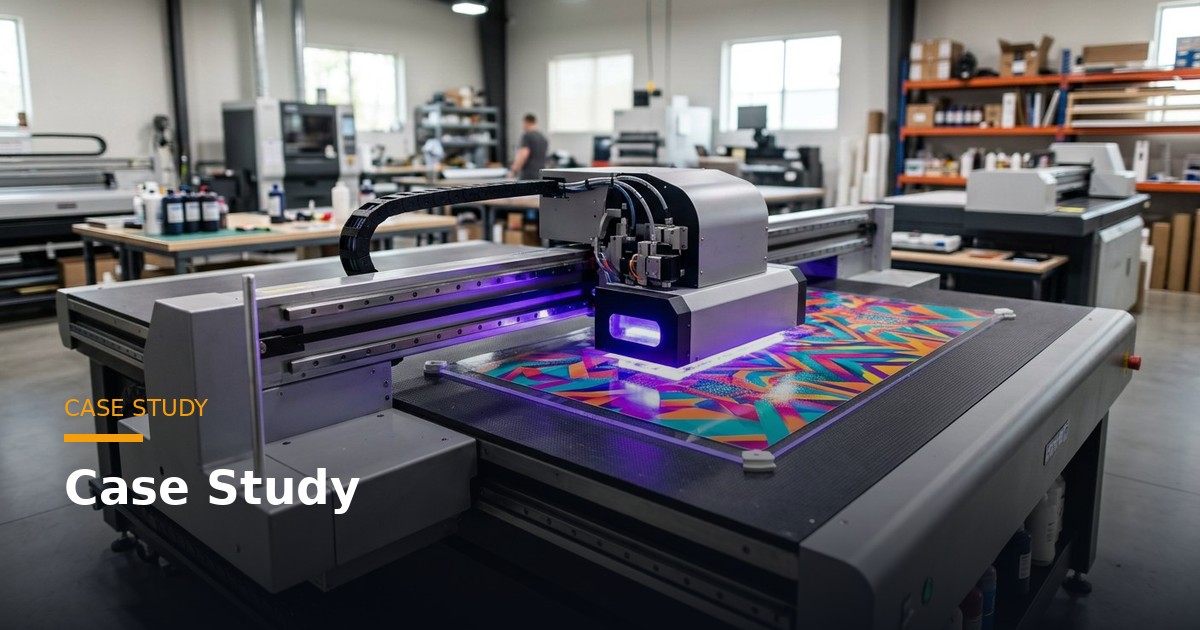
This anonymised case study follows a business that discovered a lucrative niche in industrial product marking and branding — printing directly onto panels, nameplates, control fascias, components, instruments and industrial products. By investing in a UED UV flatbed printer, the business could mark and brand a wide range of industrial items with durable, precise, professional results. Here is how UV printing opened the industrial marking market and what businesses can learn about this valuable B2B niche.
The Business and Its Opportunity
The business — originally a general printing company — identified an underserved niche: industrial product marking and branding. Manufacturers of electronics, appliances, machinery, instruments, automotive components and equipment all need their products marked — control panels, nameplates, labels, fascias, dials, branding and identification — with durable, precise, professional printing. This work was often done with older methods (screen printing, pads, labels) that had limitations, or outsourced expensively. The business saw an opportunity: UV printing could mark a huge range of industrial items directly, with durable, high-quality results, serving manufacturers who needed reliable, professional product marking.
The Situation Before
Before moving into industrial marking with UV, the business competed in general commercial printing — a crowded, price-competitive market. The industrial marking niche, by contrast, was underserved and higher-value, but required the capability to print directly onto industrial materials (metal, plastic, coated panels, components) with the durability and precision industrial applications demand. Conventional printing could not do this well. The business recognised that UV printing — which prints directly onto almost any rigid material — was ideal for industrial marking, and that serving this B2B niche offered higher margins and more stable, recurring work than the volatile commercial print market.
Machine at a Glance
| Specification | Detail |
|---|---|
| Machine | UED UV Flatbed Printer (i3200) |
| Printheads | Epson i3200 (industrial) |
| Ink channels | CMYK + White (+ varnish) |
| Prints on | Metal, plastic, acrylic, coated panels, components |
| Best for | Industrial product marking, nameplates, panels, branding |
The UV flatbed was ideal for industrial marking. It prints directly onto the rigid materials industrial products use — metal, plastic, acrylic, coated panels and components — with UV-cured ink that bonds durably to the surface. The white ink channel allowed marking on dark and metal surfaces, and the i3200 heads delivered the precise, high-resolution printing that industrial marking demands (fine text, precise graphics, accurate branding). The durability of UV-cured ink suited industrial products, which face handling, cleaning, heat and wear. One machine could mark a huge range of industrial items with professional, durable results.
The Solution and Approach
The business built an industrial product marking service around its UV flatbed. It served manufacturers needing durable, professional marking on their products — control panels, nameplates, fascias, dials, labels, branding and identification on electronics, appliances, machinery, instruments, automotive components and equipment. The direct-to-substrate UV printing replaced older methods (screen printing, labels) with a more versatile, digital, high-quality solution — short runs, customisation, no screens, and durable direct printing. Quality, precision and durability were the focus, since industrial marking must be professional, accurate and long-lasting. The business positioned itself as a specialist in industrial product marking, serving a B2B niche with specific, high-value needs.
Implementation and Support
Serving the industrial market required developing specific capabilities. The business trained its team on printing onto industrial materials, adhesion and pre-treatment for different substrates, white ink for dark surfaces, and meeting industrial clients’ specifications and standards. It learned the durability requirements of industrial applications and how to ensure marking that withstands real-world use. UED’s installation, training and support helped the business become productive quickly. Within a few months, it was delivering professional, durable industrial product marking, serving manufacturers who valued a reliable specialist for their marking and branding needs.
The Results
Moving into industrial marking transformed the business. Indicative results:
| Aspect | Before | After |
|---|---|---|
| Market | General commercial print | Industrial product marking |
| Materials | Paper, vinyl | Metal, plastic, panels, components |
| Margins | Competitive | Higher (specialist niche) |
| Clients | Varied, volatile | Manufacturers, recurring |
| Positioning | General printer | Industrial marking specialist |
The business moved from the crowded, price-competitive commercial print market into a higher-margin, specialist B2B niche. Industrial marking clients — manufacturers — provided more stable, recurring work than volatile commercial print, since products need ongoing marking as they are produced. The specialist positioning and higher margins improved profitability. And the versatile UV capability let the business serve a wide range of manufacturers across industries. Within its first year, industrial product marking had become a profitable, growing, specialised business with stable B2B clients and better margins than general commercial printing.
The Financial Impact
The economics of the industrial marking niche were attractive. As a specialist serving specific B2B needs, the business commanded higher margins than in commodity commercial printing. Industrial clients — manufacturers — provided recurring work, since their products need continuous marking as they are produced, giving revenue stability. And the direct-to-substrate UV capability served needs that older methods could not, justifying premium pricing. Because the business served a specialist niche with specific requirements, it faced less price competition. Based on the higher margins and recurring B2B clients, the owner estimated a strong return — the industrial marking niche was more profitable and stable than the general commercial printing the business had competed in.
Why It Worked
Several factors drove the success. First, the business identified an underserved, higher-value niche — industrial product marking — with specific needs that UV serves well. Second, the UV flatbed was the right technology: direct, durable, precise printing on industrial materials. Third, developing the specific capabilities (substrate adhesion, white ink, meeting industrial standards) ensured professional results. Fourth, the specialist positioning commanded higher margins and faced less competition. And fifth, serving manufacturers provided recurring, stable B2B work. The business succeeded by finding a valuable niche that UV uniquely serves, developing the expertise to serve it well, and positioning as a specialist — moving from commodity printing to a profitable, stable niche.
The Owner’s Perspective
The owner’s key insight was about the value of specialisation. “In general printing, you compete on price with everyone,” the owner explained. “In industrial marking, you are a specialist solving a specific problem — and clients pay for that expertise and reliability.” That specialisation was the value. By focusing on a specific niche that UV serves well, and developing the expertise to serve it professionally, the business escaped price competition and built a more profitable, stable operation. For the owner, the UV flatbed was not just a machine but the key to a specialised niche — industrial product marking — where expertise and reliability command premium pricing and recurring B2B relationships.
Key Takeaways
Printers can draw clear lessons. First, industrial product marking is an underserved, higher-value B2B niche that UV printing serves exceptionally well — direct, durable, precise marking on metal, plastic, panels and components. Second, developing the specific capabilities (substrate adhesion, white ink, industrial standards) ensures professional results. Third, specialisation commands higher margins and faces less price competition. And fourth, serving manufacturers provides stable, recurring work. For a printing business, moving into a specialist niche like industrial marking with UV is a powerful way to escape commodity competition, earn higher margins and build stable B2B relationships.
This is an anonymised, representative case study based on typical UED machine performance. Individual results vary with market, management, utilisation and local conditions.
Meeting Industrial Standards
Serving the industrial market required meeting specific standards and specifications, and the business took this seriously. Industrial clients — manufacturers — have precise requirements for their product marking: exact colours (often brand colours), precise text and symbols, consistent quality across production runs, and compliance with any relevant standards or durability requirements. The business developed the capability to meet these specifications reliably — accurate colour matching, precise printing, consistent quality and the durability industrial products require. Meeting industrial standards is not optional; a manufacturer’s product marking must be correct and consistent, since it identifies and brands their products in the market.
This focus on meeting standards was also what won and retained industrial clients. Manufacturers choose marking suppliers who reliably meet their specifications, since errors in product marking are costly and reflect on their brand. By consistently meeting specifications — accurate, precise, durable marking to standard — the business built the trust that secures ongoing B2B relationships. Industrial clients value reliability and precision above all, and a supplier who delivers them becomes a trusted partner. The business’s ability to meet industrial standards reliably, through quality UV printing, colour management and disciplined processes, was the foundation of its success in the demanding but rewarding industrial marking niche.
Durability for Industrial Applications
Industrial product marking faces demanding conditions, and durability was a key requirement the business’s UV capability met well. Industrial products are handled, cleaned, exposed to heat, chemicals, abrasion and wear, and their marking must last the product’s life. UV-cured ink bonds durably to substrates and resists scratching, moisture, chemicals and fading — ideal for industrial applications. The business ensured durability through quality UV ink, proper substrate preparation and adhesion, and appropriate finishing. This durability meant the marking it produced withstood real-world industrial use, which is essential — product marking that wears off or fades quickly is unacceptable for manufacturers and reflects badly on the marking supplier.
This durability also differentiated the business’s UV marking from older methods. Labels can peel, screen printing can wear, and other methods may not match UV’s durability and direct-to-substrate bonding. By delivering durable marking that lasts, the business offered manufacturers a superior, long-lasting solution for their product marking. This durability is part of the value proposition that justified the business’s premium positioning in the industrial niche. For industrial applications where marking must endure the product’s life, UV’s durability is a key advantage — and the business’s focus on delivering durable, professional marking through quality ink and proper technique was central to its success in serving manufacturers’ demanding needs.
Building B2B Relationships
Success in the industrial marking niche depended on building strong B2B relationships, and the business approached this strategically. Industrial clients are manufacturers who need reliable marking as an ongoing part of their production, so they value suppliers who are dependable, consistent and responsive. The business built relationships by consistently delivering quality marking on time, understanding clients’ specific needs and standards, and being a reliable partner in their production process. These relationships provided recurring work — as manufacturers produce their products continuously, they need marking continuously — giving the business stable, ongoing revenue from its B2B clients.
These B2B relationships also offered growth and stability that consumer-facing work often lacks. A manufacturer client, served well, becomes a long-term recurring customer with ongoing marking needs, and may expand the business’s role as its product range grows. And industrial relationships are typically less price-sensitive than consumer markets, since manufacturers value reliability and quality for their products. By building strong B2B relationships through reliable, quality marking, the business created a stable, growing revenue base. For a business in the industrial marking niche, these relationships are the foundation — recurring, stable, quality-valuing clients who provide the reliable work that makes the specialised niche so rewarding.
Could This Be Your Business’s Story?
This case study reflects a valuable opportunity for printers looking beyond commodity markets. Industrial product marking is an underserved, higher-margin B2B niche that UV printing serves exceptionally well — direct, durable, precise marking on metal, plastic, panels and components. Manufacturers need reliable marking as an ongoing part of production, offering the stable, recurring B2B relationships that commodity printing rarely provides.
For a printing business, moving into industrial marking with UV is a way to escape price competition and build a specialised, profitable, stable operation. By developing the capabilities industrial clients demand — substrate adhesion, white ink, meeting specifications, durable results — you can position as a trusted specialist. If you want higher margins and stable B2B clients, the industrial marking niche, served with quality UV printing and expertise, is a compelling opportunity.
Ready to Serve the Industrial Marking Market?
Industrial product marking is a valuable, specialised B2B niche. Unified Engineering Dynamics supplies UV flatbed printers with white ink, quality inks and expert support.
Explore industrial marking with UV → Tell us the products you want to mark, and we will recommend the right setup.
