



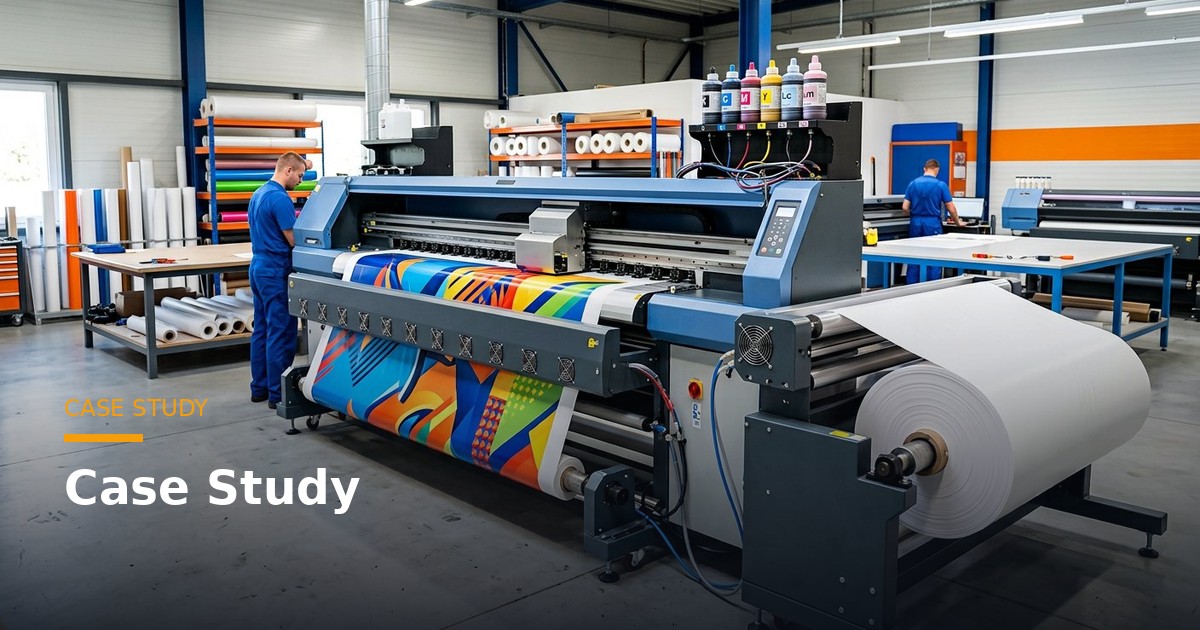
This anonymised case study follows an on-demand apparel fulfilment business — a print-on-demand operation serving e-commerce brands, creators and online stores — that needed to scale its production to meet growing order volumes with fast turnaround. By investing in UED DTF printers, the business scaled its print-on-demand capacity, maintained quality at volume and built a reliable fulfilment operation. Here is how DTF powered the growth and what on-demand apparel businesses can learn.
The Business and Its Challenge
The business — a print-on-demand apparel fulfilment operation — printed and shipped custom garments on behalf of e-commerce brands, creators, influencers and online stores who sold designs without holding inventory. This model was growing rapidly with e-commerce, and order volumes were increasing. But the business’s production capacity limited how many orders it could fulfil, and maintaining consistent quality at volume with fast turnaround was a challenge. To grow with its clients’ success, the business needed to scale its DTF production capacity while keeping quality high and turnaround fast — the fulfilment model depends on both.
The Situation Before
Before scaling its DTF capacity, the business’s production was the constraint on its growth. Print-on-demand fulfilment demands the ability to produce many different designs, in small quantities each, quickly and consistently — no two orders are alike, and every one must be printed well and shipped fast. The business’s existing capacity limited its daily order throughput, and during peak periods it risked falling behind on turnaround, which directly threatens a fulfilment business (clients and their customers expect fast shipping). The business had growing demand from its e-commerce clients but needed more production capacity to serve it reliably.
Machine at a Glance
| Specification | Detail |
|---|---|
| Machine | UED DTF Printer (i3200, 60 cm) |
| Printheads | 2 × Epson i3200 (industrial) |
| Speed | ~180–220 sq m/hour (production) |
| Ink | DTF CMYK + White (quality grade) |
| Workflow | Print → powder → cure → press, at volume |
| Best for | Print-on-demand apparel fulfilment |
The i3200 60cm DTF printer was ideal for on-demand fulfilment. Its production speed handled high daily order volumes, and DTF’s versatility meant the business could print on cotton, blends and dark garments — the full range its e-commerce clients sold. The i3200 heads provided the reliability for sustained production, essential when fulfilling a continuous stream of orders. DTF was also the right technology for print-on-demand: it handles the short runs and one-off designs that define the model economically, since there are no setup costs per design. The business scaled by adding production DTF capacity matched to its growing order volumes.
The Solution and Approach
The business scaled its DTF production capacity and optimised its fulfilment workflow for volume and consistency. It integrated its DTF production with its order-management system, so orders flowed efficiently from client stores through printing, curing, pressing and shipping. It standardised on quality DTF ink — critical for consistent output across thousands of varied designs and for protecting the expensive i3200 heads — and established disciplined white-ink maintenance. The workflow was designed for the on-demand model: many different designs, small quantities, fast turnaround, consistent quality. Scaling the DTF capacity let the business fulfil growing order volumes reliably and quickly.
Implementation and Support
Scaling fulfilment production required both equipment and process. The business added production DTF capacity and refined its workflow for efficiency and consistency at volume. Operators were trained, and white-ink maintenance was made a rigorous routine, since the heads run continuously in a fulfilment operation. Quality control was built in, since every order must be right — a fulfilment business’s reputation depends on consistently good output across thousands of varied designs. UED’s support across the DTF machines helped the business scale reliably. Within a short period, the expanded capacity was handling growing order volumes with the fast, consistent fulfilment its clients needed.
The Results
Scaling DTF capacity transformed the business’s fulfilment capability. Indicative results:
| Aspect | Before | After |
|---|---|---|
| Daily order capacity | Limited | Scaled to demand |
| Turnaround | At risk at peak | Fast, reliable |
| Quality at volume | Variable | Consistent |
| Garment range | Full (DTF) | Full, at scale |
| Client growth | Capacity-limited | Scaling with clients |
The expanded capacity let the business fulfil growing order volumes reliably and quickly, scaling with its e-commerce clients’ success. Fast, reliable turnaround — critical in fulfilment — was maintained even at peak. Consistent quality across thousands of varied designs protected the business’s reputation and its clients’ brands. And the capacity to scale meant the business could take on more clients and grow without the constraint that had limited it. Within its first year, the scaled DTF operation was fulfilling substantially higher volumes and supporting the growth of its client base.
The Financial Impact
The economics of scaling DTF fulfilment were favourable. Print-on-demand is a volume business with modest per-order margins, so efficient, high-volume production is key to profitability. The production DTF capacity lowered the effective cost per order through efficiency and enabled the volume that drives the business’s revenue. DTF’s economical consumables (ink, film, powder) supported healthy per-order margins at scale. And scaling capacity let the business grow with its clients rather than being capped. Based on the increased order volumes, the owner estimated the capacity investment delivered a solid return — in a volume business, the ability to fulfil more orders efficiently is directly tied to revenue and profit.
Why It Worked
Several factors drove the success. First, the business served a growing market — e-commerce print-on-demand — with genuine, increasing demand. Second, DTF was the right technology for the model: versatile across garments, economical for short runs and one-offs, and scalable. Third, production-capable i3200 machines provided the speed and reliability for high-volume fulfilment. Fourth, quality ink and rigorous white-ink maintenance protected the heads running continuously and ensured consistent output. And fifth, an efficient, integrated workflow enabled fast, reliable turnaround. The business succeeded by scaling the right technology and optimising its fulfilment operation for volume, consistency and speed.
The Owner’s Perspective
The owner’s key insight was that fulfilment lives and dies on reliability at scale. “Our clients trust us with their customers’ orders,” the owner explained. “Every garment has to be right, and shipped fast, every time — at any volume.” That reliability at scale is what a fulfilment business sells, and it requires production-capable equipment, quality consumables and an efficient workflow. The DTF investment gave the business the capacity and consistency to deliver that reliability as it grew. For the owner, scaling DTF capacity was not just about printing more — it was about being able to keep the promise of fast, consistent fulfilment that the whole business is built on.
Key Takeaways
On-demand apparel businesses can draw clear lessons. First, print-on-demand fulfilment is a growing, volume-driven business where production capacity, consistency and fast turnaround are the keys to success. Second, DTF is the right technology — versatile across garments, economical for the short runs and one-offs that define the model, and scalable. Third, production-capable i3200 machines, quality ink and rigorous white-ink maintenance enable reliable high-volume production. And fourth, an efficient, integrated workflow delivers the fast, consistent fulfilment that clients depend on. On-demand apparel businesses that scale the right DTF capacity and optimise their fulfilment operation can grow reliably with the booming e-commerce market.
This is an anonymised, representative case study based on typical UED machine performance. Individual results vary with market, management, utilisation and local conditions.
Quality Control at Volume
In print-on-demand fulfilment, quality control at volume is essential and challenging. The business produced thousands of garments, each with a different design, and every one had to be printed well — a single poor print goes to a client’s customer and damages both the fulfilment business’s and its client’s reputation. Maintaining consistent quality across high volumes of varied designs required discipline: quality DTF ink for consistent, vibrant output, rigorous white-ink maintenance to keep the heads firing perfectly, and quality-control checks in the workflow. The business built quality control into its process, because at scale, even a small error rate means many flawed garments unless it is managed.
This focus on quality at volume is what protects the business and its clients. A fulfilment business’s reputation depends on reliably delivering good garments, every order, and its e-commerce clients depend on that reliability for their own customer satisfaction. By investing in quality ink, disciplined maintenance and quality control, the business ensured consistent output across its high volumes. This reliability is the foundation of the fulfilment model — clients trust the business with their customers’ orders, and that trust is earned through consistent quality at scale. Quality control is not an optional extra in fulfilment; it is the core of the service the business sells.
Integrating with E-commerce
Efficient print-on-demand fulfilment requires tight integration between the printing operation and the clients’ e-commerce stores. Orders flow automatically from client stores into the fulfilment workflow — printing, curing, pressing, packing and shipping — and the whole process must be fast and seamless. The business integrated its DTF production with its order-management systems, so orders moved efficiently from receipt to shipment without manual bottlenecks. This integration is what enables the fast turnaround that print-on-demand demands, and it lets the business scale its order handling without proportional increases in labour or errors.
This operational integration is a key competitive advantage in fulfilment. The businesses that succeed in print-on-demand are those that can process high order volumes efficiently, accurately and quickly — turning orders around fast enough to satisfy e-commerce customers who expect rapid shipping. By integrating its DTF production with efficient order management, the business achieved the speed and reliability that fulfilment clients need. The technology (DTF) provides the production capability, but the integration and workflow provide the efficiency — and together they enable the fast, reliable fulfilment that wins and retains e-commerce clients in a competitive market.
The Print-on-Demand Opportunity
The business’s growth reflects one of the strongest trends in apparel: the print-on-demand boom. E-commerce, social media, creator economies and direct-to-consumer brands have made print-on-demand a rapidly growing model — selling custom apparel without holding inventory. This model depends on fulfilment partners who can print and ship orders reliably at scale, and demand for such partners is growing fast. The business positioned itself in this growing market, and its DTF capacity let it scale with the boom. As more brands, creators and sellers adopt print-on-demand, the demand for reliable fulfilment continues to grow.
DTF is particularly well suited to this market. Print-on-demand involves endless variety — countless designs, in small quantities, on many garment types and colours — and DTF handles this versatility economically, with no per-design setup costs and the ability to print on cotton, blends and dark garments. This makes DTF ideal for the varied, short-run nature of print-on-demand. The business’s investment in production DTF capacity positioned it to serve the growing print-on-demand market efficiently. For apparel businesses, the print-on-demand boom is a major opportunity, and reliable, scalable DTF fulfilment is the key to capturing it.
Could This Be Your Business’s Story?
This case study reflects the opportunity in the booming print-on-demand market. If you serve e-commerce brands, creators or online sellers, or want to enter this growing market, scalable DTF fulfilment is the key. Print-on-demand is growing rapidly with e-commerce, and it demands reliable, high-volume production with fast turnaround and consistent quality — exactly what production DTF capacity, quality ink and an efficient workflow deliver. The businesses that succeed scale the right DTF capacity, maintain rigorous quality control at volume, and integrate tightly with their clients’ e-commerce operations.
The print-on-demand opportunity is substantial and growing, and DTF is ideally suited to its varied, short-run nature. For an apparel business, investing in scalable DTF fulfilment is an investment in capturing this expanding market. With the right production capacity, quality discipline and operational efficiency, an on-demand apparel business can grow reliably with the e-commerce boom — serving more clients, fulfilling higher volumes and building a business on one of the strongest trends in apparel today.
Ready to Scale Your On-Demand Apparel Business?
Print-on-demand fulfilment demands reliable, high-volume production. Unified Engineering Dynamics supplies production DTF printers, quality inks and support to help you scale.
Discuss scaling your fulfilment production with UED → Tell us your order volumes, and we will recommend the right DTF capacity.
