

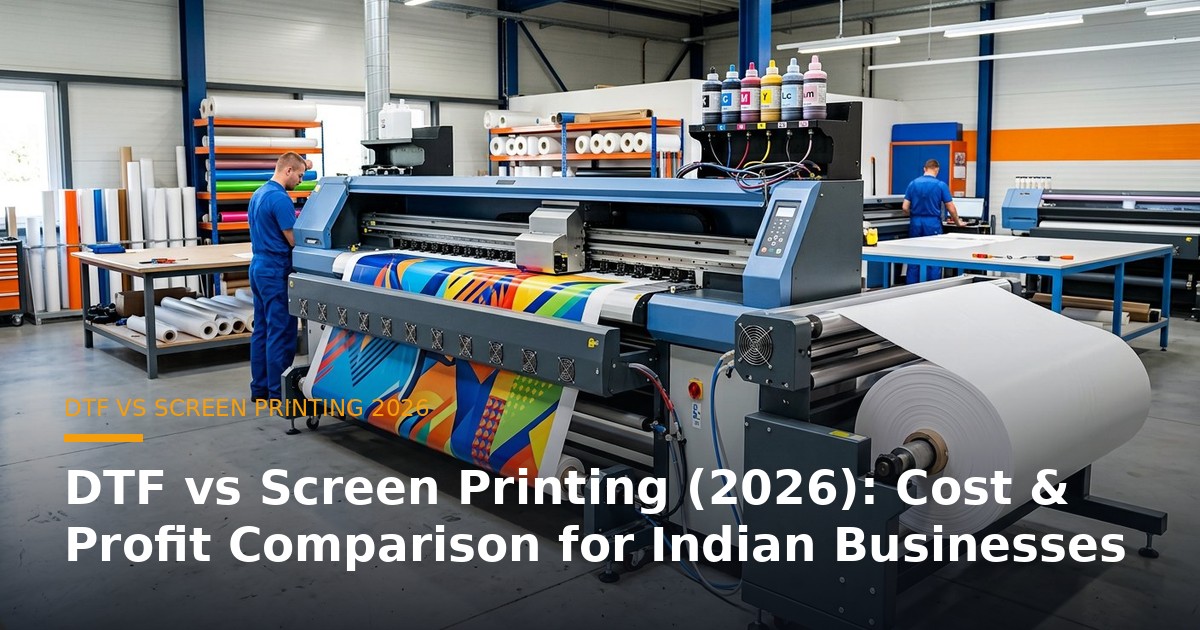
DTF and screen printing are the two dominant garment-decoration methods, and choosing between them comes down to cost, order size and design complexity. This guide compares DTF vs screen printing on setup cost, per-unit cost, quality and profit, so you can decide which method — or combination — is right for your business.
The short answer: screen printing wins on cost for very large runs of simple designs, while DTF wins for small batches, multi-colour and detailed designs, and one-off custom orders. Understanding the economics helps you choose profitably.
DTF vs Screen Printing: Quick Comparison
| Factor | DTF | Screen Printing |
|---|---|---|
| Setup cost per design | None | High (screens, separation) |
| Best for | Small batches, complex art | Large runs, simple art |
| Colour limit | Unlimited (full colour) | Limited by screens |
| Cost per unit | Low at small volume | Low at large volume |
| Equipment cost | ₹3.5L – ₹6L | ₹1L – ₹5L+ |
The key difference: screen printing has high setup but low per-unit cost at volume; DTF has no setup, so it is economical at any volume, especially small batches and complex designs.
How Each Method Works
Screen printing pushes ink through a mesh stencil (screen) onto the garment. Each colour needs a separate screen, so setup involves creating screens and separating artwork — costly and time-consuming, but once set up, printing thousands of the same design is fast and cheap per unit. DTF prints the design digitally onto film and transfers it, with no screens or setup, so any design — however complex or colourful — prints at the same low setup cost.
Cost Comparison by Order Size
For a single shirt or a small batch, screen printing is uneconomical because the setup cost (screens, separation) is spread over few units, making per-unit cost very high. DTF has no setup, so a single custom shirt costs the same to set up as a hundred. For very large runs of a simple one-or-two-colour design, screen printing becomes cheaper per unit because the setup is amortised over thousands. The break-even typically falls somewhere in the hundreds of units, depending on design complexity and colours.
Design Complexity and Colour
Screen printing is limited by the number of screens, so complex, full-colour or photographic designs require many screens (expensive) or simulated process printing (skilled and costly). DTF handles unlimited colours and photographic detail at no extra setup cost, making it ideal for complex, gradient and full-colour artwork. If your customers want detailed, multi-colour or photographic designs, DTF is far more practical and economical than screen printing.
Quality and Feel
Both produce durable, quality prints. Screen printing lays down a thick ink layer that is very durable and has a distinct feel, excellent for bold, simple designs on cotton. DTF produces a soft, flexible transfer that stretches with the fabric and handles fine detail and full colour beautifully. For bold logos and text, screen printing is classic; for detailed, full-colour artwork, DTF excels. Quality is strong with both — the choice depends on the design and fabric.
Which Is More Profitable?
Profitability depends on your order profile. If you mostly print large runs of simple one-or-two-colour designs (bulk uniforms, basic tees), screen printing offers the lowest per-unit cost and best margins at volume. If you print small batches, one-off custom orders, or complex multi-colour designs, DTF is far more profitable because there’s no setup cost and no minimums. Many successful businesses run both — screen printing for large simple runs, DTF for custom and complex work — to serve every order profitably.
When to Choose Screen Printing
Choose screen printing if your business focuses on large-volume runs of simple designs: bulk uniforms, basic promotional tees, event shirts in one or two colours, and orders in the hundreds or thousands. Its low per-unit cost at volume and classic durable print make it ideal for these jobs. If you have steady bulk orders for simple artwork, screen printing maximises your margin per unit at scale.
When to Choose DTF
Choose DTF if your business focuses on custom, small-batch or complex work: one-off personalised orders, small brand drops, full-colour and photographic designs, and orders with no minimums. DTF’s zero setup cost and unlimited colours make it economical at any volume and ideal for the customisation market. For most new and small apparel businesses serving custom orders, DTF is the more practical and profitable choice.
Why Buy from UED?
Unified Engineering Dynamics (UED) supplies, installs and services DTF setups across India, and can advise on the best decoration method for your order profile. We provide genuine printheads, inks and consumables, professional installation and training, and dependable after-sales support — so you can serve custom and complex orders profitably with a reliable DTF setup.
DTF vs Screen Printing: Setup Cost Explained
Setup cost is the defining economic difference. Screen printing requires creating a separate screen for each colour, plus artwork separation, exposure and setup on the press — a fixed cost incurred regardless of how many shirts you print. For a large run this cost is negligible per unit, but for a small batch it makes each shirt very expensive. DTF has no screens and no setup: you simply print the design, so the first shirt costs the same to set up as the thousandth. This zero-setup advantage is why DTF dominates small-batch and custom work, where screen printing simply cannot compete economically.
DTF vs Screen Printing: The Break-Even Volume
The break-even between DTF and screen printing depends on design complexity and colours, but a useful rule of thumb is that screen printing becomes cheaper per unit somewhere in the hundreds of pieces for simple designs. Below that, DTF is more economical because there is no setup. Above it, screen printing’s low per-unit cost wins for simple artwork. For complex, multi-colour designs, DTF often stays cheaper even at higher volumes because screen printing would need many screens. Knowing this break-even helps you quote competitively and choose the right method per order.
DTF vs Screen Printing: Turnaround and Flexibility
DTF offers faster turnaround and greater flexibility for custom work. With no screens to make, you can print a new design immediately, change designs between shirts, and handle one-off orders profitably — ideal for the on-demand customisation market. Screen printing needs setup time for each design and colour, so it suits planned bulk runs rather than quick, varied custom orders. For businesses serving customers who want fast, personalised, varied orders, DTF’s flexibility is a major competitive and profitability advantage over screen printing.
Running Both Methods Profitably
The most versatile garment businesses run both DTF and screen printing, using each where it is most profitable. Screen printing handles large runs of simple one-or-two-colour designs at the lowest per-unit cost. DTF handles custom orders, small batches and complex full-colour designs with no setup. This combination lets you quote competitively for every order type — winning bulk uniform contracts with screen printing and custom retail orders with DTF — maximising your addressable market and profit. If you can only invest in one to start, choose based on whether your orders are mostly large-simple (screen) or small-complex (DTF).
Choosing for a New Apparel Business
For a new custom apparel business, DTF is usually the better first investment. The customisation market is dominated by small-batch, personalised and full-colour orders, which DTF serves profitably with no setup or minimums, while screen printing struggles economically at low volumes. DTF also requires less space and skill to start than a full screen-printing setup. As your business grows and you win large bulk orders for simple designs, you can add screen printing for those runs. Starting with DTF positions you for the custom market that drives most new apparel businesses today.
DTF vs Screen Printing: Durability and Wash Performance
Both methods produce durable prints when done correctly, but they age differently. Screen printing lays down a thick plastisol or water-based ink layer that is extremely durable and can last the life of the garment, making it a classic choice for workwear and heavy-use apparel. DTF produces a flexible transfer that, with good film, powder and pressing, survives dozens of washes without cracking or peeling and stretches with the fabric. For most custom apparel, both are more than durable enough. The choice comes down to design complexity and order size rather than durability, since both withstand normal washing and wear well.
DTF vs Screen Printing: Best for Different Fabrics
Fabric compatibility slightly favours each method in different areas. Screen printing works beautifully on cotton and is the traditional choice for cotton tees, though it can also print on blends and some polyester with the right inks. DTF works on almost any fabric — cotton, polyester, blends, nylon — and on any colour including dark garments, thanks to its white ink layer. For a business serving varied fabrics and colours, DTF offers more flexibility. For a business focused on classic cotton tees in bulk, screen printing remains a strong, proven choice.
DTF vs Screen Printing: Scaling Your Business
The two methods scale differently. Screen printing scales efficiently for large runs of the same design — once screens are made, printing thousands is fast and cheap per unit, ideal for bulk uniform and promotional contracts. DTF scales by adding printing and curing capacity, and excels at varied, short-run and custom work with no setup between designs. As your business grows, you may find bulk simple orders favour screen printing while custom and complex orders favour DTF. Many established garment businesses run both, scaling each for the order types it handles most profitably.
Which Method for Your First Investment?
For a new custom apparel business, DTF is usually the smarter first investment. The market is dominated by small-batch, personalised and full-colour orders, which DTF serves profitably with no setup, no minimums and unlimited colours, while screen printing’s setup costs make small runs uneconomical. DTF also needs less space and skill to start. As you grow and win large bulk orders for simple designs, you can add screen printing for those specific runs. Starting with DTF positions you for the custom, on-demand market that drives most new apparel businesses in India today.
Summary: Choosing Between DTF and Screen Printing
DTF and screen printing each win in different situations. Screen printing offers the lowest per-unit cost for very large runs of simple one-or-two-colour designs, making it ideal for bulk uniforms and promotional tees. DTF has no setup cost, so it is far more economical for small batches, one-off custom orders and complex full-colour designs — the orders that dominate the customisation market. For most new and small apparel businesses, DTF is the more practical and profitable first investment. As you grow and win large bulk contracts for simple artwork, adding screen printing lets you serve every order type at the best margin. Many established garment businesses profitably run both, using screen printing for bulk simple runs and DTF for everything custom and complex.
Frequently Asked Questions
Which is cheaper: DTF or screen printing?
For small batches and complex designs, DTF is cheaper because there is no setup cost. For very large runs of simple one-or-two-colour designs, screen printing is cheaper per unit because setup is spread over many units.
Which is better for small custom orders?
DTF is far better for small and one-off custom orders, because it has no setup cost or minimums and handles unlimited colours, while screen printing’s setup makes small runs uneconomical.
Can I use both DTF and screen printing?
Yes. Many businesses run both — screen printing for large simple runs and DTF for custom, complex and small-batch work — to serve every order type profitably.
Do these prices include GST and installation?
Usually not. Prices are typically ex-GST and may exclude installation and training. Always request a written, configuration-specific quotation.
Want help choosing the right printing setup? Talk to UED’s specialists — share your budget and volume, and we’ll recommend the right machine with transparent pricing. Request a quote →
Figures on this page are indicative estimates and vary with configuration, consumables, location and volume. Always confirm a written, configuration-specific quotation.
