

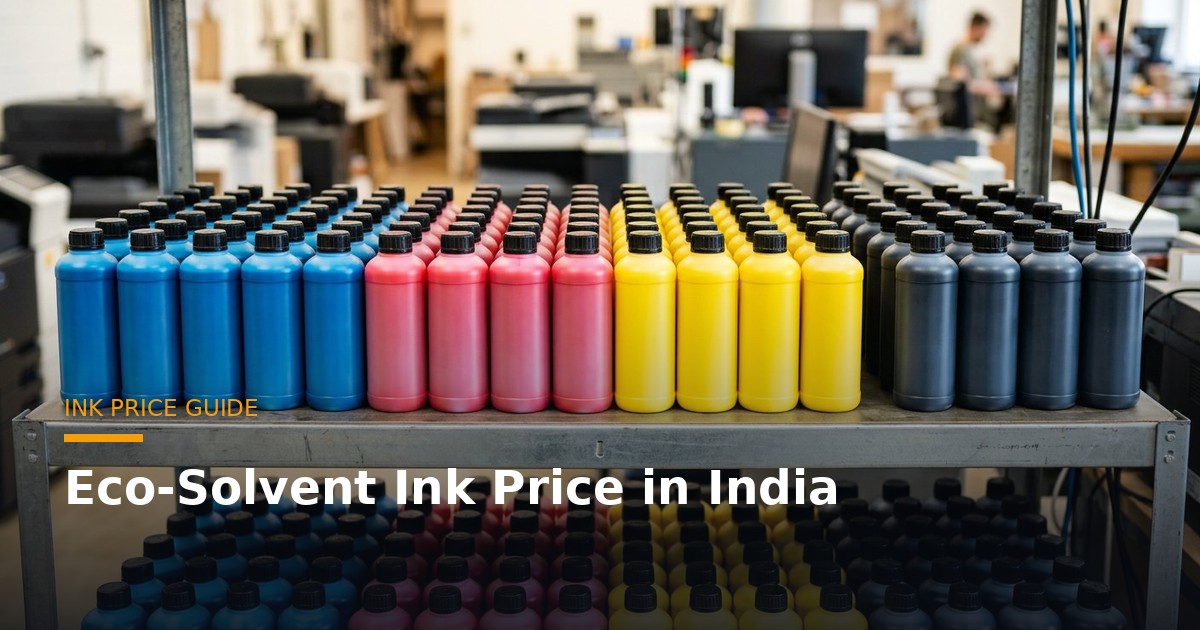
Eco-solvent ink has become the popular choice for indoor-outdoor signage, vinyl graphics, decals and display printing in India, thanks to its lower odour, better indoor suitability and good durability. If you run an eco-solvent printer, ink is one of your biggest ongoing costs, so understanding its real price — and what affects it — is essential for profitable operation. This guide gives you current per-litre eco-solvent ink prices in India, explains what drives those prices, shows how to calculate your cost per print, and helps you choose quality ink that protects your printer.
Eco-Solvent Ink Price in India (Per Litre)
Eco-solvent ink is priced by the litre, and cost varies with quality, brand and formulation. Indicative market ranges for 2026:
| Ink Type | Indicative Price (per Litre) | Notes |
|---|---|---|
| Economy eco-solvent ink | ₹400 – ₹700 | Lowest cost, variable quality |
| Standard quality eco-solvent | ₹700 – ₹1,200 | Good balance for most work |
| Premium / imported eco-solvent | ₹1,200 – ₹2,000+ | Best colour, consistency, head safety |
Eco-solvent ink is generally more expensive per litre than full solvent ink, because its milder formulation and better indoor characteristics cost more to produce. Most shops use standard-quality ink in the ₹700–₹1,200 range, which balances cost with reliable, vibrant output.
What Eco-Solvent Ink Is and Why It’s Popular
Eco-solvent ink is a milder version of solvent ink, using a gentler solvent carrier that produces less odour and fewer harmful fumes. This makes it suitable for indoor use and more comfortable in the workplace, while still delivering good durability and vibrant colour on vinyl, flex and coated media. Its popularity in India has grown because it suits the wide range of work many sign shops do — from outdoor signage to indoor display graphics, decals and vehicle graphics. The trade-off is a higher per-litre cost than full solvent, offset by its versatility and better working environment. As with all ink, quality directly affects colour, durability and how gently it treats your printhead.
What Affects Eco-Solvent Ink Prices
Several factors determine eco-solvent ink pricing. Quality and brand lead the way — premium imported inks with consistent pigment and refined formulation cost more than economy options. Pigment quality matters for colour strength, gamut and outdoor fastness. Formulation affects how well the ink performs on different media and how gently it treats the printhead. Import and raw-material costs feed through, so prices move with the rupee–dollar rate and chemical costs. Volume buying usually earns a better per-litre price, and supplier reliability affects cost — established distributors charge fairly but deliver the consistency that protects your printer and output.
How Much Eco-Solvent Ink Does Your Printer Use?
Consumption depends on coverage and print settings, much like solvent ink. A typical eco-solvent print uses roughly 8–15 ml per square foot, varying with how much of the media is covered and the quality mode used. At a standard price of around ₹900 per litre (₹0.9 per ml), that works out to roughly ₹7–₹14 of ink per square foot. High-quality modes with more passes use more ink; draft modes use less. Knowing your consumption lets you cost jobs accurately and set profitable prices, rather than underpricing and losing money on ink without realising it.
Calculating Cost per Print and per Square Foot
Your ink cost per square foot is a foundational business number. Divide the ink’s per-litre price by 1,000 to get the cost per ml, then multiply by ml used per square foot. For ink at ₹900/litre (₹0.9/ml) and 12 ml per square foot, that is about ₹11 per square foot of ink. Add media cost, and you have your core material cost — the basis of a profitable quote. Eco-solvent work often includes higher-value items like decals, banners and display graphics, where accurate costing protects healthy margins. Shops that know their cost per square foot quote confidently; those that guess often erode profit on ink.
Cheap vs Quality Eco-Solvent Ink
Cheap eco-solvent ink is tempting, but it carries the same risks as cheap solvent ink — and often more, since eco-solvent printers frequently use finer industrial heads like the Epson i3200 that are sensitive to ink quality. Poor ink can produce dull, inconsistent colour, cause banding, and — most expensively — clog nozzles and shorten printhead life. An i3200 head costs ₹55,000–₹85,000; saving a few hundred rupees a litre on ink that clogs it is a poor trade. Quality eco-solvent ink, matched to your head, delivers vibrant consistent colour, good durability and protects your investment. For a business that depends on output quality and printer reliability, quality ink is the economical choice.
Compatibility with Your Printer and Printhead
Eco-solvent ink must be matched to your printer and printhead. Epson-head eco-solvent printers — using heads like the i3200, DX7 or TX800 — need ink formulated for those heads, since finer industrial nozzles are more demanding. Using incompatible or poor-quality ink is a leading cause of clogging and head damage. Always use ink recommended for your specific machine, and avoid switching brands casually, as different formulations may not mix well in the ink system. When in doubt, ask your machine supplier which eco-solvent ink is recommended — using the right ink is one of the simplest, cheapest ways to protect an expensive printhead and ensure consistent quality.
Where to Buy Eco-Solvent Ink in India
Reliability matters more than the lowest price when buying eco-solvent ink. Your machine supplier or an authorised ink distributor is the best source — they stock ink matched to your printer and head, offer consistent quality, and provide advice. Established distributors are good for bulk buying at competitive prices. Be wary of unknown cheap sources, since inconsistent ink can damage fine industrial heads. Consider bulk purchasing for a better per-litre price, but only buy what you can use within the ink’s shelf life. The goal is consistent, printer-compatible, quality ink from a reliable supplier — protecting both your output and your printhead.
Storage, Shelf Life and Handling
Eco-solvent ink has a shelf life of roughly six months to a year, extended by proper storage. Keep it in a cool, dry place away from heat and direct sunlight, which degrade the formulation. Seal containers tightly to prevent evaporation and contamination. Stir or shake before use if recommended, since pigment settles. Use first-in-first-out rotation so you always print with fresh ink. Avoid over-buying, since expired ink produces poor output and can harm the printhead. Good storage and stock rotation ensure you get the vibrant, consistent colour you paid for and protect your printer from degraded ink.
Getting the Best Value on Eco-Solvent Ink
You can improve your ink value without compromising quality. Buy in bulk for a better per-litre price, but only what you can use within shelf life. Build a relationship with a reliable distributor for consistent pricing and quality. Minimise wastage — proper maintenance, correct print settings and avoiding rejected jobs all save ink. And choose quality ink that protects your printhead, since the cost of a clogged or damaged head far exceeds any ink saving. The best value is not the cheapest litre, but the ink that delivers consistent quality, protects your printer, and keeps your output saleable — which is what actually maximises your profit.
Frequently Asked Questions
What is the eco-solvent ink price in India?
Roughly ₹400–₹700 per litre for economy, ₹700–₹1,200 for standard quality, and ₹1,200–₹2,000+ for premium imported ink.
Is eco-solvent ink more expensive than solvent ink?
Generally yes, per litre, because its milder formulation costs more to produce. It offers better indoor suitability and lower odour.
How much eco-solvent ink does a printer use?
Typically 8–15 ml per square foot depending on coverage and quality mode — roughly ₹7–₹14 of ink per square foot at standard prices.
Can I use cheap eco-solvent ink to save money?
It is risky, especially with fine industrial heads like the i3200. Cheap ink can clog nozzles and damage costly printheads. Quality ink is the economical choice.
How should I store eco-solvent ink?
Cool, dry and sealed, away from heat and sunlight, with a shelf life of about six months to a year. Use older stock first.
Do you supply eco-solvent ink?
Yes. Unified Engineering Dynamics supplies quality eco-solvent ink matched to our printers and printheads, with expert support.
Eco-Solvent Ink and Printhead Longevity
One of the most valuable but least discussed benefits of quality eco-solvent ink is how it protects your printhead. Eco-solvent ink is milder than hard solvent, but it is still a chemical working inside a precision component with extremely fine nozzles. Poorly formulated or contaminated ink leaves residue, causes gradual nozzle clogging, and eventually leads to permanent head damage. On a machine using an expensive Epson i3200, DX7 or industrial head, this is a serious risk, because those heads cost tens of thousands of rupees to replace and are the single most expensive consumable-like component in the machine.
Quality eco-solvent ink, properly filtered and consistently formulated, flows cleanly, clogs less and keeps your head healthy for far longer. The small difference in price per litre is trivial compared with the cost of replacing a head prematurely. Many printers who chase the cheapest ink end up spending more overall through head replacements, downtime and rejected output. Treat ink quality as an investment in head longevity: keep your machine maintained, run regular cleaning cycles, and use ink that suits your head. Over a year, the printer who uses good ink almost always ends up ahead of the one who saved on ink but replaced heads.
Planning Your Eco-Solvent Ink Budget
Set your ink budget on expected output, not guesswork. Estimate your monthly printed area in square feet, multiply by your usage per square foot (around 8–15 ml) and by your cost per ml. A business printing 8,000 square feet a month at 12 ml per square foot uses roughly 96 litres — at ₹1,000 a litre that is nearly ₹96,000 a month, a major cost that must be budgeted precisely. Track actual usage monthly and investigate any sudden increase, since a spike usually signals a head problem, a settings change or a leaking supply that is quietly wasting money.
Also connect ink planning to your other decisions. Ink is one of several running costs alongside media, lamination and power, but it is the one most affected by buying and maintenance choices. Buy in sensible volumes for better pricing, store ink correctly so none degrades unused, and keep your machine serviced so it transfers ink efficiently. Because eco-solvent output is so broad — covering vinyl, flex, banners, stickers, backlit film, wall graphics and vehicle wraps — accurate ink costing across those applications lets you price every job confidently. A disciplined, measured approach to ink budgeting is one of the clearest signs of a well-run printing business.
Eco-Solvent Ink Across Different Media
Eco-solvent ink’s behaviour varies subtly across media, and understanding this helps you get the best from it. On cast vinyl and polymer films the ink sits and bonds on the surface, giving sharp, vibrant results; on porous or textured media it may absorb slightly differently, affecting colour saturation. Coated media designed for eco-solvent — with a receptive coating — gives the most consistent, vibrant output, while uncoated stock can look dull and use more ink as it absorbs. Choosing the right media for eco-solvent, and matching your ink and profile to it, is as important as the ink itself for consistent quality.
This media relationship also affects your ink economy. A good coated eco-solvent media transfers ink efficiently and looks vibrant at normal coverage, while a poor media soaks up ink and needs heavier coverage to look good — raising your ink cost per print without improving the result. So optimising ink cost means optimising the whole ink-media-profile chain, not just buying cheaper ink. Printers who match quality ink with suitable coated media and a proper profile get the best colour at the lowest effective ink cost, which is the real measure of efficiency in eco-solvent printing.
Buy Quality Ink — Protect Your Printer and Profit
Eco-solvent ink is a major running cost, so buy it wisely: know your cost per print, choose quality ink matched to your head, and buy from a reliable source. Unified Engineering Dynamics supplies quality eco-solvent ink matched to our printers, with genuine products and nationwide support.
Get eco-solvent ink pricing and advice from UED → Tell us your printer and volumes, and we will recommend the right ink at a competitive price.
Related Reading
- How to Choose the Right Ink for Your Printer: Complete India Guide
- Solvent Ink Price in India 2026: Per-Litre Cost, Brands & Buy Guide
- Printer Ink Consumption & Cost per Print: How to Calculate (2026)
- Why Cheap Ink Ruins Your Printhead (And What It Really Costs You)
- Sublimation Ink Price in India: Cost, Quality & Where to Buy
Unified Engineering Dynamics supplies quality printer inks and machines with expert support across India. Get in touch for ink advice and pricing →
