

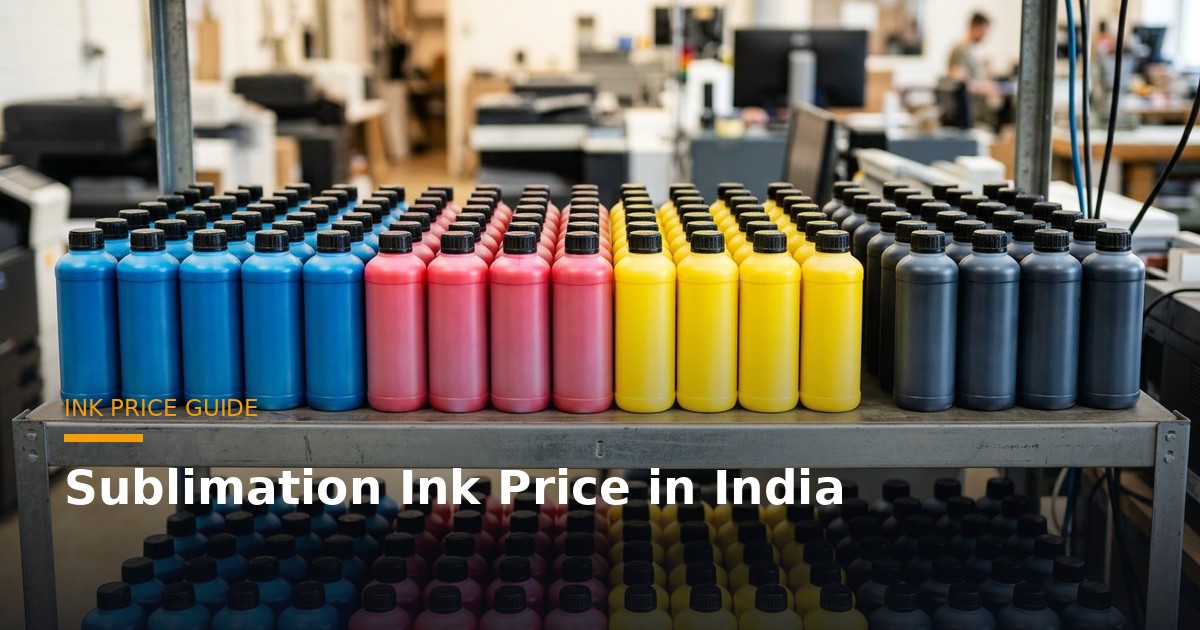
Sublimation printing has carved out a strong niche in India for textile and apparel printing, mugs, tiles, phone cases and polyester-based products, prized for its vibrant, permanent, wash-fast results. At the heart of it is sublimation ink — a specialised ink that turns from solid to gas under heat, bonding permanently into polyester and polymer-coated surfaces. If you run a sublimation business, ink is a key ongoing cost, so understanding its price and quality is important. This guide gives you current per-litre sublimation ink prices in India, explains what affects them, shows your cost per print, and helps you buy quality ink.
Sublimation Ink Price in India (Per Litre)
Sublimation ink is a specialised product, priced above standard inkjet inks. Indicative market ranges for 2026:
| Sublimation Ink Type | Indicative Price (per Litre) | Notes |
|---|---|---|
| Economy sublimation ink | ₹800 – ₹1,400 | Lowest cost, variable quality |
| Standard quality sublimation | ₹1,400 – ₹2,500 | Good colour and transfer |
| Premium / imported sublimation | ₹2,500 – ₹4,500+ | Best colour gamut, consistency, head safety |
Most sublimation businesses use standard-quality ink in the ₹1,400–₹2,500 range, which balances cost with vibrant, reliable transfer results. Premium ink offers a wider colour gamut and better consistency for quality-focused work.
What Sublimation Ink Is and How It Works
Sublimation ink is unique in how it works. It is printed onto a special transfer paper, then placed on a polyester or polymer-coated substrate and heated under pressure. The heat causes the solid ink pigment to sublime — turn directly into a gas without becoming liquid — which then penetrates the substrate and solidifies within it as it cools. Because the ink becomes part of the material rather than sitting on top, sublimation prints are permanent, will not crack or peel, and are completely wash-fast. This is why sublimation is so valued for apparel, sportswear and personalised products. The specialised dye-based formulation is what makes sublimation ink more expensive than standard inks.
What Affects Sublimation Ink Prices
Several factors determine sublimation ink pricing. Quality and brand lead — premium inks with high-purity dyes deliver a wider colour gamut, more vibrant results and consistent transfers, and cost more. Dye purity matters greatly, since impurities affect colour, transfer efficiency and can clog printheads. Raw-material and import costs feed through, so prices track the rupee–dollar rate and chemical costs. Volume buying usually earns a better per-litre price. And supplier reliability affects cost — consistent, quality ink protects your printhead and ensures predictable colour, which is critical in sublimation where colour accuracy is a key selling point.
How Much Sublimation Ink Does Your Printer Use?
Sublimation ink consumption depends on design coverage and the substrate. As a rough guide, sublimation printing uses around 8–15 ml per square foot, similar to other inkjet processes, varying with coverage and quality settings. Because sublimation prints are often smaller items — a mug wrap, a T-shirt graphic, a phone case — it is often more practical to think in cost per item. At around ₹1,800 per litre (₹1.8 per ml), a design using 10 ml costs about ₹18 in ink. Knowing your ink cost per item, alongside paper and blank costs, lets you price your sublimation products profitably.
Calculating Your Cost per Print
Sublimation products are usually priced per item, so calculate your cost per item. Add the ink cost (based on design coverage), the sublimation paper cost, the blank product cost (mug, shirt, case), and your labour and overheads including the heat-press time. Ink is a meaningful component but usually smaller than the blank and paper for many products. For example, a sublimated mug might use ₹15–₹25 of ink plus paper, against a blank cost of ₹40–₹80. Understanding the full per-item cost lets you price competitively while keeping a healthy margin, rather than underpricing and losing money on materials.
Cheap vs Quality Sublimation Ink
Cheap sublimation ink is tempting but carries real risks. Poor-quality ink with impure dyes produces dull, inconsistent colour, poor transfer efficiency (wasting ink and blanks), and can clog printheads. Colour inconsistency is especially damaging in sublimation, where accurate, vibrant colour is the whole selling point — a customer reordering a design expects the same colours. Quality sublimation ink delivers a wider gamut, vibrant consistent colour, efficient transfer and protects your printhead. Given that sublimation competes on colour quality, investing in good ink is directly investing in your product’s appeal and your ability to win repeat business.
Compatibility with Your Printer
Sublimation ink must suit your printer. Sublimation is commonly done on Epson-based printers (converted or dedicated sublimation machines) using heads like the i3200, i1600, DX5/DX7 or F-series heads. The ink must be formulated for your specific printhead, since dye-based sublimation ink behaves differently from other inks and can clog incompatible heads. Always use sublimation ink recommended for your printer, and avoid switching brands casually, as different dye formulations may not mix well and can cause problems. Your machine or ink supplier can confirm the right ink. Using compatible, quality sublimation ink protects your printhead and ensures the vibrant, consistent results your customers expect.
Where to Buy Sublimation Ink in India
Buy sublimation ink from reliable sources, prioritising quality and colour consistency. Your machine supplier or an authorised sublimation ink distributor is the best source — they stock ink matched to your printer, with consistent colour and reliable quality. Established distributors offer competitive bulk pricing. Be cautious with unknown cheap sources, since inconsistent or impure ink ruins colour and can damage heads. For a business that competes on colour quality, buying consistent, quality ink from a reliable supplier is essential — it ensures every product matches the last, which is what builds a reputation and repeat customers.
Storage, Shelf Life and Handling
Sublimation ink has a shelf life of roughly six months to a year, and proper storage preserves its quality. Store it in a cool, dry place away from heat and direct sunlight, sealed tightly to prevent evaporation and contamination. Shake or stir before use if recommended. Use first-in-first-out rotation so you print with fresh ink, and avoid over-buying beyond shelf life. Expired or degraded ink produces dull colour and poor transfer, wasting ink and blanks. Good storage ensures you get the vibrant, consistent colour that sublimation is known for, and protects your printhead from degraded ink.
Sublimation vs Other Methods: The Ink Cost Context
It helps to understand sublimation ink cost in context. Sublimation ink costs more per litre than standard inks, but it produces permanent, wash-fast, vibrant results on polyester that other methods cannot match — the ink becomes part of the fabric rather than sitting on top. Compared with DTF, sublimation only works on polyester or polymer-coated items (not cotton), but its results on those materials are exceptionally durable and soft-handled. So while the ink is a premium product, it enables a premium, durable product. For businesses focused on polyester apparel, sportswear, and personalised hard goods, sublimation’s ink cost is justified by the quality and durability of the output it produces.
Frequently Asked Questions
What is the sublimation ink price in India?
Roughly ₹800–₹1,400 per litre for economy, ₹1,400–₹2,500 for standard quality, and ₹2,500–₹4,500+ for premium imported ink.
Why is sublimation ink more expensive?
Its specialised dye-based formulation, which sublimates (turns to gas) under heat to bond permanently into polyester, costs more to produce with high-purity dyes.
How much sublimation ink does a printer use?
Roughly 8–15 ml per square foot, though sublimation is often costed per item — a design might use ₹15–₹25 of ink depending on coverage.
Can I use cheap sublimation ink?
It is risky. Cheap ink gives dull, inconsistent colour, wastes blanks through poor transfer, and can clog heads. Quality ink is essential for colour-critical sublimation.
Does sublimation ink work on cotton?
No — sublimation bonds into polyester or polymer coatings, not cotton. For cotton, DTF or other methods are needed.
Do you supply sublimation ink?
Yes. Unified Engineering Dynamics supplies quality sublimation ink matched to our sublimation printers, with consistent colour and expert support.
Sublimation Ink and Colour Management
Colour management is where sublimation ink quality really shows, and it is central to a sublimation business. Because sublimation competes on vibrant, accurate, consistent colour, the ink’s colour gamut and consistency directly determine your product’s appeal. Quality sublimation ink, combined with proper ICC profiles and colour management, lets you reproduce designs accurately and — critically — reproduce them the same way every time. A customer reordering a design expects the identical colours, and only consistent, quality ink with good colour management delivers that. This consistency is what builds a reputation and wins repeat business in a competitive market.
Cheap or inconsistent sublimation ink undermines this. Dull, drifting or variable colour means every batch looks slightly different, customers notice, and reorders disappoint. Because sublimation’s whole value proposition is vibrant permanent colour, cutting corners on ink directly cuts into your product’s appeal. Invest in quality ink, use proper ICC profiling for your printer-ink-paper combination, and keep your process consistent. Printers who master colour management with good ink can confidently take on brand work and repeat orders where colour accuracy is contractual, moving upmarket and earning better margins than those competing purely on price with inconsistent output.
Planning Your Sublimation Ink Budget
Set your sublimation ink budget on expected output, whether you measure it in area or in items. Estimate your monthly printed area at around 8–15 ml per square foot, or your item volume at a per-item ink cost. A business printing 2,500 square feet a month at 12 ml per square foot uses roughly 30 litres — at ₹1,800 a litre that is about ₹54,000 a month, a meaningful cost to budget precisely. Track actual usage and investigate any spike, since it usually signals a head issue, poor transfer wasting ink, or a settings change.
Connect ink planning to your other sublimation costs. Ink is one component alongside sublimation paper and the blank products (mugs, shirts, cases), so cost all three per item to price accurately. Buy ink in sensible volumes for better pricing, store it well so it stays fresh, and keep your machine maintained so it transfers ink efficiently onto the paper. Because sublimation is often a per-item, personalisation-driven business, accurate per-item costing — including ink — is what lets you price competitively while keeping a healthy margin. A disciplined approach to sublimation ink budgeting supports both the colour quality and the profitability that a successful sublimation business needs.
Sublimation Ink Across Different Products
Sublimation is used across a wide range of products — polyester apparel and sportswear, mugs, tiles, phone cases, mousepads, cushions, keychains and more — and ink behaviour varies subtly across them. On polyester fabric the dye sublimates into the fibres, giving soft, permanent, vibrant results. On polymer-coated hard goods (mugs, cases, tiles) the dye bonds into the coating, and results depend on the coating quality as well as the ink. Understanding how your ink performs on each product type, with the right press temperature, time and pressure, is key to consistent quality across your range.
This product diversity also shapes your ink economy. Small items like mugs and cases use little ink per piece, while large fabric prints use more, so your ink cost per item varies widely across your catalogue. Costing ink accurately per product type lets you price each item correctly. And because sublimation competes on vibrant, permanent colour, consistent quality ink across all your products — apparel, hard goods and gifts — is what builds a reputation for quality. Printers who understand their ink across their full product range deliver consistent, vibrant results that keep customers coming back.
It is also worth matching your ink investment to the products that earn the most. High-margin personalised items and branded corporate orders reward the extra cost of premium ink with noticeably better colour, while low-cost bulk items may justify standard ink. A thoughtful, product-aware approach to ink selection and costing — rather than using one ink for everything and one price for all jobs — is what lets a sublimation business stay both competitive and profitable.
Buy Quality Sublimation Ink — Protect Your Colour and Printer
Sublimation competes on vibrant, consistent colour, so buy quality ink matched to your printer, store it well, and buy from a reliable source. Unified Engineering Dynamics supplies quality sublimation ink matched to our printers, with genuine products and nationwide support.
Get sublimation ink pricing and advice from UED → Tell us your printer and products, and we will recommend the right ink at a competitive price.
Related Reading
- How to Choose the Right Ink for Your Printer: Complete India Guide
- Why Cheap Ink Ruins Your Printhead (And What It Really Costs You)
- How to Store Printer Ink: Shelf Life, Tips & Safety
- Printer Ink Problems: Clogging, Banding & Not Drying (Causes & Fixes)
- Original vs Compatible Ink: What’s the Difference and Which to Use?
Unified Engineering Dynamics supplies quality printer inks and machines with expert support across India. Get in touch for ink advice and pricing →
