



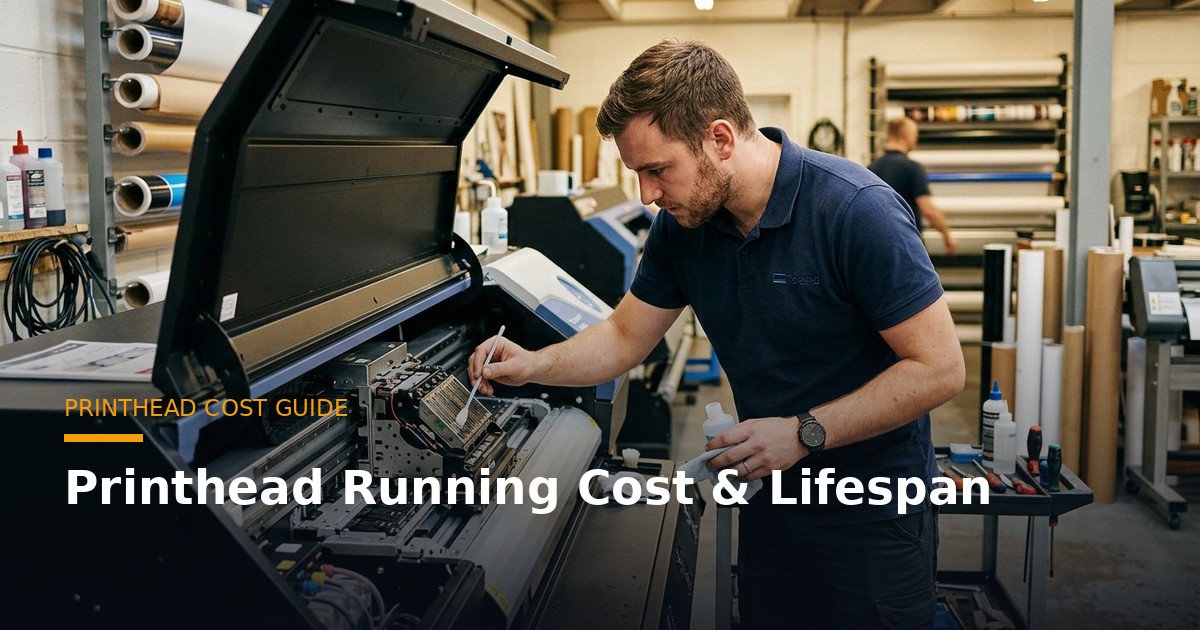
When buying a printer, most owners focus on the machine’s price — but one of the biggest ongoing costs is hiding in plain sight: the printhead. Printheads are consumables; they wear out and must be replaced, and over a machine’s life that replacement cost is significant. Yet few owners calculate it properly. This guide breaks down the real running cost and lifespan of printheads by brand — Konica, Ricoh and Epson — so you can budget accurately, compare machines on total cost of ownership, and understand how maintenance dramatically reduces what you actually spend.
Why Printhead Running Cost Matters
A printhead is not a one-time purchase — it is a recurring operating cost, like ink or media. Every head eventually wears out and needs replacing, and depending on the head and your usage, that could be every year or every few years. For a production business, this recurring cost directly affects your margins and your cost per square foot or per print. Understanding it lets you compare machines honestly: a cheaper machine with an expensive, short-lived head may cost more to run than a pricier machine with a durable head. It also lets you budget, so a head replacement is a planned expense rather than a financial shock. For any serious printing business, printhead running cost is a number worth knowing.
Typical Printhead Lifespan by Brand
Lifespan varies by head class and, crucially, by how well the head is maintained. As general guidelines for genuine heads in regular production:
| Brand / Head | Typical Lifespan |
|---|---|
| Epson XP600 | ~1 year (heavy use) |
| Epson TX800 / DX5 | ~1–2 years |
| Epson i3200 | Multiple years |
| Konica KM512i | ~1.5–3 years |
| Konica KM1024i | ~2–4 years |
| Ricoh Gen5i / Gen6 | ~2–4+ years |
The pattern is clear: industrial heads last longer than entry heads, and every head lasts longer with good maintenance. These are guidelines, not guarantees — ink quality, daily care and usage intensity are the real determinants of how long your specific head survives.
Cost-per-Year: A Practical Comparison
The fairest way to compare running cost is cost per year of service, which divides the head’s price by its expected life. Here is an indicative comparison:
| Head | Price (₹) | Typical Life | Approx. Cost/Year |
|---|---|---|---|
| Epson XP600 | 10,000–20,000 | ~1 yr | ₹10,000–20,000 |
| Konica KM512i | 35,000–55,000 | ~2 yrs | ₹17,500–27,500 |
| Epson i3200 | 55,000–85,000 | ~3 yrs | ₹18,000–28,000 |
| Konica KM1024i | 85,000–1,40,000 | ~3 yrs | ₹28,000–47,000 |
| Ricoh Gen5i | 90,000–1,50,000 | ~3 yrs | ₹30,000–50,000 |
Notice something important: the affordable XP600 and the industrial i3200 have similar cost-per-year, because the i3200 lasts much longer. This is why “expensive” industrial heads are often not more costly to run — their longevity evens out the higher sticker price, and they print faster besides.
Don’t Forget: Machines Use Multiple Heads
A critical factor many owners overlook is that most large-format machines use several heads, so your running cost is a multiple of the single-head figure. A four-head KM512i machine costs four times as much to fully re-head as a single-head one; a six-head Ricoh UV machine carries a very large printhead cost over its life. In practice you rarely replace all heads at once — they wear at different rates — but the multiplied exposure is real and should shape your budgeting. When comparing machines, always ask how many heads the machine uses and what each costs to replace, because that total, repeated over the machine’s life, is a major operating cost.
What Drives Printhead Replacement Cost
Several factors determine what you actually spend on heads over time. The head model sets the base price and lifespan. Your usage intensity matters — a head running sixteen hours a day wears faster than one on light duty. Ink quality is huge: poor ink clogs nozzles and kills heads prematurely, while recommended ink protects them. Maintenance discipline is the biggest lever you control — daily care routinely adds a year or more to a head’s life. And genuine versus counterfeit matters enormously: a cheap fake that fails in months costs far more per year than a genuine head that lasts for years. Understanding these drivers lets you minimise your real running cost.
How Maintenance Slashes Your Running Cost
The single most effective way to reduce printhead running cost is to make each head last as long as possible, and that is almost entirely within your control. Use recommended, well-filtered ink — cheap ink is false economy that kills heads. Run a nozzle check every day and clean promptly when jets drop, before clogs set. Cap the head properly at the end of every shift so it never dries out. Keep the capping station, wipers and carriage clean, and control dust in the workshop. Follow a regular maintenance schedule rather than reacting only when output suffers. These habits cost minutes a day, but they routinely extend a head’s life by a year or more — which, on a head costing tens of thousands, is an enormous saving for almost no effort.
The Hidden Cost: Downtime
Beyond the head’s price, there is a running cost that is easy to miss but often larger: downtime. When a head fails and you have no replacement, your machine sits idle, and every idle hour costs you lost production and potentially lost customers. For a busy shop, a few days of downtime can cost more than the head itself. This is why keeping a genuine spare head on hand — especially for production machines — is smart economics: it turns a multi-day halt into a same-day swap. It is also why buying genuine heads that last, and maintaining them well, matters so much: reliability is worth real money, and the cheapest head is rarely the cheapest once downtime is counted.
Genuine vs Cheap: The False Economy
It is tempting to cut running cost by buying the cheapest heads, especially counterfeit or dubious refurbished units. This is a false economy. A counterfeit head that fails in a few months, produces poor output, wastes your media and risks damaging your printer costs far more per year than a genuine head that lasts for years and prints reliably. When you calculate true cost per year — including the frequent replacements, the wasted media, the missed deadlines and the repair risk — the genuine head is almost always cheaper. Cutting cost on the head is cutting cost on the very component that runs your revenue, which is precisely the wrong place to economise.
Budgeting for Printhead Costs
Smart owners budget for printhead replacement as a normal operating cost, not a surprise. Estimate your machine’s head count and replacement price, divide by expected lifespan, and set aside that amount annually — it will be there when you need it. Keep a genuine spare for production machines to avoid downtime. Track head life so you can plan replacements rather than react to failures. And invest in maintenance, since it is the cheapest way to extend head life and reduce this cost. Treating the printhead as a planned, budgeted consumable — like ink or media — removes the financial shock and keeps your costing accurate and your business profitable.
Frequently Asked Questions
How much does it cost to run a printhead per year?
Roughly the head’s price divided by its lifespan — from about ₹10,000–20,000/year for an XP600 to ₹30,000–50,000/year for a premium Ricoh or Konica industrial head. Multiply by the number of heads in your machine.
Which printhead is cheapest to run?
Industrial heads like the Epson i3200 often have a competitive cost-per-year because they last longer, despite a higher sticker price. Entry heads are cheaper upfront but replaced more often.
How can I reduce my printhead running cost?
Maintain the head daily, use recommended ink, buy genuine heads, and keep a spare to avoid downtime. Maintenance is the biggest lever — it routinely adds a year or more to head life.
How long do printheads last?
From about a year for entry heads like the XP600 to 2–4+ years for industrial Konica, Ricoh and Epson i3200 heads, depending heavily on maintenance and usage.
Is a cheaper (non-genuine) head a way to save?
No — counterfeit and poor refurbished heads fail fast, waste media and risk your printer, costing more per year than a genuine head. Genuine is cheaper in the long run.
A Worked Example: Three-Year Printhead Cost
Let us put real numbers to this. Imagine two flex businesses, each running a four-head machine for three years. Business A runs a four-head KM512i machine: the heads cost around ₹40,000 each, last about two years, so over three years it replaces them roughly once and a half — say six head replacements total, around ₹2.4 lakh. Business B runs a four-head KM1024i machine: the heads cost around ₹1.1 lakh each but last about three years, so over three years it replaces them roughly once — four replacements, around ₹4.4 lakh. On paper, Business A spends less on heads. But Business B’s KM1024i heads print roughly twice as fast, so over the same three years Business B produces far more saleable output. When you divide printhead cost by output produced, the two are often comparable — and the faster machine earns considerably more. This is why cost-per-year alone is misleading: cost per unit of output is the number that truly matters.
Comparing Two Machines on Total Cost of Ownership
The same principle applies when comparing machines to buy. Two printers may have similar sticker prices but very different total costs once you account for their printheads. A cheaper machine with short-lived, frequently replaced heads — or one that uses many expensive premium heads — can cost far more to run over five years than a pricier machine with durable, efficient heads. To compare honestly, add up: the machine price, the expected printhead replacement cost over the ownership period (head count × price × replacements), ink and maintenance, and the value of any downtime. Then divide by the output each machine produces. This total-cost-per-output view regularly reveals that the “expensive” machine with the durable, fast head is actually the cheaper one to run — which is why savvy buyers look past the sticker price to the printhead economics underneath.
Building a Printhead Cost Budget
Turning this into a practical budget is straightforward. First, note your machine’s head count and the genuine replacement price of each head. Second, estimate lifespan based on your usage intensity — heavy daily production wears heads faster. Third, divide the total replacement cost by the expected life to get an annual figure, and set that amount aside each year as a planned operating cost. Fourth, add a contingency for a genuine spare if downtime would seriously hurt you. Finally, invest in maintenance, because it is the cheapest way to extend head life and reduce this budget over time. Treating printhead replacement as a planned, budgeted line item — like ink, media or rent — removes the financial shock when a head needs replacing, keeps your job costing accurate, and ensures your business stays profitable rather than being blindsided by a cost that was always coming.
The Bottom Line on Printhead Costs
Printhead running cost is one of the most significant and most overlooked expenses in a printing business, but it is also one of the most controllable. The head you choose sets the baseline, but how you maintain it, whether you buy genuine, and how you avoid downtime determine what you actually spend. The savings are not found in buying cheap heads — which fail fast and cost more per year — but in buying genuine heads, maintaining them daily, using good ink, and keeping a spare to avoid costly downtime.
Understand your real costs, budget for them as a planned operating expense, and invest in the maintenance that extends head life, and printhead ownership stops being a source of unpleasant surprises and becomes a predictable, manageable part of running a profitable printing business. That is the difference between owners who are blindsided by a head replacement and those who planned for it — and it is a difference measured not just in rupees, but in uninterrupted production and peace of mind.
Know Your Real Costs — and Cut Them the Right Way
Printhead running cost is a major, recurring expense in any printing business, and understanding it lets you budget accurately and choose machines on true total cost. The way to reduce it is not to buy cheap heads, but to buy genuine ones, maintain them well, and avoid downtime. Unified Engineering Dynamics supplies genuine printheads with warranty and expert support, helping you keep running costs low and production reliable.
Get genuine printheads and cost advice from UED → Tell us your machine and volumes, and we will help you plan affordable, reliable printhead ownership.
