


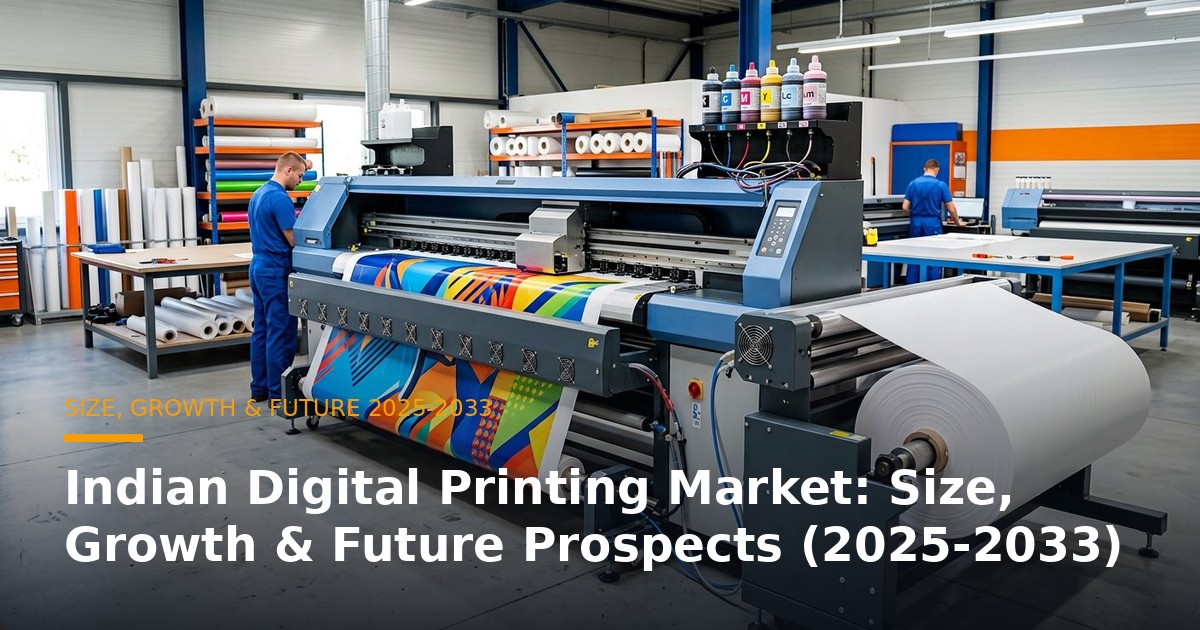
India’s digital printing industry has crossed a decisive threshold. What began two decades ago as a niche, import-dependent technology used mainly for signage and photo printing has become one of the fastest-growing segments of the country’s manufacturing, textile and creative economy. Driven by e-commerce, mass customisation, a booming direct-to-consumer (D2C) brand wave, and the digitisation of India’s enormous textile sector, digital printing in India is now expanding faster than almost any other major market in the world.
This guide breaks down the size of the Indian digital printing market, the segments driving it, the technology trends shaping it, and its future prospects through 2033 — with figures drawn from leading industry research houses, so print entrepreneurs, investors and business owners can understand where the opportunity lies.
How Big Is the Indian Digital Printing Market?
Estimates vary by research house and scope, but the direction is unanimous: strong, sustained double-digit-adjacent growth. According to IMARC Group, the India digital printing market reached roughly USD 1.4 billion in 2024 and is projected to reach USD 2.9 billion by 2033, a compound annual growth rate (CAGR) of about 7.8%. Grand View Research puts the market at USD 1,457 million in 2023, rising to USD 2,674 million by 2030 at a CAGR near 9.1% — making India the fastest-growing digital printing market in the Asia-Pacific region.
| Segment | Current Size | Forecast | CAGR |
|---|---|---|---|
| Overall digital printing (India) | ~USD 1.4B (2024) | ~USD 2.9B (2033) | ~7.8% |
| Digital textile printing (India) | USD 466.7M (2024) | USD 1,134M (2030) | 16.4% |
| Digital printing for packaging (India) | ~USD 2,202M (2024) | ~USD 3,562M (2029) | ~10.1% |
| Global digital textile printing | USD 5,800M (2024) | USD 11,596M (2030) | 12.7% |
The headline takeaway is clear: the Indian digital printing market is on track to roughly double within this decade, and certain segments — especially digital textile printing — are growing far faster than the overall market.
The Growth Engine: Digital Textile Printing
If there is one segment defining India’s digital printing story, it is digital textile printing. Grand View Research values India’s digital textile printing market at USD 466.7 million in 2024, forecast to reach USD 1,134 million by 2030 — a remarkable 16.4% CAGR, the highest of any major country. India is expected to be the fastest-growing digital textile printing market in the world, already accounting for around 8% of global revenue.
Several forces explain this. India has one of the world’s largest textile and apparel industries, a deep heritage of printed fabric (from block printing to rotary screen), and a massive shift under way from analogue screen printing to digital. Digital textile printing wins on short runs, design flexibility, faster turnaround and dramatically lower water consumption — exactly what today’s fast-fashion, home-textile and export buyers demand. Within the segment, direct-to-fabric is the largest process, while direct-to-garment (DTG) is the fastest-growing, fuelled by custom apparel and print-on-demand.
Segment-by-Segment Breakdown
Beyond textiles, the Indian digital printing market spans several high-growth application areas:
- Signage, graphics & flex printing: the original volume driver — hoardings, banners, backlit displays, vehicle wraps and retail graphics, powered by eco-solvent and solvent printers.
- Packaging & labels: one of the fastest risers. MarketsandMarkets pegs India’s digital printing packaging market at roughly USD 2.2 billion in 2024, growing at ~10.1% CAGR to 2029, driven by e-commerce, FMCG, pharmaceuticals and the demand for short-run, customised and sustainable packaging.
- Apparel & garment decoration: DTF, DTG and sublimation printing serving the custom t-shirt, team-wear, merchandising and fashion markets.
- Commercial & photo printing: catalogues, brochures, photo products and personalised print, increasingly produced on production inkjet presses.
- Industrial & specialty printing: décor (wallpaper, tiles, laminates), technical textiles, ceramics and electronics — an emerging, high-value frontier.
Across all of these, inkjet is the dominant and fastest-advancing technology, with UV-curable, eco-solvent, sublimation and water-based pigment inks each serving distinct applications.
Why India Is Outpacing the World
India’s digital printing growth is not accidental. A convergence of structural tailwinds is at work:
1. The e-commerce and D2C explosion. India’s e-commerce Gross Merchandise Value crossed roughly ₹4.96 lakh crore in 2023, and hundreds of D2C brands — more than 246 offering personalised products in early 2024 alone — depend on short-run, on-demand, customised printing that only digital can deliver economically.
2. Mass customisation. Consumers increasingly expect personalised products — from custom apparel and phone cases to bespoke home décor and packaging. Digital printing makes one-off and short-run production viable, turning personalisation into a mainstream business model.
3. Textile digitisation. With global brands demanding sustainability, shorter lead times and design variety, India’s vast textile sector is steadily converting from screen to digital — a multi-year tailwind with enormous runway.
4. Sustainability. Digital printing uses far less water, energy and ink than conventional methods and generates less waste. As environmental compliance tightens and buyers favour greener supply chains, digital’s low-impact profile is a decisive advantage.
5. Make in India and MSME momentum. Government manufacturing incentives, a growing MSME base and improving access to financing are bringing digital printing within reach of small and mid-sized print businesses across tier-2 and tier-3 cities.
Technology Trends Shaping the Future
The next decade of Indian digital printing will be defined by several technology shifts:
Faster, higher-quality inkjet. Industrial printheads — from Konica Minolta, Epson, Ricoh and others — keep raising speed and resolution while lowering cost per print, pushing digital into ever-higher-volume production.
DTF and DTG go mainstream. Direct-to-Film has democratised custom apparel printing with low entry costs, while DTG grows for premium, high-detail garment work. Both are fuelling the customisation economy.
UV and eco-solvent expansion. UV flatbed and roll-to-roll printing continues to grow across signage, packaging, décor and industrial applications, while eco-solvent remains the workhorse of the flex and graphics market.
Sustainable inks. Water-based pigment, latex and eco-solvent chemistries are gaining share as brands and regulators push for lower-VOC, greener production.
Automation and software. Web-to-print platforms, AI-assisted design, colour-management tools and workflow automation are reducing labour, cutting errors and making print businesses more scalable and profitable.
Future Prospects: 2025–2033
The outlook for Indian digital printing is among the brightest of any manufacturing segment. On current trajectories, the overall market is set to roughly double to around USD 2.9 billion by 2033, with digital textile printing more than doubling to over USD 1.1 billion by 2030 and packaging printing sustaining double-digit growth. Industry observers expect digital methods to capture a steadily rising share of total print volume — globally, digital is projected to account for a large and growing portion of textile printing within this decade.
Three structural opportunities stand out. First, export competitiveness: as global brands diversify sourcing toward India, digitally printed textiles, apparel and packaging positioned for speed and sustainability will win orders. Second, tier-2 and tier-3 expansion: falling equipment costs and financing are spreading digital printing beyond metros into smaller cities, unlocking a huge underserved demand base. Third, value-added specialty printing: industrial décor, technical textiles and functional printing offer higher margins than commodity signage.
For entrepreneurs, the message is that this is a growth market with room for new entrants — particularly those who combine the right technology with a clear niche, strong customer acquisition and operational discipline.
Challenges to Watch
The path is not without friction. Capital cost remains a barrier for micro-entrepreneurs, though entry-level DTF and eco-solvent setups have lowered the threshold significantly. A shortage of skilled operators and colour-management expertise can limit quality and uptime. Dependence on imported printheads, inks and components exposes businesses to currency and supply-chain swings. And intense price competition in commodity segments rewards those who differentiate on quality, service and niche focus rather than racing to the bottom. Businesses that invest in training, reliable equipment, genuine consumables and a defined market position are best placed to convert the market’s growth into durable profit.
What This Means for Print Businesses
For anyone running or starting a print business in India, the data points to a clear strategy: align with the growth segments (textile, packaging, custom apparel), adopt digital where it beats analogue (short runs, customisation, sustainability), and build a repeatable niche rather than competing on price alone. The businesses that thrive will be those that pair the right machine — matched to their volume, substrate and market — with genuine consumables, professional installation, operator training and dependable after-sales support.
Where UED Fits
Unified Engineering Dynamics (UED) supplies, installs and services a comprehensive range of digital printing technology across India — flex and eco-solvent printers, UV flatbed and roll-to-roll machines, DTF and textile printing solutions — backed by genuine printheads and consumables, professional installation, operator training and responsive after-sales support. Whether you are entering the custom-apparel boom, scaling a signage and graphics business, or moving into digital textile and packaging printing, UED helps you choose the right configuration for your market and budget, so your investment is positioned to grow with one of India’s fastest-expanding industries.
Regional Hotspots and the Spread Beyond Metros
Digital printing in India has historically concentrated in a few clusters — the textile belts of Surat, Tirupur, Jaipur and Ludhiana; the commercial print hubs of Mumbai, Delhi NCR and Chennai; and the signage and graphics markets of the major metros. But the next wave of growth is geographic. Falling equipment costs, easier financing and the reach of e-commerce are pushing digital printing into tier-2 and tier-3 cities, where demand for custom apparel, local signage, packaging and photo products is rising quickly and supply is still thin. For entrepreneurs, these smaller markets often offer better margins and less competition than saturated metros, because customers value local turnaround and personal service. Establishing an early, well-equipped presence in a growing regional market can build a durable customer base before larger competitors arrive.
The Role of Exports in India’s Digital Printing Future
Exports are set to be a major accelerant for Indian digital printing. As global apparel, home-textile and packaging brands diversify their sourcing away from single-country dependence, India is a prime beneficiary — and these buyers increasingly specify digital production for its design flexibility, short lead times and lower environmental footprint. Digitally printed fabrics, garments, made-ups and packaging that meet international sustainability and quality standards can command premium export orders. Print businesses that invest in colour accuracy, certification-friendly inks, consistent quality and reliable delivery are best positioned to tap export demand, which typically offers larger orders and better margins than purely domestic commodity work.
Financing and Entry Costs Are Falling
One of the most important enablers of India’s digital printing boom is that the cost of entry keeps dropping. Where production digital printing once required capital out of reach for most small businesses, today an entrepreneur can launch a credible custom-apparel operation with a DTF setup for a few lakh rupees, or a signage and graphics business with an entry-level eco-solvent printer. Equipment financing, government schemes supporting MSMEs and manufacturer support have further lowered barriers. This democratisation means the market’s growth is being driven not only by large players but by thousands of small and mid-sized businesses entering with focused niches — which is exactly how a market roughly doubles in a decade.
Frequently Asked Questions
What is the size of the digital printing market in India?
Estimates put India’s digital printing market at roughly USD 1.4 billion in 2024, projected to reach around USD 2.9 billion by 2033 (about 7.8% CAGR), with some research houses forecasting near 9% growth to 2030.
Which segment is growing fastest?
Digital textile printing is the standout, growing at about 16.4% CAGR to 2030 — the fastest of any major country — followed closely by digital packaging printing at roughly 10% CAGR.
Why is India growing faster than other markets?
A combination of e-commerce and D2C growth, mass customisation, the digitisation of India’s huge textile industry, sustainability demand, and Make-in-India support for MSMEs.
Is digital printing a good business to enter in India?
Yes. It is a growing market with accessible entry points (especially DTF and eco-solvent), strong demand for customisation, and multiple high-growth niches — provided you pick the right machine, target a clear niche and focus on quality and service.
What technology should a new print business start with?
It depends on your target market: DTF for custom apparel, eco-solvent for flex and signage, UV for rigid and specialty substrates, and sublimation or pigment textile printing for fabric. Match the technology to your products and volume.
Planning to enter or expand in digital printing? Unified Engineering Dynamics (UED) supplies, installs and services the full range of digital printing technology across India — flex, eco-solvent, UV, DTF and textile printers. Talk to our specialists about the right machine for your market and budget. Request a quote →
Market figures cited on this page are drawn from published industry research (IMARC Group, Grand View Research, MarketsandMarkets and others) and are indicative. Different research houses use different scopes and base years, so estimates vary. Always validate figures against the latest primary reports for investment decisions.
