



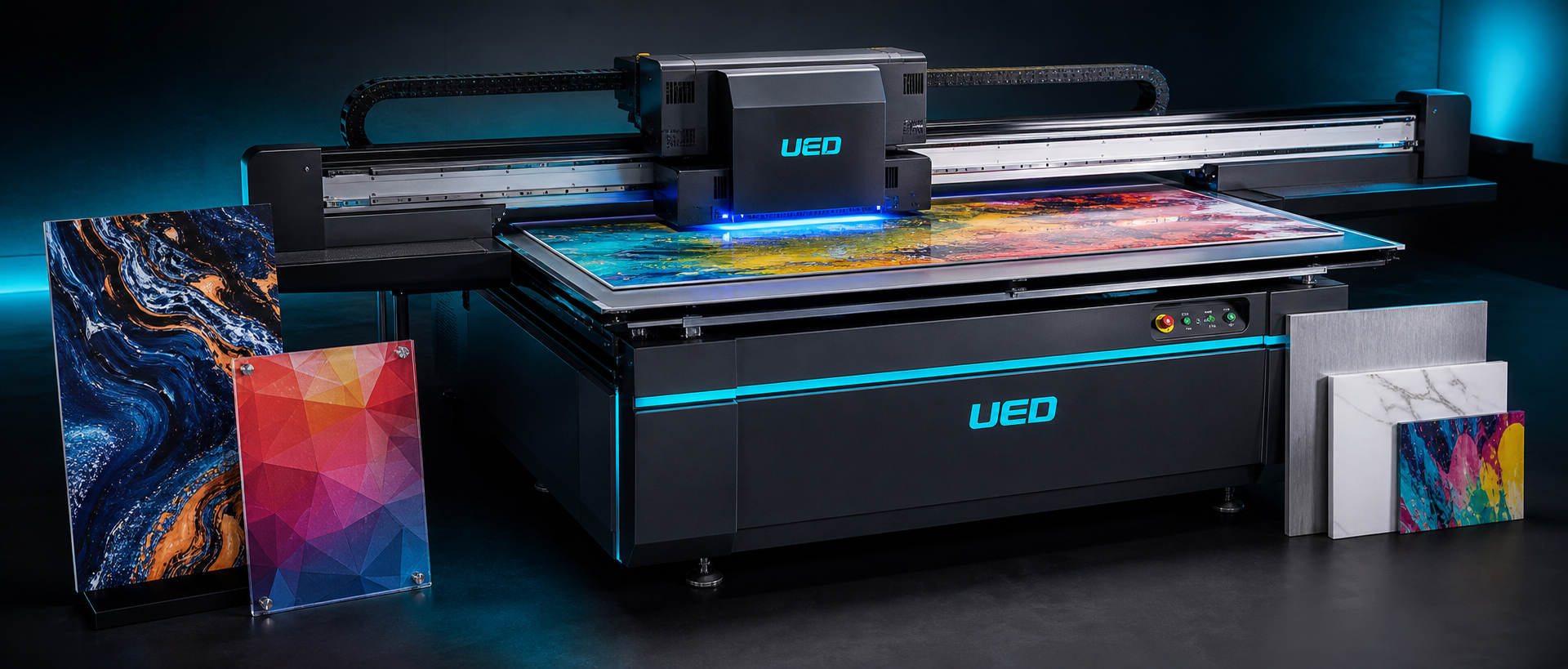
The “best” UV flatbed printer is not the biggest or the most expensive — it is the one whose bed size, heads and options match the products your business sells and the support your region offers. This 2026 guide defines best-for in the Indian context, maps the winning classes from desktop gift printers to large production beds, and gives a checklist so you can evaluate any flatbed and choose with confidence.
Best-for, not best: fix your three inputs
Before comparing models, fix your daily finished-piece volume, your product mix (gifts, signage boards, décor, industrial) and your regional support options. A gift studio’s best flatbed is a compact white-ink bed; a signage shop’s best is a 4×8 ft white+varnish bed; an industrial printer’s best is a large bed with industrial heads. The three inputs narrow the field faster than any spec sheet.
The winning classes in India in 2026
- Desktop/A3–A2 object printers: best for focused gifting and personalisation startups; low cost, strong per-piece margin.
- 60×90 cm beds: best for small signage, awards and décor where boards are cut down.
- 1.2×2.4 m (4×8 ft) beds: best for signage and décor shops; matches standard sheet sizes and carries white+varnish premium work.
- 2×3 m+ production beds: best for panel, ACP and industrial volume where uptime and size matter.
What makes a flatbed “best”
- Bed flatness and vacuum: decide rigid print quality and double-sided registration.
- Height sensing and Z-clearance: protect heads and enable thick objects.
- White and varnish: create the premium décor and signage finishes.
- Frame rigidity: keeps registration across a large sheet over years.
- Support and spares: local engineers and response time are part of the product.
Printhead choice for flatbeds
As with roll-to-roll, i3200-based flatbeds are the best balance for signage, décor and gift volumes: excellent quality at moderate head cost with wide availability. Konica and Ricoh industrial heads are best only at high daily volume and industrial work where uptime pays. Choose by volume; over-speccing heads on a décor business is wasted capital.
Options that make it “best” for your products
The options should follow the product strategy: white ink for dark/transparent substrates, varnish for finish and protection, a rotary attachment for drinkware, pin/vacuum registration for double-sided boards, and extended Z-height for thick objects. A flatbed configured to your chosen families earns far more than a bigger but plainer bed, because options open sellable products while size only opens capacity.
Support: the decisive Indian factor
A flatbed must be installed level, profiled and serviced; the best machine is one whose supplier commissions properly and responds fast in your region. Check regional references, spares availability and training inclusion. A good bed with weak support underperforms a solid bed with strong support, because rigid work is deadline-driven and downtime is lost revenue and reputation.
Running cost and best value
Best value on a flatbed is highest contribution per finished piece at your volume. Model ink, varnish, substrate, waste and prep labour per piece for your top products and compare candidates. A machine with better vacuum and registration wastes fewer sheets and reprints, so its higher sticker can be the cheaper choice per good piece.
Buying checklist for the best flatbed
- Fix bed size from your largest common sheet, not the largest you can afford.
- Inspect bed flatness, vacuum strength and height sensing on a live demo.
- Insist on a printed, adhesion-tested sample on your substrates.
- Get head price, life and availability in writing.
- Confirm white/varnish/rotary options you need for your product families.
- Verify installation, training, warranty and service response inclusions.
Common “best flatbed” mistakes
- Buying the biggest bed instead of the size your jobs need.
- Skipping white/varnish, then missing the premium décor market.
- Ignoring vacuum and registration that decide rigid quality.
- Choosing on price over support geography.
- Under-budgeting primers, jigs and packing for the rigid workflow.
Frequently asked questions
What is the best flatbed size for a signage shop?
Usually 1.2×2.4 m (4×8 ft), matching standard acrylic, ACP and foam sheets, so boards print whole without cutting and re-handling.
Is a small A3 flatbed “best” for gifts?
For a focused gifting business, yes — low entry, high margin. Plan the upgrade to a larger bed when signage demand arrives.
Do I need industrial heads to be competitive?
Only at high volume. For décor, signage and gifts, i3200 quality at moderate head cost is the competitive choice.
A deeper look: spec-first selection for flatbeds
As with roll-to-roll, invert the process: write the product plan first — families, monthly piece counts, selling prices, payback target — then derive bed size from job sizes, heads from volume, and options from families. Shortlist beds that meet the spec and compare on support and contribution per piece. Spec-first selection prevents the two classic errors, over-sized beds and under-optioned machines, and lands on the flatbed that is genuinely best for your business.
A deeper look: the demo that reveals a flatbed’s truth
Bring your own substrates — acrylic, MDF, glass, metal — and print them, not the vendor’s showcase stock. Check edge sharpness at the bed corners, double-sided registration, white opacity on dark acrylic and varnish finish. Watch how the operator primes and handles sheets; that discipline is what you are buying into. Measure a real job end to end including prep. The demo’s evidence, gathered on your materials, is the only reliable predictor of how the bed will earn in your shop.
Best by business type: four archetypes
For a focused gifting and personalisation startup, the best is a desktop or 60×90 cm white-ink bed: low entry, strong per-piece margin, and the object range to build a catalogue. For a signage shop, the best is a 1.2×2.4 m i3200 bed with white and varnish and pin registration, matching standard sheets and premium boards. For an interior décor studio, the best is a 60×90 to 4×8 bed with white, varnish and good Z-height for glass, wood and acrylic. For an industrial and panel printer, the best is a 2×3 m+ bed with industrial heads and adhesion support, where uptime and size dominate.
Total cost of ownership as the tiebreaker
When two beds both fit, TCO decides. Add purchase, installation, training, a year of ink, varnish and substrates at your volume, expected waste from strikes and adhesion failures, maintenance and one head replacement; divide by good finished pieces for cost per piece per candidate. The lower figure is the better buy even at a higher sticker, because vacuum, registration and stability reduce waste that quietly eats margin. Bring TCO to the negotiation; it shifts the conversation from discount to value.
Warranty and service contracts: read the fine print
For a flatbed, clarity on heads, lamps, vacuum and sensors in the warranty matters, as does a stated response time and a commissioning visit that levels and profiles the bed. Understand exclusions and local spares. A flatbed is installed, not just delivered, so the service commitment is part of the product; the best buy pairs solid hardware with enforceable, well-defined support, because rigid work is deadline-driven and ambiguity costs reputation.
RIP and software: the underrated half of “best”
Flatbed quality and throughput lean on the RIP: white-layer and varnish control, colour profiles per substrate, nesting for ganged small items and double-sided registration workflows. Confirm the included RIP, that profiling for your substrates happens at install, and how jigs and templates are managed. A strong RIP lifts a mid bed above a superior bed with weak software, so demo the software on a real ganged job, not just a single showcase print.
Future-proofing your flatbed choice
Choose a platform that can grow: options addable later (white, varnish, rotary), heads that stay available, and a supplier ecosystem that keeps evolving media and ink support. A bed locked to a dead head or narrow options becomes stranded as your product families expand. The best buy is one that can still open next year’s products, so check the roadmap and ecosystem before committing capital.
Financing the best bed without over-leveraging
Fold the repayment into the TCO and stress-test at half utilisation; the best bed is one whose pessimistic-case contribution still services the instalment while leaving margin for heads, primers and consumables in year one. Because a flatbed’s payments are fewer and larger than a roll-to-roll’s, match the term to that shape and keep a buffer so a slow quarter never forces deferred maintenance. Financing discipline is part of choosing well.
New versus used in the search for best
A used flatbed can be best value as a second capacity bed from a trusted source, but as a first machine it is risky: bed flatness, vacuum and height sensors are hard to judge and are exactly what decide rigid print quality. Insist on a printed, adhesion-tested demo on your substrates, head-hour logs and a commissioning warranty if buying used; otherwise new with proper installation is the best risk-adjusted first buy.
Planning the second machine from the first
Choose the first flatbed with the second machine in mind. A flatbed first builds décor and signage margin; the natural second is a roll-to-roll to serve those clients’ banner and vinyl needs. Track declined flexible work from day one, and when it reaches steady weekly value, add the roll-to-roll funded by proven demand. A two-machine plan keeps each purchase purposeful and the platform growing deliberately.
Regional market nuances across India
Regional demand shapes the best bed: metros favour premium décor, retail and corporate work that rewards white and varnish; tier-2 and tier-3 markets favour signage boards and gifting at value price points; industrial belts add panel and identification work that rewards size and durability. Read your city’s mix and the local support network before choosing class and options, so the bed you buy matches the market that pays for it.
The verdict in one line
Across classes, the pattern holds: the best UV flatbed for most Indian signage and décor businesses in 2026 is a 4×8 ft i3200 bed with white and varnish and solid registration, from a supplier that commissions and supports it locally; gifting startups do best on a compact white-ink bed, and industrial printers on a large industrial-head bed. Choose spec-first, compare on contribution per piece and support, and decide on a demo run with your own substrates.
Hold that discipline through the purchase and the first year — spec first, support verified, demo on your substrates, TCO compared — and the bed you crown the best will earn that title in your shop, board after board, season after season.
And when demand proves the next step, the same framework — job sizes, product families, support, TCO — will choose the second machine as confidently as it chose the first, keeping the platform growing on evidence rather than ambition.
That is the whole of choosing well: evidence over brochure, support over gloss, options that open products, and a bed matched to the market that already pays for it.
Apply it and the 2026 shortlist stops being a lottery: the bed that matches your job sizes, families and support, verified on your substrates, is the one that will still look like the best buy five years from now.
Buy on that evidence, not on the demo-day gloss, and the flatbed becomes the dependable margin engine your signage or decor business was missing.
Make the checklist your contract and the demo your proof, and the purchase becomes a decision you can defend.
Then run it well, and let proven demand choose the next step.
Conclusion
The best UV flatbed printer in India in 2026 is the bed sized to your real jobs, headed for your volume, and optioned with the white, varnish and rotary your product families need — backed by a supplier who commissions and supports it in your region. For most signage and décor businesses that is a 4×8 ft i3200 bed with white and varnish; for gifting, a compact white-ink bed; for industry, a large industrial-head bed. Compare on contribution per piece and support, and demo on your substrates. Explore our UV flatbed range or request a demo.
