



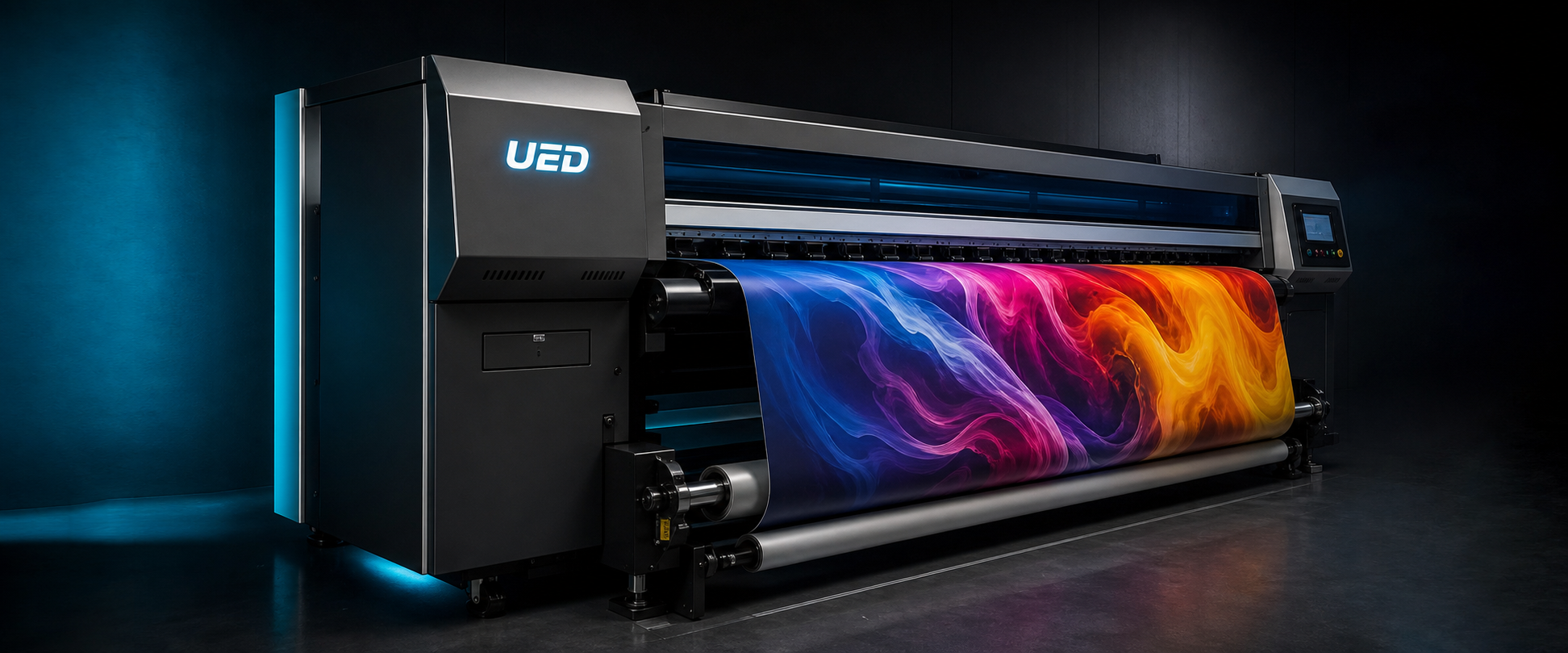
UV roll-to-roll printer prices in India in 2026 span a wide band — from compact single-head machines for a first shop to wide-format multi-head production lines — and the sticker price is only the entry to the real cost. This guide explains what actually drives the price, gives indicative 2026 brackets by width and configuration, and shows how to compare quotes and total cost of ownership so you buy the right machine at the right number. All prices are indicative market ranges in INR, ex-works, and vary by configuration, heads, ink set and supplier; always confirm a written quote.
What drives the price of a UV roll-to-roll printer
Four factors dominate the price: print width, printhead configuration, ink channels (white and varnish), and build quality of the media-handling system. Width is the base: a 1.6–1.9 m machine costs less than a 3.2 m line. Heads multiply the price: a single Epson i3200 is far cheaper than dual i3200s or Konica/Ricoh industrial heads. Adding white and varnish channels adds both hardware and ink-system cost. And a robust tension, tracking and take-up system — the part that decides roll quality — separates budget builds from production builds. Understanding these levers lets you read any quote.
Indicative 2026 price brackets by class
- Entry (1.6–1.9 m, single i3200/XP600-class head, CMYK): roughly ₹6–12 lakh. Suits a first shop doing banners, stickers and vinyl at moderate volume.
- Entry plus white (same width, +white): roughly ₹10–16 lakh. Unlocks stickers on clear vinyl and backlit work.
- Mid (1.9–3.2 m, dual i3200, CMYK+W+V): roughly ₹18–35 lakh. The workhorse band for advertising producers.
- Production (3.2 m, multi i3200 or Konica/Ricoh heads, full channels): roughly ₹40 lakh–1 crore+. For high-volume and industrial flexible printing.
These are market indications for 2026; the same width can vary by tens of percent on head brand and build. Treat them as a compass, not a price list.
Printheads: the biggest price and running-cost lever
Head choice sets both purchase price and economics. Epson i3200-based machines dominate the value segment: good quality at moderate head cost, ideal for most advertising work. XP600-based budget machines are cheaper but shorter-lived. Konica and Ricoh industrial heads cost more upfront and per head but deliver higher uptime, longer life and better consistency at production volumes. The right head is a function of your daily volume: low-to-mid volume favours i3200 value; high volume favours industrial heads. Ask for head price and expected life in every quote, because heads are the largest recurring cost.
White ink and varnish: the adders that create margin
A CMYK-only machine is cheaper but cannot print white, which closes off the highest-margin flexible products: clear-vinyl stickers, day-night backlit, window films and high-opacity prints on coloured media. Adding white typically adds a few lakh and requires a circulation system; varnish adds further. Because white-enabled products carry premium prices, the white option usually pays for itself quickly in an advertising or signage business. If your market wants premium flexible products, budget for white from the start rather than retrofitting.
Running cost: ink, media and cost per square metre
Beyond the machine, model the running cost: UV ink per ml, media cost per square metre, and waste. UV ink is costlier than eco-solvent per ml but removes lamination on many jobs. Build a cost-per-sellable-square-metre for your top products and compare it against your selling price to see the true margin at each machine class. A cheaper machine with poorer yield or more waste can cost more per good square metre than a pricier, more stable one.
Hidden and first-year costs to budget
- Installation, training and a service contract.
- RIP software and colour profiling (sometimes bundled, sometimes extra).
- Media stock (flex, vinyl, backlit) and finishing tools (trimmer, laminator, grommets).
- Spare heads, dampers, filters and white-ink consumables.
- Power conditioning and, where needed, extraction/ventilation.
- Working capital for the first months of media and ink.
New versus used machines
A used UV roll-to-roll can halve the entry cost, but UV machines age in heads, lamps and media-path wear, and a used machine without service history is a gamble. If buying used, insist on head-hour logs, a printed test banner, lamp-hour records and a warranty or commissioning visit from the supplier. Often a new entry machine with warranty and support is the safer first buy; used makes sense for a second, capacity machine from a trusted source.
Financing and payback
Most buyers finance, so match the term to the machine’s cash-flow shape and stress-test at half utilisation. An entry UV RTR in a busy advertising market can recover its cost through volume within a couple of years; a production line needs assured volume contracts. Model the instalment against realistic monthly contribution, not optimistic projections, and keep a cash buffer for heads and maintenance in year one.
UV roll-to-roll price versus eco-solvent
Entry eco-solvent machines are cheaper than entry UV roll-to-rolls, which is why eco still owns commodity banner volume. UV costs more upfront and per ml of ink but adds white ink, no-lamination turnaround and a wider, premium media range. The comparison is not which is cheaper but which earns more on your order mix: commodity volume favours eco; premium and same-day favours UV. Many shops budget for eco now and UV as the margin upgrade.
How to get an accurate, comparable quote
- Fix the spec first: width, heads, channels (CMYK/W/V), media list.
- Ask for head brand, head price and expected life in writing.
- Ask what is included: RIP, profiling, installation, training, warranty, service response.
- Request a printed sample on your media, costed per square metre.
- Compare total first-year cost, not just the machine price.
Common pricing mistakes buyers make
- Comparing only sticker price, ignoring heads, white and first-year consumables.
- Buying CMYK-only to save, then losing the premium white-ink market.
- Over-buying width or heads for demand that does not yet exist.
- Buying used without head-hour logs and a commissioning warranty.
- Ignoring service response time, which is downtime cost in season.
Frequently asked questions
What is a realistic starting budget for a UV roll-to-roll in India?
For a capable single-head machine with white, plan roughly ₹10–16 lakh ex-works plus installation, media stock and working capital. A CMYK-only entry machine starts lower.
Does a wider machine always cost proportionally more?
Not strictly; width adds cost, but heads and channels add more. A 3.2 m single-head can be cheaper than a 1.9 m dual-head with white and varnish.
Are prices falling in 2026?
Entry-segment prices have eased as i3200-based builds matured, while industrial-head production lines hold value. Expect continued value at the entry end and stability at the top.
A deeper look: a total-cost-of-ownership worksheet
Build a simple three-year TCO per candidate: purchase + installation + training; add annual ink, media, waste, maintenance, spares and one head replacement; add financing cost; divide by realistic good square metres per year to get cost per good square metre. Then compare against your selling prices. The machine with the lowest cost per good square metre at your volume — not the lowest sticker — is the cheapest machine. Re-run it whenever ink or media prices move, and use it to negotiate, because suppliers respond to buyers who compare on TCO.
A deeper look: negotiating a UV roll-to-roll deal
Negotiate on the whole package, not the machine line: ask for bundled RIP and profiling, free installation and training, a first-year service commitment with response time, consumable pricing locked for a period, and a spare-head deal. Time the purchase to the supplier’s quarter-end or a trade show for better terms. Get every inclusion in writing. A slightly higher price with strong support and locked consumables usually beats the lowest price with thin support, because in season the cost of a day’s downtime exceeds the negotiated discount.
Maintenance cost by machine class
Maintenance spend scales with class and utilisation. Entry single-head machines need routine head cleaning, dampers and filters plus an occasional head, a modest annual figure. Mid dual-head machines with white add white-system consumables and a second head to the budget. Production lines with industrial heads carry higher per-head costs but longer intervals, plus lamp and media-path service. Budget a percentage of revenue for maintenance per class and hold a spare-head policy matched to your season, because an unplanned head in peak season is both a parts cost and a lost-revenue cost.
Regional price variation and where to buy
Prices vary by region and channel: metro distributors with showrooms and engineers may quote higher but include support that inland buyers value; direct-from-importer pricing can be lower but shifts support risk to you. Freight, installation travel and local service coverage all affect the real landed cost, so compare quotes on a delivered-and-commissioned basis in your city. A machine a few percent cheaper from a supplier with no local engineer can cost far more in downtime than the saving, so weigh support geography heavily.
When to upgrade your roll-to-roll
Upgrade signals are operational, not aspirational: regularly declining wide or high-volume jobs, white-ink demand you cannot serve, or heads at capacity through the season. The right upgrade adds the specific capability that is constraining revenue — width, a second head, white, or an industrial head for uptime — rather than a blanket bigger machine. Because the first machine retains value if maintained, plan the upgrade as a trade-in or a second capacity line so both keep earning.
Budgeting for the ecosystem, not just the printer
A roll-to-roll is the centre of a small production ecosystem: RIP workstation, finishing bench, laminator, media racking, power conditioning and a clean, lit workspace. Budgeting only the printer leaves the ecosystem unfunded and slows the business. Including these line items in the initial plan means the machine can actually run at the throughput its price promises, and it prevents the common experience of a capable printer idling behind an under-funded finishing area.
A worked example: costing a mid-range UV roll-to-roll
Take a 1.9 m dual-i3200 machine with white and varnish quoted at ₹24 lakh ex-works. Add installation and training ₹1 lakh, RIP and profiling (if not bundled) ₹1–2 lakh, first media stock ₹2–3 lakh, and a year-one consumables and spares buffer ₹2 lakh. First-year outlay is roughly ₹30–32 lakh. If it produces, say, 1,500 good square metres a month at a net contribution of a few hundred rupees per square metre, annual contribution can approach or exceed the outlay within a couple of years at realistic utilisation — which is why the mid band is the advertising workhorse. Run your own numbers; the structure matters more than the example figures.
The cheapest machine is the one that matches your volume
Across all brackets, the recurring lesson is that the cheapest machine is the one matched to your actual volume and product mix. An under-specced machine loses revenue at the margin; an over-specced machine ties capital that earns nothing. Use your order book, the TCO worksheet and a pessimistic utilisation case to land on the configuration that your demand already pays for, and let proven growth — not ambition — fund the next step up.
Bring your TCO worksheet to every negotiation and insist on written inclusions; a buyer who compares total cost and support, not stickers, is the buyer suppliers take seriously — and the one who ends up with the machine that actually earns.
Finally, remember that prices move and configurations evolve, so treat any 2026 figure as a planning anchor rather than a promise. Re-check current quotes against the brackets here, keep the TCO model current, and you will buy at the right time with the right specification for your market.
Conclusion
UV roll-to-roll prices in India in 2026 range from around ₹6 lakh for a CMYK entry machine to well over ₹1 crore for industrial production lines, with the value sweet spot for advertising businesses in the ₹10–35 lakh band once white and varnish are included. Read quotes by heads, channels and support; model cost per good square metre; and buy the configuration your order mix already pays for. Explore our UV roll-to-roll printer range or request a configured quote.
