


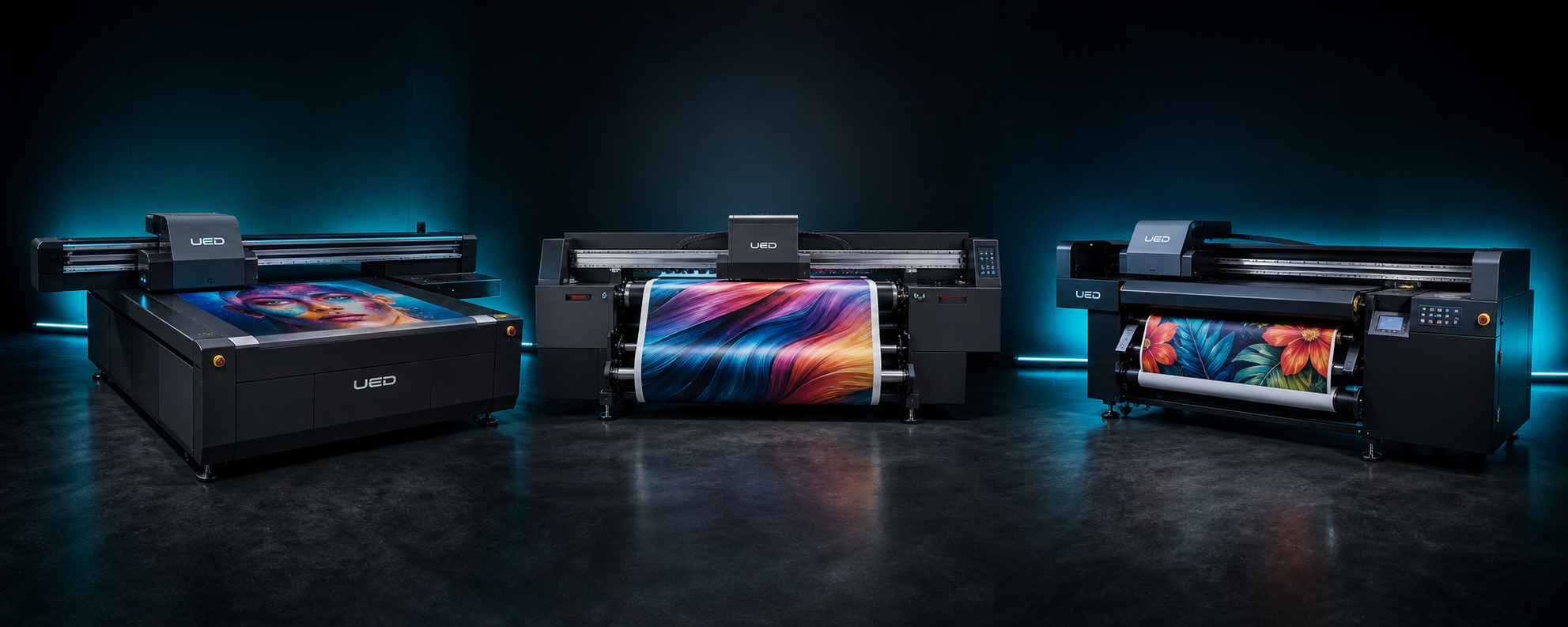
Stand in front of three UV printers — a flatbed, a roll-to-roll and a hybrid — and the spec sheets blur. Yet they serve different strategies, and buying the wrong one is the most common capital mistake in this industry. This guide defines each architecture plainly, weighs their strengths and trade-offs, and gives a decision framework — by media mix, budget, space and growth path — so you can say with confidence which UV printing machine you should buy.
The three architectures, plainly defined
A UV flatbed printer holds rigid sheets and objects stationary on a vacuum bed while the carriage prints across them — acrylic, glass, wood, metal, tile, foam board, gifts. A UV roll-to-roll printer feeds flexible media from a roll and prints continuously — banner, vinyl, backlit flex, stickers, wallpaper. A UV hybrid printer combines both on one frame: a belt or bed that accepts rigid boards while also feeding rolls, so one machine covers both media forms. Each is excellent at its core job; the question is which core job your business needs.
Flatbed: strengths and limits
The flatbed’s strength is value: it prints the rigid and three-dimensional work that commands premium prices — signage, décor, personalisation, industrial panels. Its limits are throughput on flexible media (poor) and footprint (large). If your market buys finished rigid pieces, the flatbed is the margin engine. If your market buys metres of banner, a flatbed is the wrong tool and will sit underused.
Roll-to-roll: strengths and limits
The roll-to-roll’s strength is volume: continuous, wide, fast printing of flexible advertising media with instant cure and no lamination. Its limits are rigid media (none) and thinner per-metre margins. If your market is advertising and signage volume, the roll-to-roll is the cash-flow engine. If your market is décor and personalisation, it cannot serve them.
Hybrid: the versatile compromise
The hybrid’s strength is coverage: one machine, one footprint, both media forms — ideal where space or capital allows only one machine but the market demands both. Its trade-offs are that it is usually costlier than a single-purpose machine, can be more complex to operate and maintain, and may not match a dedicated machine’s top performance in either mode. The hybrid is a strategic compromise, not a free lunch: it buys flexibility at a price.
Decision factor 1 — your media mix
The single most important input is the ratio of flexible to rigid work in your real order book. If 80% is flexible, buy a roll-to-roll. If 80% is rigid, buy a flatbed. If the split is near 50/50 and will stay that way, a hybrid is rational. If the split is 50/50 but you expect one side to grow, buy the machine for the growing side and plan the second. The media mix, measured from actual enquiries, should overrule every other consideration.
Decision factor 2 — budget
On a tight budget, buy the single-purpose machine that matches your dominant media; it gives the best performance per rupee and the fastest payback. A hybrid costs more than either single machine, so it suits a budget that can absorb the premium for versatility. If the budget allows two machines over time, buy the dominant-side machine now and the other when demand proves — this staged path usually beats buying a hybrid and then still needing a second dedicated machine.
Decision factor 3 — space
Space can force the decision. A roll-to-roll needs length for media; a flatbed needs a large flat footprint and board storage; a hybrid needs both to a degree but less total floor than two machines. In a small shop, the hybrid’s single footprint is a genuine advantage. In a large workshop, two dedicated machines use space more profitably. Measure the floor, including finishing and storage, before choosing.
Decision factor 4 — growth path
Think about the second machine from day one. If you start with a roll-to-roll for advertising volume, the natural second is a flatbed to capture rigid signage and décor margin from the same clients. If you start with a flatbed for décor, the second is a roll-to-roll to serve those clients’ banner and vinyl needs. A hybrid can be the first machine that you later pair with a dedicated unit as volume grows. Choosing with the second step in mind avoids dead-end purchases.
Application mapping: which machine wins which job
- Banners, hoardings, vehicle graphics, window film, stickers — roll-to-roll.
- Backlit lightbox media and wallpaper — roll-to-roll (or hybrid).
- Acrylic, glass, wood, metal, tile signage and décor — flatbed.
- Gifts, awards, phone cases, objects — flatbed.
- Foam board and rigid exhibition panels — flatbed (or hybrid).
- Mixed small-shop general signage — hybrid.
White ink and varnish across the three
All three can be configured with white and varnish, but their importance varies. Roll-to-roll white enables stickers and backlit; flatbed white and varnish enable premium rigid finishes; a hybrid needs both capabilities to be genuinely useful, so verify the hybrid’s white and varnish are not compromised. Because white is the highest-maintenance channel, compare white-ink systems as seriously as bed size or width.
Speed and throughput compared
For pure flexible volume, a dedicated roll-to-roll is fastest. For pure rigid value, a dedicated flatbed is most efficient. A hybrid sits between: adequate at both, supreme at neither. If one media type dominates your volume, the dedicated machine for it will out-earn the hybrid. If your work is genuinely mixed and moderate, the hybrid’s single-pass versatility wins on floor economics.
Cost compared: machine, ink, media
Single-purpose machines give the lowest cost per capability; the hybrid carries a premium for combining two. Ink cost per square metre is similar across all; media cost differs by form (flexible cheap, rigid costlier) and so does selling price. The honest comparison is contribution margin per hour on your actual jobs, not purchase price alone. Run your three candidate machines against your five most common jobs and compare the numbers.
Who should buy a flatbed first
Studios, gift and personalisation shops, interior-focused sign makers and industrial printers should buy a flatbed first: their markets buy rigid, high-value, personalised pieces and pay premiums that a flatbed uniquely serves. The flatbed-first path builds margin and differentiation before adding volume capability.
Who should buy a roll-to-roll first
Advertising producers, banner and hoarding shops, vehicle-graphic studios and high-street signage shops should buy a roll-to-roll first: their markets buy flexible media by the metre, daily, and the roll-to-roll’s speed and low media cost match that demand. The roll-first path builds cash flow before adding value capability.
Who should buy a hybrid
A hybrid suits a general sign shop with a balanced but moderate mix of flexible and rigid work, limited floor space, and a budget for one versatile machine rather than two. It also suits a business testing which side will grow before committing to dedicated machines. It is the pragmatic choice when versatility matters more than peak performance.
Upgrading without waste
Plan so the first machine stays productive after the second arrives. A roll-to-roll remains the volume engine once a flatbed is added; a flatbed remains the margin engine once a roll-to-roll is added; a hybrid can shift to whichever mode dominates while the new dedicated machine takes the other. Buying with this division of labour in mind keeps every machine earning and avoids the stranded-asset mistake.
Common mistakes in choosing among the three
- Buying a hybrid expecting it to equal two dedicated machines, then hitting its compromises.
- Buying on the media you like rather than the media your market buys.
- Ignoring space and finishing requirements until installation.
- Underestimating white-ink maintenance on any platform.
- Buying the second machine before the first has proven the demand for it.
Frequently asked questions
Is a hybrid good enough for serious rigid work?
Yes for boards and panels; for heavy objects and high-end finishes a dedicated flatbed is better. Judge by your rigid mix’s sophistication.
Will I outgrow a hybrid?
Often, on the volume side. Many shops keep the hybrid for rigid or mixed work and add a dedicated roll-to-roll for banner volume.
Which is cheapest to start?
Usually a single-purpose machine matching your dominant media; the hybrid costs more but replaces two.
A deeper look: three real-world scenarios
Scenario one — a busy advertising shop: enquiries are 80% banner and vinyl. Buy the roll-to-roll; add a flatbed in year two for rigid signage margin. Scenario two — a décor and gift studio: enquiries are 80% rigid and personalised. Buy the flatbed; add a roll-to-roll later for clients’ flexible needs. Scenario three — a compact general sign shop: a 50/50 mix, small floor, one-machine budget. Buy the hybrid, run both modes, and let the growing side justify the first dedicated addition. These archetypes cover most real decisions, and each follows the same rule: let the order book choose.
A deeper look: the total cost of ownership view
Purchase price is only the entry. Add installation, finishing equipment, consumables (ink, white, varnish, primers, media), maintenance contracts, spare heads, and the labour each workflow needs. A roll-to-roll adds finishing and installation cost; a flatbed adds preparation and packing cost; a hybrid adds complexity and training cost. Spread these over realistic annual volume and you get a true cost per sellable unit per machine. The machine with the best contribution after total cost — not the cheapest sticker price — is the one to buy.
Operator skill and training across the three
Each platform asks for a slightly different operator. Roll-to-roll work rewards speed, neat media loading, tension awareness and tidy finishing; mistakes show as banding or wrinkled media. Flatbed work rewards preparation discipline — cleaning, priming, head-height and careful handling of heavy sheets; mistakes show as adhesion failures and strikes. A hybrid asks for both skill sets in one operator, which is a hidden cost: training and SOPs must cover two workflows. Factor the learning curve and the standard operating procedures into your choice, because a versatile machine with an untrained operator underperforms a dedicated machine with a confident one.
Financing, risk and the pessimistic case
Most buyers finance or stretch for these machines, so test each option against a pessimistic year. A roll-to-roll’s risk is margin compression in a competitive banner market; a flatbed’s risk is low utilisation in a market that does not yet value rigid work; a hybrid’s risk is paying a versatility premium while the business actually specialises. Model each at half the expected volume and confirm it still services its cost. The option that survives the bad year is the one that will not jeopardise the business in a slow one, and that resilience is worth more than peak-year upside.
A simple decision worksheet
- List three months of enquiries; total flexible revenue vs rigid revenue.
- Score your floor space for roll length vs flat footprint vs one hybrid footprint.
- Score your team’s skill toward finishing-speed vs prep-discipline.
- Price all three candidates with consumables and finishing for a year.
- Run each at 50% volume; keep the ones that still pay.
- Choose the survivor that matches your dominant media; plan the second.
In the end, the right machine is the one your customers already pay for, sized to the space you have and stress-tested against a slow year. Choose with evidence, plan the second step, and the printer becomes an investment rather than a gamble.
Remember too that whichever architecture you choose, the fundamentals of UV printing still apply: reliable white ink, disciplined maintenance, honest durability claims and careful media handling. A well-chosen machine operated well will out-earn a perfect machine operated casually, so invest in training and process as seriously as in hardware.
Conclusion
Flatbed, roll-to-roll and hybrid are three strategies: value, volume and versatility. Measure your media mix, budget, space and growth path; let the dominant media pick the first machine; and choose the hybrid only when versatility genuinely outweighs peak performance. Done this way, the machine you buy is the one your market already pays for. Explore the digital UV printer range or contact us to walk through your numbers before you invest.
