



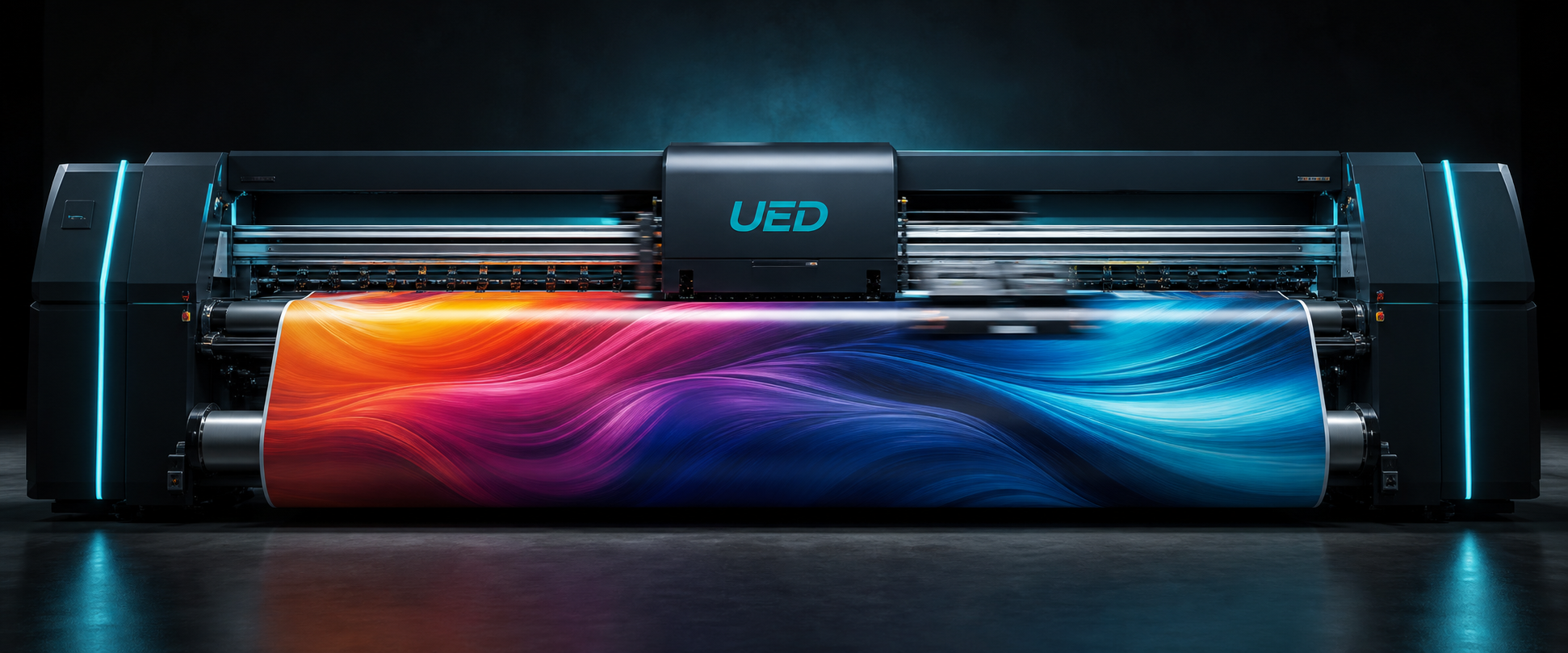
Search “best UV roll-to-roll printer” and you will get a wall of model numbers; ask “best for my business” and the answer becomes clear, because the best machine is the one whose specification matches your volume, products and support needs. This 2026 guide defines what “best” means for an Indian business, breaks the market into the classes that actually win, and gives a checklist to evaluate any machine so you can choose with confidence.
There is no single best — there is best-for
The best UV roll-to-roll for a first-time banner shop is not the best for a high-volume advertising producer or a premium sticker studio. “Best” is always relative to three inputs: your daily square-metre volume, your product mix (commodity banner versus white-ink premium), and the service support available in your region. Fix those three first and the field of “best” narrows quickly.
The classes that win in India in 2026
- Value entry (1.6–1.9 m, single i3200): best for a first shop doing banners, vinyl and stickers at moderate volume; low entry cost, proven heads.
- Entry plus white: best for sticker and backlit studios that need white ink without production-level spend.
- Mid workhorse (1.9–3.2 m, dual i3200, W+V): best for advertising producers balancing volume and premium; the most common right answer.
- Production (3.2 m, multi i3200 or Konica/Ricoh): best for high-volume and industrial flexible printing where uptime rules.
What actually makes a roll-to-roll “best”
- Media handling: tension, tracking and take-up quality decide roll print quality more than headline resolution.
- Head economics: head price, expected life and availability set your running cost and downtime risk.
- White ink system: circulation and reliability; white is the margin channel and the maintenance burden.
- Build and frame: rigidity and serviceability affect consistency over years.
- Support: local engineers, spares and response time are part of the product.
Printhead choice: the heart of “best”
For most Indian businesses, Epson i3200-based machines are the best balance of quality, head cost and availability, which is why they dominate the market. XP600 budget builds suit very light duty but age faster. Konica and Ricoh industrial heads are the best choice only at genuinely high volume where uptime and head life pay for the premium. Choose the head your volume justifies; over-buying heads is the most common “best machine” mistake.
White and varnish: the premium differentiator
The best machine for a business chasing premium flexible products includes reliable white (and ideally varnish) from the start, because retrofitting is costlier and the premium market — clear-vinyl stickers, day-night backlit, window films — is where margin lives. If your plan is pure commodity banner, a CMYK machine is the best economics; know which business you are in before deciding.
Service and support: the invisible specification
In India, support geography can outweigh hardware. The best machine is one whose supplier has engineers and spares within reach, a documented response time and training included. A slightly superior machine with no local support loses to a good machine with fast support, because in season a day of downtime costs more than the hardware difference. Check references from shops in your region before committing.
Running cost and the real “best value”
Best value is lowest cost per good square metre at your volume, not lowest sticker price. Compare ink cost per ml, media compatibility, waste rates and head life across candidates, and model cost per sellable square metre. A machine that prints fewer wasted metres at a higher sticker often beats a cheaper, less stable one over a year.
Buying checklist for the best roll-to-roll
- Fix width and heads from your volume, not ambition.
- Insist on white-ink reliability data and a live white print demo.
- Test media tracking with your actual flex and vinyl at speed.
- Get head price, life and local availability in writing.
- Confirm RIP, profiling, installation, training and warranty inclusions.
- Check service response time and regional references.
Common “best machine” mistakes
- Choosing by brochure speed instead of tracked media quality.
- Over-buying heads or width for demand that does not exist.
- Skipping white to save, then losing the premium market.
- Ignoring support geography, then paying in downtime.
- Buying the cheapest quote without comparing inclusions.
Frequently asked questions
Which head is best for a new advertising shop?
Typically a single or dual Epson i3200: quality and head cost suit entry-to-mid volume, and spares are widely available in India.
Is a 3.2 m machine always better than 1.9 m?
Only if your jobs need the width or your volume justifies it. Width adds cost and floor; buy the width your largest common job requires.
Should a startup buy the “best” (top) machine?
Rarely. The best first machine matches proven demand; the top machine is a second-step purchase once volume is assured.
A deeper look: matching specification to your business plan
Write a one-page business plan: expected monthly square metres by product (banner, vinyl, sticker, backlit), your selling prices, and your target payback. From the volume, derive heads and width; from the product mix, derive white/varnish; from the payback, derive the affordable band. Then shortlist machines that meet that spec and compare them on support and TCO. This inverts the usual process — spec first, model second — and reliably lands on the machine that is best for your business rather than best in a brochure.
A deeper look: how to run a decisive demo
A demo should test your work, not the vendor’s. Bring your own flex, vinyl and sticker stock; print at the speed you would run; check banding, registration and white opacity; time the job end to end; and ask the operator about daily maintenance. Print a long banner to watch tracking over metres, not a small showcase. A vendor confident in their machine welcomes this; the demo’s evidence, not the showroom gloss, should decide the purchase.
Best by business type: four archetypes
For a first-time banner and signage shop, the best is a value entry or entry-plus-white 1.6–1.9 m i3200 machine: low capital, proven heads, and the product range to start. For a sticker and backlit studio, the best is an entry-to-mid machine with reliable white, because clear-vinyl and day-night work is the margin. For an established advertising producer, the best is a mid dual-i3200 1.9–3.2 m with white and varnish, balancing volume and premium. For a high-volume or industrial flexible printer, the best is a 3.2 m industrial-head line where uptime and head life dominate the economics.
Total cost of ownership as the tiebreaker
When two machines both fit the spec, TCO decides. Add purchase, installation, training, a year of ink and media at your volume, expected waste, maintenance and one head replacement, then divide by good square metres to get cost per good square metre per candidate. The lower figure is the better buy even if its sticker is higher, because stability and yield compound over years. Use TCO in negotiation too: suppliers respect a buyer who compares running cost, and it often unlocks better consumable terms.
Warranty and service contracts: read the fine print
The best machine comes with a warranty and service commitment that match your risk: heads covered or clearly excluded, response time stated, and a first-year service plan included or priced. Understand what voids warranty (voltage, unauthorised parts) and what spares are held locally. A machine whose warranty and service are clear and enforceable is worth more than a cheaper one whose terms are vague, because ambiguity always surfaces at the worst time — mid-season, mid-job.
RIP and software: the underrated half of “best”
A roll-to-roll is only as good as its RIP and profiles: colour management, white-layer control, nesting and queueing decide daily quality and throughput. Confirm which RIP is included, whether profiling for your media is done at install, and how easy variable data and step-and-repeat are. A capable RIP with good profiles lifts a mid machine above a superior machine with poor software, so treat the software demonstration as seriously as the hardware demo.
Future-proofing your roll-to-roll choice
Choose a platform with a growth path: the ability to add white or varnish later if not now, heads that remain available, and media support that keeps evolving. A machine locked to a dead head or narrow media range becomes a stranded asset as your market moves. The best buy is one that can still sell next year’s products, so check the supplier’s roadmap and the ecosystem’s breadth before committing.
Financing the best machine without over-leveraging
Most buyers finance, so fold the repayment into the TCO and stress-test at half utilisation. The best machine is one whose pessimistic-case contribution still services the instalment, leaving margin for heads and maintenance in year one. Match the term to the machine’s cash-flow shape — a roll-to-roll’s frequent small payments suit shorter terms — and keep a cash buffer so a slow quarter never forces a missed service or a skipped head.
New versus used in the search for best
A used UV roll-to-roll can be the best value for a second capacity line from a trusted source with head-hour logs and a commissioning warranty, but as a first machine it is usually a false economy: UV machines age in heads, lamps and media-path wear that a buyer cannot fully see. For a first or primary machine, new with warranty and support is the best risk-adjusted choice; reserve used for proven, incremental capacity.
Planning the second machine from the first
The best first machine is chosen with the second in mind. A roll-to-roll first builds advertising volume and cash flow; the natural second is a flatbed to capture rigid signage and décor margin from the same clients. Track declined rigid work from day one; when it reaches steady weekly value, the second machine is funded by proven demand. Buying the first machine as step one of a two-machine plan keeps every purchase purposeful.
Regional market nuances across India
Demand varies by region: metro markets skew premium retail and corporate branding, favouring white-ink capability; tier-2 and tier-3 markets skew banner, flex and event volume, favouring value and speed; industrial belts add label and panel work. The best machine for your business therefore also reflects your city’s demand mix and the support network available there. Read your local market before importing a metro assumption, and let regional reality refine the class and options you choose.
The verdict in one line
Across classes, the pattern holds: the best UV roll-to-roll for most Indian advertising businesses in 2026 is a dual-i3200 mid machine with reliable white and varnish, bought from a supplier with proven regional support; startups do best on a value entry, and high-volume producers on an industrial-head line. Whatever the class, choose spec-first from your volume and mix, compare on support and cost per good square metre, and decide on a demo run with your own media.
Hold that discipline through the purchase and the first year — spec first, support verified, demo on your media, TCO compared — and the machine you crown the best will actually behave that way in your shop, season after season.
And when demand proves the next step, the same framework — volume, mix, support, TCO — will choose the second machine as confidently as it chose the first.
That is the whole of choosing well: evidence over brochure, support over gloss, and a machine matched to the market that already pays for it.
Apply it and the 2026 shortlist stops being a lottery: the machine that matches your volume, mix and support, verified on your media, is the one that will still look like the best buy five years from now.
Conclusion
The best UV roll-to-roll printer in India in 2026 is the one whose width, heads and channels match your volume and product mix, whose white ink is reliable if you chase premium, and whose supplier can support you in season. For most advertising businesses that is a dual-i3200 mid machine with white and varnish; for startups, a value entry; for high volume, an industrial-head production line. Compare on support and cost per good square metre, and demo with your own media. Explore our UV roll-to-roll range or request a demo.
