

“Best UV printer” is a meaningless phrase until three words get added: for what work, at what volume, with what budget. The best machine for a home-based gifting startup would smother a signage fabricator; the best machine for a trophy shop would bankrupt someone who only wanted phone cases.
Small businesses win at UV printing through product focus and margin discipline — not through machine size. This guide matches you to your machine through your business model, then gives concrete picks across five budget tiers, the spec checklist that separates honest machines from brochure traps, and the 90-day operating plan that turns the machine into money. Every recommendation here reflects the Indian 2026 market: parts availability, technician coverage, and resale value included.
First: Which Small-Business UV Model Are You?
All successful small UV shops trace to one of five business models. Identify yours — the machine choice flows from it:
| Business Model | Core Products | Customers | Monthly Revenue Potential (Year 1) |
|---|---|---|---|
| Gifting Studio | Phone cases, mugs*, photo frames, keychains, pens (*via UV DTF for curves) | Walk-ins, Instagram, corporate gift buyers | ₹60,000 – 1,80,000 |
| Awards & Recognition Shop | Acrylic trophies, medals plates, certificates, wooden plaques | Corporates, schools, event companies | ₹80,000 – 2,50,000 |
| Signage & Fabrication Partner | Acrylic letters boards, sunboard signs, backlit panels, nameplates | Retail shops, contractors, interior designers | ₹1,00,000 – 3,50,000 |
| Decor & Interiors Supplier | Wall panels, glass art, tile printing, furniture laminates | Interiors designers, architects, hotels | ₹1,20,000 – 4,00,000 |
| Promotional Products Printer | Branded USB drives, bottles (UV DTF/rotary), diaries, corporate kits | B2B gifting distributors | ₹90,000 – 3,00,000 |
Notice: four of five print mostly RIGID items — meaning flatbed territory. Only the phone-case-heavy gifting studio can start sub-₹2.5 lakh. Model first, machine second, always.
The 2026 Picks by Budget Tier
No model names for the sake of it — Indian UV machines are sold by assemblers under rotating labels, all built from the same component families. What matters is the CONFIG. Here are the five tiers worth your money:
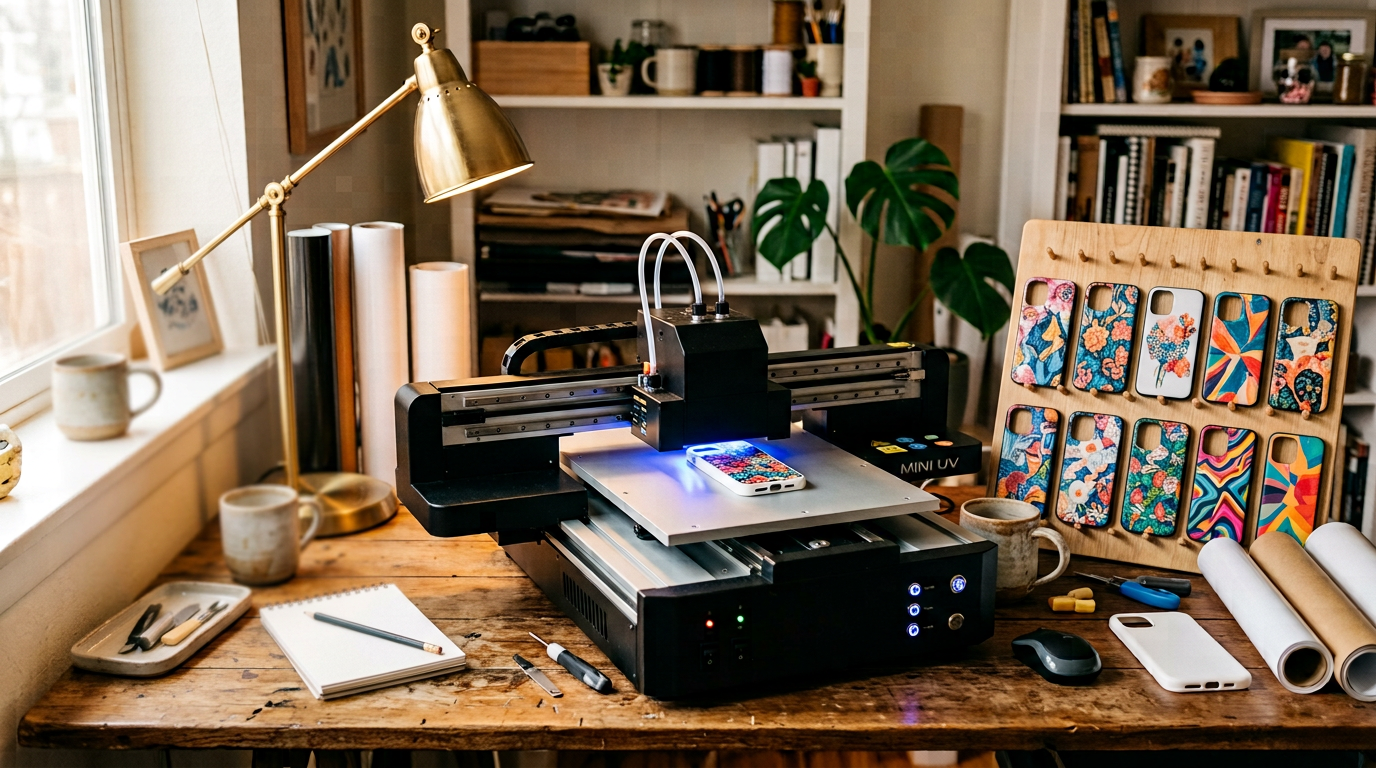
Tier 1: ₹80,000 – 2.2 lakh — Desktop A3/A4 UV (Epson-based)
The honest starter. A3 bed (30×42 cm), single XP600/TX800-class head, CMYK+White+Varnish channels, LED lamp. Prints phone cases, pens, ID cards, keychains, small plaques — 60 to 150 cases/day depending on single-piece vs jig printing.
- Wins: Lowest entry ticket; 100×100 sq cm product tables fit a bedroom; sellable output from week two; resale demand strong from the next starter.
- Limits: One head = slow white-layer jobs; 8–15 month head life; no large rigid items. It’s a bridge machine, and proud of it.
- Buy if: You’re proving gifting demand or adding UV to an existing gifts/print shop on a tight budget.
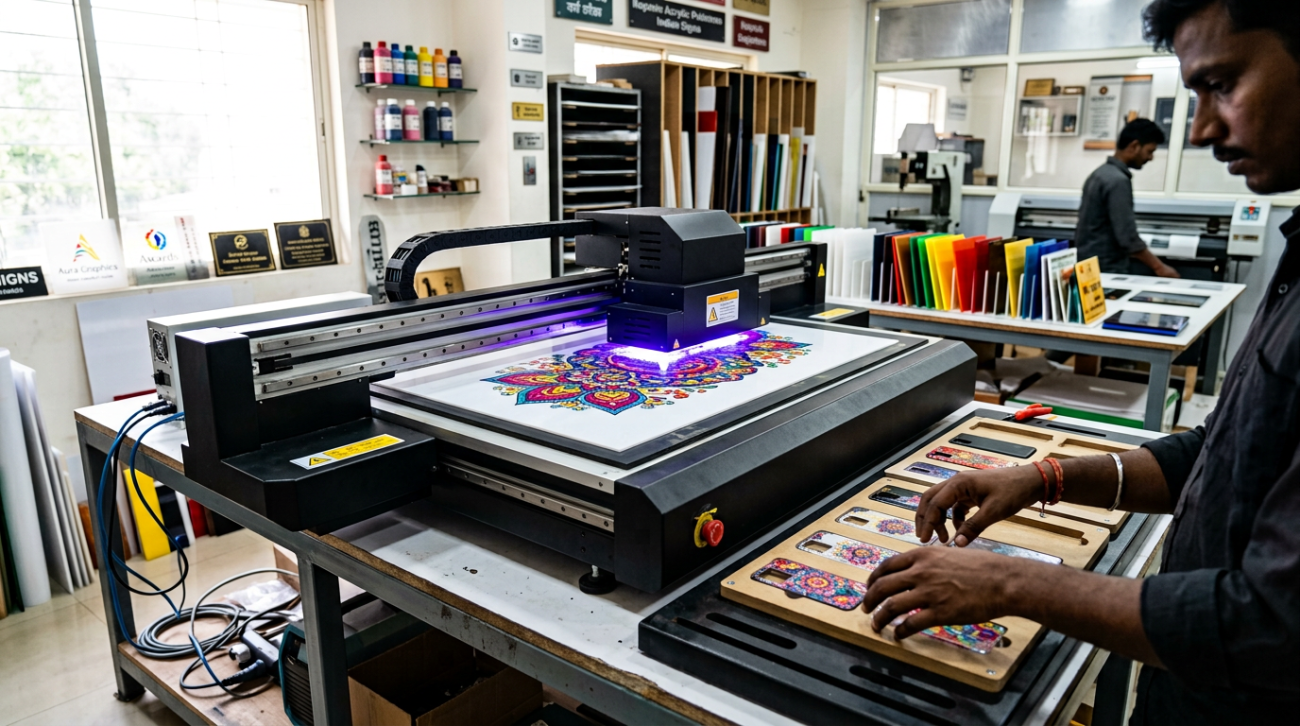
Tier 2: ₹4.5 – 7.5 lakh — 6090 Flatbed, Dual Epson i3200-U (THE sweet spot)
Where real businesses are built. 60×90 cm bed, dual i3200-U heads (one colour, one white/varnish — or colour both heads, white dedicated config varies), CMYK+W+V, LED curing, zoned vacuum bed, auto white circulation, licensed RIP.
- Wins: Full small-business product menu — A2 signage, acrylic sheets, award plaques, 12–24 phone cases per jig pass, box printing with 10–15 cm Z-height. Speed: 3-5× Tier-1 on layered jobs. Heads 3,200 nozzles each with 18–30 month life.
- Limits: Needs 150–250 sq ft and clean power; full 8×4 sheets need cutting first.
- Buy if: You have any evidence of order flow (or transferrable print/gift customers) and want the machine that 70% of successful Indian UV shops run.
Tier 3: ₹1.5 – 6.5 lakh — UV DTF Machine (the curve conqueror)
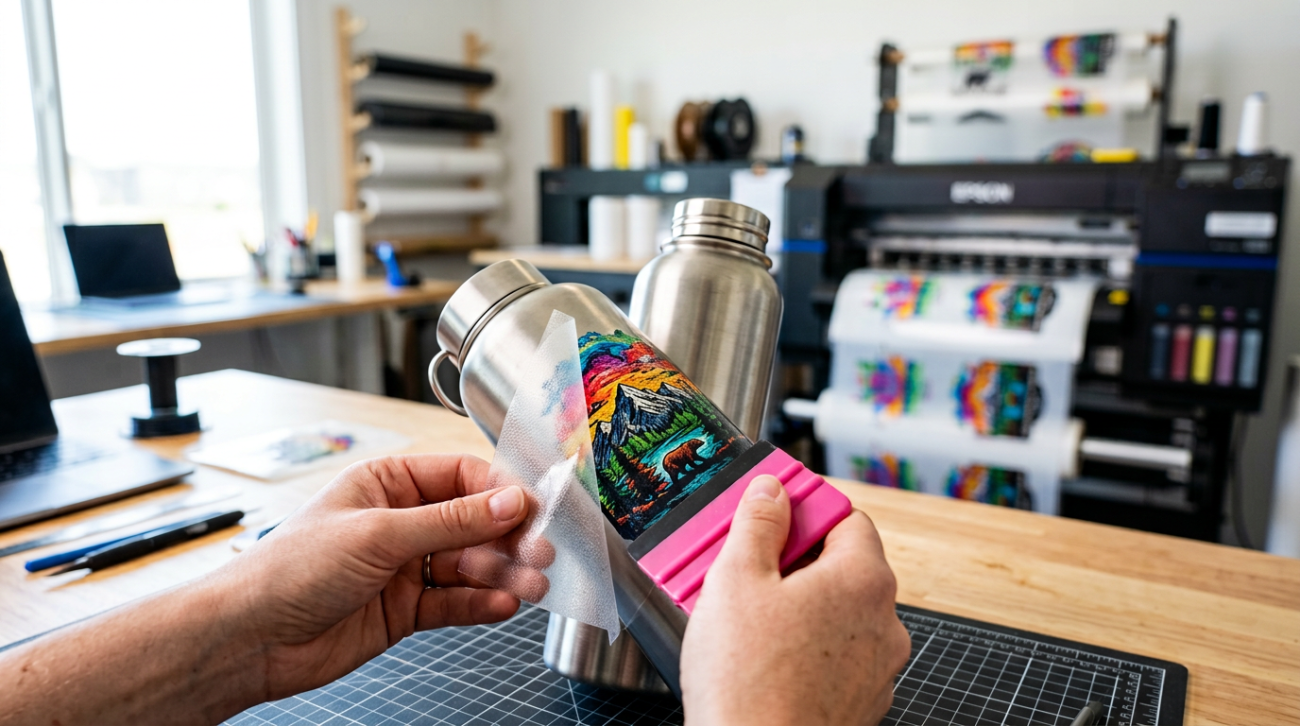
Not a flatbed — prints transfer films whose “crystal stickers” hand-apply to bottles, helmets, gadgets, kettles, tools — every curved thing flatbeds can’t hold. 30–60 cm width roll, 2–3 Epson-class heads with dedicated white and varnish layers.
- Wins: Products nothing else can personalize; “sticker” cost ₹8–18 transfers at ₹120–300; pairs beautifully beside a flatbed to make a full product house.
- Limits: Transfers are a film on a surface — perceived value lower than direct print for premium signage; film/lamination supply line matters.
- Buy if: Your model is promotional products/bottles/helmets — or as machine #2 next to a flatbed.
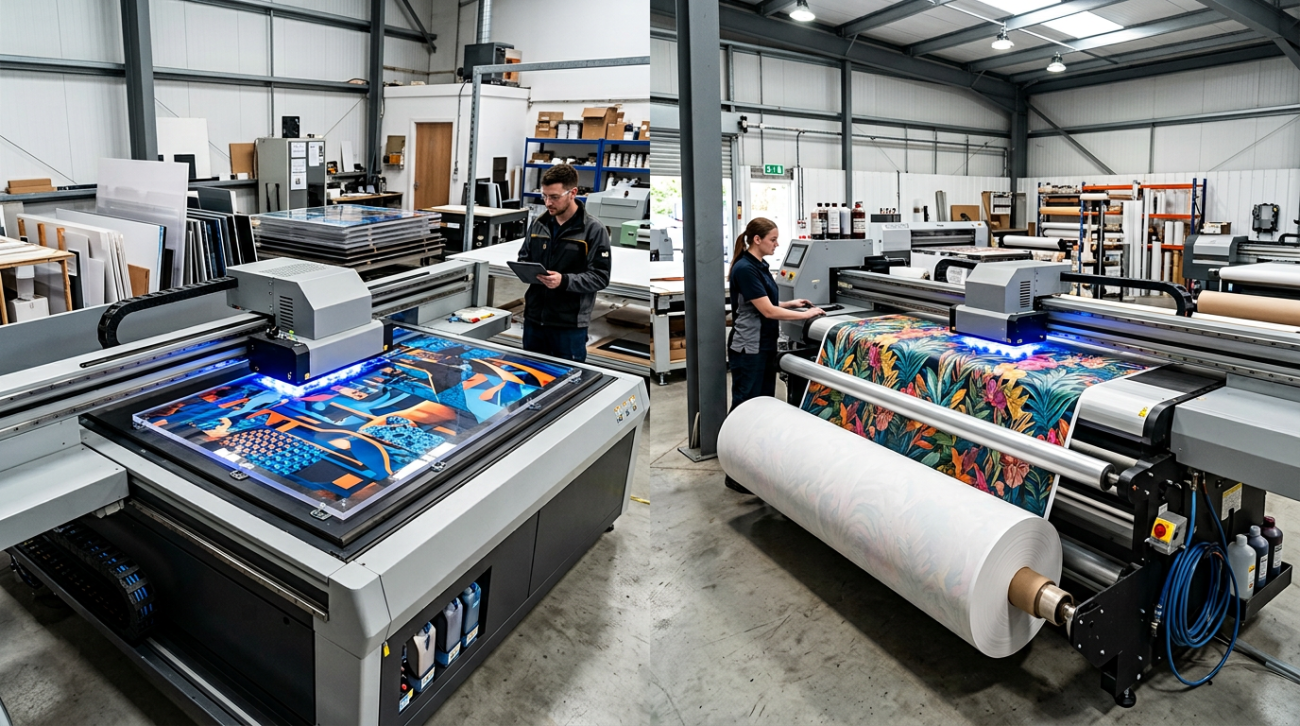
Tier 4: ₹9 – 18 lakh — 9060/13090 Flatbed with Ricoh Gen5/Gen6
Industrial-heads territory: 2–3 Ricoh heads, chiller-cooled, bigger beds, greyscale precision at production speed. For when Tier-2 throughput becomes your ceiling and the order book proves it.
- Buy if: You have dealer networks, institutional contracts, or 6-day/week full-bed utilization for 3+ months.
Tier 5: ₹12 – 28 lakh — Hybrid Flatbed + Roll
Belt-fed hybrid running both rigid sheets and roll media. The “one machine does everything” answer to “we do signage panels AND wallpapers AND banners.”
- Buy if: A mixed model is proven, not imagined — hybrids compromise slightly on each side versus dedicated machines. Two specialists beat one generalist until volume forces the merge.
The Spec Non-Negotiables (At Any Budget)
| Spec | Minimum for Business Use | Why |
|---|---|---|
| White ink channel + circulation | Mandatory, with auto-stirring pump | No white = half the product menu closed (dark/transparent items) |
| Curing | LED lamp, water/air cooled per head class | Mercury lamps cook thin substrates and die in ~1,000 hrs |
| RIP | Licensed (Maintop Pro / Onyx / PrintFactory / Cadlink) | White-layer, varnish-layer and jig tooling live in the RIP; cracked software = production lottery |
| Z-height | ≥10 cm adjustable with anti-collision sensor | Boxes, bottles, plaques — and one sensor saves a ₹80,000 head strike |
| Vacuum bed | Zoned suction (Tier 2+) | Holds sunboard/acrylic flat — warp = head strike = tears |
| Service | Engineer reachable within 48 hrs, spares stocked in India | A saving of ₹40,000 evaporates at the first week-long downtime |
Match the Machine: Model × Business Decision Table
| Your Model | Right Machine | Setup Budget (×1.35 rule) | Payback Target |
|---|---|---|---|
| Gifting studio (cases/pens/frames) | Tier 1 desktop A3 → Tier 2 by month 9–12 | ₹1.1 – 3 lakh | 4–7 months |
| Awards & recognition | Tier 2 6090 (white+varnish mandatory) | ₹6 – 10 lakh | 8–12 months |
| Signage partner (with fabrication friend/CNC) | Tier 2 6090; Tier 4 when panels scale | ₹6.5 – 11 lakh | 8–14 months |
| Decor & interiors | Tier 2 → Tier 4 as panels grow | ₹7 – 12 lakh | 10–16 months (higher-ticket, slower cycle) |
| Promotional products (bottles/gadgets) | Tier 3 UV DTF + rotary jig flatbed later | ₹2.5 – 8 lakh | 6–10 months |
| “All of it” (mixed ambition) | Start Tier 2 + UV DTF combo under ₹12 lakh | ₹10 – 14 lakh | 9–14 months |
Space, Power & Setup Reality for a Small Shop
- Room: Tier 1 fits a desk; a 6090 wants 12×14 ft working room with bed access from 3 sides. Door width matters — confirm the machine fits through YOUR door before signing (measure twice, many first-timers have angle-grinded machine frames for doors).
- Power: single-phase 16A line, 3–5 kVA servo stabilizer/online UPS. UV machines hold grudges against voltage dips.
- Air: compressor for vacuum bed; placement outside the print room keeps the air clean and the noise out.
- Environment: 20–28°C, dust-controlled. LED-UV smell is mild — an exhaust fan for long runs is good practice, especially with varnish work.
- Workflow furniture: substrate storage racks (vertical), two work tables (in/out), jig shelf. Jigs multiply fast; storage planned early saves daily hunting.
The First 90 Days: Small-Business Ramp Plan
| Phase | Focus | Output Goals |
|---|---|---|
| Days 1–15 | Setup, substrate testing, jig building, ICC/profiles per substrate | Print sample book across 15+ materials — your physical portfolio |
| Days 16–30 | Warm-network launch, Google Business Profile, WhatsApp catalogue, market-day/board visibility | 20 paid orders; photo-document everything for reels |
| Month 2 | Product menu crystallization — publish 12–15 priced SKUs; approach 10 B2B (event companies, schools, corporates) | ₹60,000–1,00,000 billing |
| Month 3 | Anchor accounts + repeat cycles (corporate gifting calendar, awards seasons, festive gifting) | ₹1,20,000–2,00,000 billing; identify your cash-cow SKU |
5 Expensive Mistakes Small UV Buyers Make
- Buying on bed size and price, ignoring head model. A bigger bed with a dying XP600 loses money to a smaller i3200 machine every single month.
- Skipping white-ink education. White settles overnight; no circulation/discipline = clogged channel in weeks AND the most grey hair in UV ownership.
- No jig strategy. Machines print single items for ₹5 and jig-batches for ₹1.20 each. Jigs are not accessories; they’re the productivity system.
- Saying yes to every product. Segment champions (e.g., “acrylic wedding plaques in Jaipur”) scale; generalists drown quoting everything.
- Ignoring the ×1.35 setup rule. The machine at 100% of budget leaves zero for ink, jigs, UPS and samples — an under-capitalized machine is an expensive paperweight.
Product × Machine Compatibility Matrix (What Each Tier Can Actually Print)
The simplest way to sanity-check a tier against your product dream list. Save yourself a wrong purchase by running YOUR top five products through this grid:
| Product | Desktop A3 (Tier 1) | 6090 Flatbed (Tier 2) | UV DTF (Tier 3) | 9060+/2513 (Tier 4) |
|---|---|---|---|---|
| Phone cases (single / jig batch) | ✅ single; small jigs | ✅✅ 12–24 per pass | ✅ via transfers | ✅ overkill |
| Acrylic trophies & plaques | ⚠️ small sizes only | ✅✅ ideal | ❌ wrong tool | ✅ volume work |
| Sunboard signage (up to A2) | ⚠️ A3 panels only | ✅ standard | ❌ | ✅✅ full sheets |
| Full 8×4 ft panels | ❌ | ❌ (cut first) | ❌ | ✅ (2513) |
| Bottles / tumblers / helmets (curved) | ❌ | ⚠️ rotary-jig cylinders only | ✅✅ the specialist | ⚠️ |
| Glass art / backlit panels | ⚠️ small | ✅ | ⚠️ film-on-glass look | ✅✅ |
| Wooden furniture panels | ❌ | ⚠️ cut sizes | ❌ | ✅✅ |
| Embossed/3D texture effects | ⚠️ slow (single head stacking) | ✅✅ dedicated varnish head | ⚠️ limited texture | ✅✅ fast |
| Pens / USB drives / small merch (jigs) | ✅ | ✅✅ big jigs | ⚠️ flat faces only | overkill |
The Jig System: Small Business’s Real Productivity Hack
New UV owners obsess over print speed; veterans obsess over jigs — the templated fixtures that hold 12, 24, or 48 items in precise positions so one bed pass prints them all. The math is a business plan by itself:
| Approach | Phone Cases/Hour (6090) | Effective Ink+Time Cost/Piece |
|---|---|---|
| Single-case printing, manual placement | 18 – 30 | ₹8 – 14 |
| 12-position acrylic jig | 70 – 110 | ₹2.5 – 5 |
| 24-position production jig + template file | 130 – 190 | ₹1.2 – 2.8 |
Jig discipline looks like: template files for your 10 standard items pre-built in the RIP; two physical jig sets per hot item (one prints while you load the other); local acrylic fabricator on speed-dial for new-jig cutting. This unglamorous system is why two shops with identical machines bill ₹1 lakh vs ₹3 lakh in the same month.
Hiring vs Learning: The Operator Question
UV machines forgive beginners more than eco solvent (no harmful fumes, no wet prints) but demand their own skills: jig placement precision, white-layer logic, and substrate prep. Realistic paths:
- Owner-operator (recommended start): the machine’s learning curve IS the business education. Budget 3–4 genuinely slow weeks; every failed plaque teaches substrate science no training class transfers.
- Hired operator: market rate ₹15,000–22,000/month for trainable staff; ₹25,000–35,000 for someone who already speaks white-circulation and ICC profiles. Retention matters — your trained operator poached is a ₹40,000 setback; document every process so knowledge lives in the shop, not in one head.
- Designer dependency: UV workflows are design-led (white layers, emboss maps, jigs). A part-time CorelDRAW/Illustrator-fluent designer pays for themselves faster than any second helper.
Warranty Fine Print: What “12-Month Warranty” Actually Covers
UV machine warranties deserve the same reading glasses as bank loans. Standard honest structure: 12 months on mechanicals/boards, 3–12 months on printheads conditional on approved ink, lamps 6–12 months, onsite labour 90–365 days. The clauses that bite:
- Printhead claims rejected for “non-approved ink” — get your ink brand/model listed on the invoice as approved, or the head warranty is decorative.
- “Service at our works” vs “onsite” — a 6090 doesn’t courier well. Onsite-labour terms (who pays engineer travel?) decide real response.
- Consumables excluded (dampers, wipers, filters) — fine — but ask prices now; some suppliers’ parts lists are priced like jewelry.
- Response-time SLA absent entirely. A written “48-hour remote + 7-day onsite” beats an unconditional-sounding warranty with no clocks.
The Exit Question: Resale Value by Tier
Machines get outgrown; plan the exit at entry. Desktop A3 units resell fastest (40–55% recovery in 18 months — every week another starter wants one). Dual-i3200 6090s hold 45–55% at two years with maintenance logs — the most liquid serious machine in the segment. Ricoh industrial units depreciate slower but sell narrower (fewer buyers, more due diligence). UV DTF machines are newest to the used market — liquidity still forming; assume 35–45%. The universal resale multipliers: complete documentation, head-counter photos, spares kit included, and — most underrated — the machine’s demo video printing white-on-black on listing day.
Your Pre-Purchase One-Pager
Before you transfer any advance, answer these eight lines in writing (if any answer is blank, you’re not ready to buy):
- My top 5 products, in revenue priority order: ______
- Monthly unit demand I can already see for #1: ______
- Budget, including the ×1.35 rule: machine ₹____ + setup ₹____
- Machine tier this map selects: ______
- Printhead model & count I’m insisting on: ______
- My room size, door width, and power arrangement: ______
- Service source: assembler distance ____ km, response time promised: ____
- Two reference customers I will call, and what I’ll ask them: ______
Buy the machine this one-pager points to — not the machine a persuasive video points to — and the odds bend steeply in your favor.
The 90-Day Discipline Details Nobody Prints in Brochures
Plans say “ramp up sales.” Here’s what the successful shops actually DO in those 90 days, at the behavioural level:
- The daily sample habit (Days 1–30): one new substrate or product variation printed and photographed EVERY day — tile on Tuesday, leather diary on Wednesday. Thirty days of samples = a portfolio competitors take a year to assemble, plus complete substrate confidence.
- The 10-minute review ask: every completed order ends with the same two-line script — “review bhej dijiye” + a subtle next-order discount mention. By day 90 you’re the highest-reviewed UV printer within your city radius, and local search follows review velocity religiously.
- The Wednesday B2B walk: every week, three physical visits with the sample bag — schools, designers, event companies, HR offices. Not selling; introducing. By day 90, fifty local businesses know exactly where the UV printer in town is.
- The Sunday reels batch: one afternoon weekly shoots and schedules the week’s content. Process videos (print passes, peel reveals, emboss tilts) — the machine is the cast member, free forever.
Pricing Psychology for Small UV Shops
Small UV businesses chronically underprice because they price against print shops instead of against what their product IS — a customized, made-while-you-wait manufactured good. Fixes that lift realized prices 20–40% without losing orders:
| Tactic | How It Works |
|---|---|
| Three-tier quotes (Basic / Standard / Premium finish) | Anchoring drives 60%+ to middle — engineer the middle to carry your ideal margin |
| Named finish upgrades (“3D Texture +₹150”, “Gloss Guard +₹100”) | Named upgrades feel like choices; unnamed bundling feels like price |
| Express lanes (Same-day +40%, 2-hour kiosk premium) | Time-poor customers reveal willingness to pay instantly; a third take the premium |
| Bundles that lift ticket (“Case+pop grip+ box = ₹499”) | Bundle math hides per-item comparison; perceived value leads |
| No silent discounts, ever | Any concession is traded visibly (advance payment, quantity, off-season) — silent discounts teach customers your prices are negotiable fibs |
Competitor Analysis: Actually Checking Your Local Market
Before finalizing tier and pricing, run this 3-day reconnaissance every shop should do and most never bother:
- Map every direct-print-capable shop within 15 km — Google Maps, IndiaMART, JustDial. Who prints on acrylic/wood/glass TODAY? Note their visible product sets and price hints.
- Mystery-shop the top three: request a quote for a standard plaque and a phone case; note response SPEED, professionalism, and price. Most owners discover their market is slower and pricier than assumed — proof of opportunity in writing.
- Identify the missing lane: in most tier-2/3 cities the gap is specific — nobody doing quality embossed awards, or nobody answering corporate gifting calls professionally. Your hero-product lane = the local gap, not your personal favourite.
- Check wholesale reality: what do local sign shops currently pay to outsource UV work? If fabricators bus panels to the nearest metro weekly, a local 6090 captures that freight-and-delay premium instantly.
Two Shop Archetypes: What Success Actually Looks Like at Month 12
Archetype 1 — The Gifting Hub (Tier 1 → Tier 2 path): bedroom A3 desktop, Instagram-led, cases + frames + keychains. Month 4: 25 orders/day average. Month 8: 6090 added (from savings + small loan), corporate gifting discovered through one HR client. Month 12: ₹1.8–2.4L/month billing, two helpers, the desktop unit now the kiosk/backup machine. Reinvestment habit: every third month’s surplus went to capability, not consumption.
Archetype 2 — The B2B Specialist (Tier 2 from day one): previous signage-industry experience, opened straight with a 6090 + tight credit terms. Month 1–3: slow walk-in traffic BUT six B2B groundwork visits weekly. Month 4: school trophy season + two interior designers onboarded. Month 12: ₹2.5–3.5L/month — 70% from five repeat B2B accounts — with walk-in retail deliberately kept selective. Their Instagram has 400 followers; their ledger has what matters.
Both worked — different entry tickets, different first lanes, identical discipline: product focus, weekly B2B contact, review acquisition, reinvestment. Copy whichever archetype matches your starting resources and temperament; both lead to the same place by different roads.
Your First 30-Day Execution Checklist
- Machine installed, trained, first perfect white-on-black print logged
- Sample book: 20 pieces across 10 substrates, photographed professionally
- Google Business Profile live with 15 photos
- WhatsApp Business catalogue: 12 priced flagship SKUs
- Templates + jigs library for top 6 products
- GST + Udyam + current account complete, letterhead ready
- Rate card printed + price tags visible in the workspace
- First 10 gifted samples to high-visibility local businesses (tagged photos)
- First 5 paid orders completed + reviews collected
- Maintenance ritual printed and pinned above the machine
Thirty days, ten lines. Shops that complete this list don’t ask “how do I get customers” in month two — they ask “how do I handle Tuesdays.”
The Support Questions That Reveal a Supplier’s Truth
Machines sell on demos; suppliers reveal themselves on after-sales answers. Five questions whose answers matter more than spec sheets:
- “If my machine fails October 15th (Diwali rush), what EXACTLY happens?” — listen for response clocks, prioritization logic, and honest holiday-season language vs evasion.
- “Who trained your last three customers, and can I call one?” — training is the delivery mechanism of everything you’re buying; references expose its quality.
- “Your spares stock for my machine: show me physically.” — a shelf with your model’s dampers/pumps/boards beats a promise-world entirely.
- “What’s your oldest running machine nearby, and its head history?” — reveals both product longevity and their own record-keeping transparency.
- “If I outgrow this in 18 months, what’s your upgrade/trade-in path?” — serious assemblers have one (they profit from your growth); traders reset the question.
Space Layout: A Working 6090 Studio Blueprint
The layout detail that months of YouTube research misses: a 6090 shop works in ZONES, not a single room-with-a-machine. Rough blueprint that works in 12×14 ft: machine against the LONG wall (3-side clearance for bed access); in-table beside the machine’s load side (substrates staged); out-table opposite (finished work cooling/packing zone); vertical storage racks behind the operator’s weak-side; the packing/QC counter near the door (dispatch flow without machine-room entry); jet-clean printer utility corner for blanks prep. The design principle: material flows IN one side and OUT the other — because crossed flows are where finished plaques meet dusty substrates and where your morning hour disappears into searching.
The Second-Machine Triggers (Exactly When #2 Is Right)
- Sustained 6+ productive print-hours/day for 8+ consecutive weeks (logged, not felt).
- Refused/delayed orders documented at 15–20%+ of inquiries specifically for capacity reasons.
- Rush-premium acceptance by customers proving time-scarcity exists and is payable.
- Machine #1’s P&L clearly profitable + second machine fundable with ≤50% debt.
- The second unit planned as either same-family redundancy (spares/skills shared) OR complementary family (flat + curve coverage) — never a hopeful category leap.
All five yes → buy confidently. Any two no → the constraint is still demand-side, and demand is the spend that actually returns.
The Shortlist Scorecard: Rate Machines Side by Side
Bring this scored comparison to your final two-or-three machine shortlist (score 1–5 each, total honestly):
| Dimension (Weight) | Machine A | Machine B | Machine C |
|---|---|---|---|
| Printhead config vs my products (×3) | |||
| White + varnish system quality (×2) | |||
| Service distance & response commitment (×3) | |||
| RIP license + training quality (×2) | |||
| Spares availability + parts price sanity (×2) | |||
| Bed/Z-height/spec fit to product list (×2) | |||
| Total cost incl. full setup (×1) | |||
| Reference-customer feedback (×2) |
The scorecard quietly prevents the classic mistake: falling for the machine whose salesman was warmest. Weights carry your priorities; scores carry your investigation; the total usually surprises somebody — let it.
Mistakes by Tier: What Goes Wrong Where
| Tier | The Characteristic Mistake |
|---|---|
| Desktop A3 (~₹1–2L) | Outgrowing capacity in month 6 while revenue can’t fund upgrade — because machine consumed 100% of launch capital |
| 6090 (~₹4.5–7.5L) | Buying the cheapest 6090 with a mystery head and living the next two years inside its service queue |
| UV DTF (~₹1.5–6.5L) | Film-quality neglect — transfers that peel destroy reputation faster than slow machines ever could |
| Ricoh industrial (~₹9–18L) | Beautiful hardware arriving to underdeveloped demand — capacity worship instead of order-book building |
| Hybrid (~₹15–28L) | Buying both-worlds claims without either world proven — the universal hybrid lesson |
The Final Sanity Check Before Paying the Advance
Last page discipline, thirty quiet minutes before the transfer: Re-read your top-five products list beside the machine’s demonstrated capabilities. Re-read the quotation for the third time, hunting only for what is ABSENT (licenses, training days, spare-parts lists, response clocks). Call one reference customer — a real conversation, not a plan to call. Sleep one night on the complete pile. The machine you’re buying will serve roughly 2,000 working days after this evening; the evening’s patience is priced accordingly. The right machine survives this checklist without a blink — and that’s precisely how you recognize it.
The Honest Counterpoint: When a Small Business Should NOT Buy UV
Every guide owes its readers the exceptions; this machine isn’t for everyone:
- If your volume dream is fabric/apparel — UV prints hard goods; T-shirts need DTF/DTG/screen lanes. Wrong tool.
- If every target product is commodity banner/flex at market-destroying rates — eco solvent serves that lane at a third of UV’s operating cost per square metre.
- If there’s no sales muscle available (owner unwilling to do B2B rounds or content) — UV’s premium products need storytelling and door-knocking more than the alternative technologies do.
- If budget reality is under ₹1 lakh total — respect it; start with services (design + vendor-fulfilled print partnerships) and arrive at the machine from earned capital, not strained credit.
For everyone else — the gifting, awards, signage, decor, and personalization entrepreneurs — the 6090-class decision stands as the best-supported machinery bet in Indian small-format printing in 2026. Buy it deliberately, run it religiously.
Frequently Asked Questions (FAQs)
Which UV printer is best for a small business in India?
For most, a 6090 flatbed with dual Epson i3200-U heads (₹4.5–7.5 lakh). For gifting-only models on tight budgets, a desktop A3 unit (₹1–2.2 lakh). For bottles/curved items, a UV DTF machine (₹1.5–6.5 lakh).
What can I print with a small UV printer?
Phone cases, acrylic plaques & trophies, sunboard signs, glass art, wooden frames, metal plates, leather diaries, boxes, ID cards, pens — any flat or gently-curved rigid object within bed size and Z-height.
Is a desktop A3 UV printer worth buying?
Yes — as a demand-proving machine for gifting models. It earns real money (60–150 cases/day capacity) and resells easily to the next starter when you upgrade.
Single-head or dual-head UV printer for a small shop?
Dual wherever budget allows: dedicating heads to colour vs white/varnish multiplies layered-job speed 2–3× and halves idle babysitting. Single-head only for the sub-₹2.5 lakh entry tier.
How much electricity does a UV printer use?
LED-cured 6090 machines draw 1–2.5 kW while printing — ₹2,500–5,500/month at typical duty cycles. Mercury-lamp machines multiplies this and add bulb costs.
Do I need GST registration for a UV printing business?
Practically yes from day one: your best customers (corporates, event companies, distributors) require GST invoices, and MSME benefits need Udyam. Both are fast, inexpensive, and unlock B2B doors.
Final Verdict
The “best UV printer for small business” contest has a repeating winner in India: the 6090 dual-i3200-U flatbed at ₹4.5–7.5 lakh — because it balances bed area, layered speed, head economics, and product breadth better than anything above or below it. Tight-budget starters: prove the model on a desktop Tier-1. Curve/product specialists: UV DTF. Signage scalers: Ricoh-powered Tier 4 only when throughput — not hope — demands it. Everything else is noise the dealer’s brochure makes.
Ready to shortlist real machines? Browse our UV printer lineup — desktop, 6090 flatbeds, and industrial configurations with honest spec sheets, licensed RIPs, and pan-India installation & support. Tell us your business model — we’ll match the machine to the model, not the other way round.