


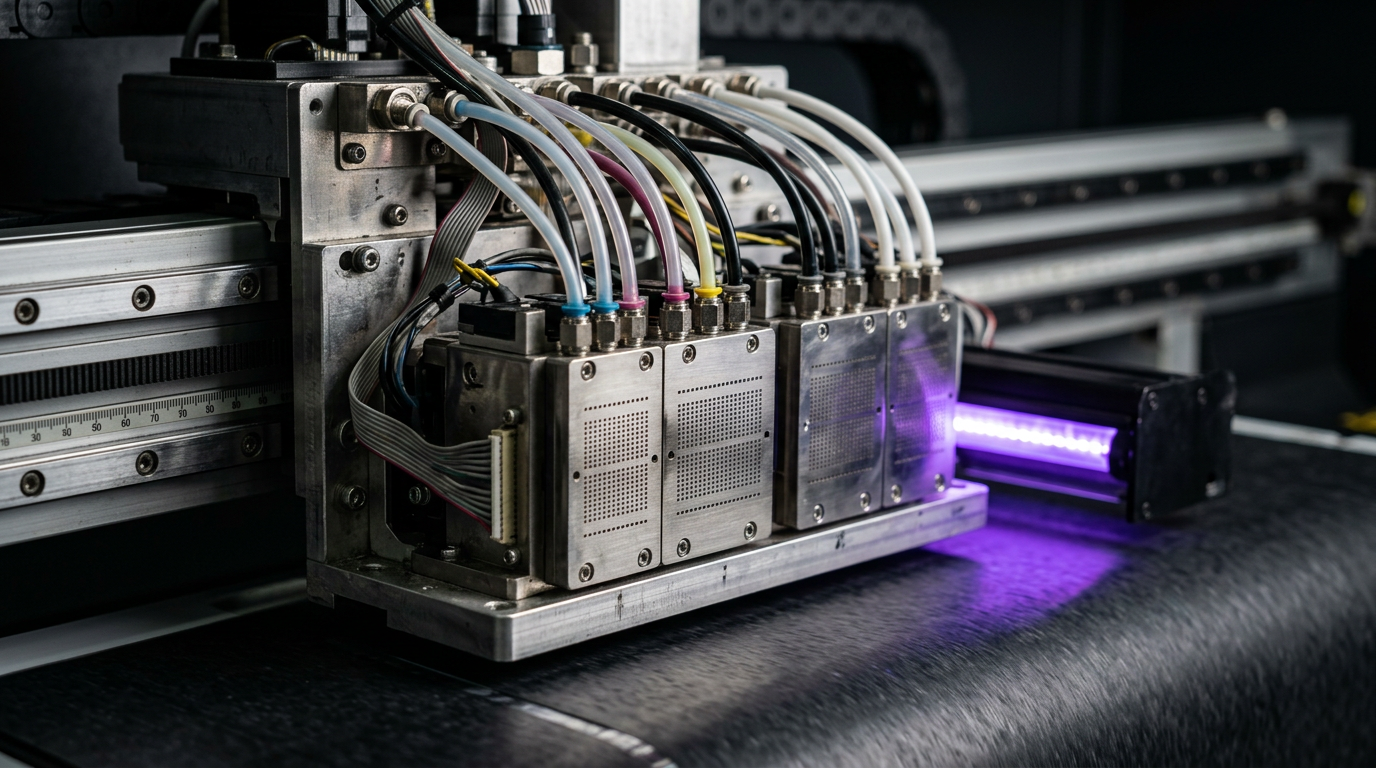
Every UV printer is really just a motion system carrying one decision: the printhead. The head sets print quality, production speed, ink chemistry compatibility, maintenance temperament, replacement cost — and quietly fixes the machine’s resale value years later. Two “6090 UV printers” can wear price tags ₹3 lakh apart purely because one runs Epson i3200-U heads and the other Ricoh Gen6.
In India’s 2026 UV market, three head families rule: Epson’s i3200-U/i1600-U (the value-precision king), Ricoh Gen5 (the industrial workhorse), and Ricoh Gen6/G5i (the production flagship). This is the complete buyer’s comparison — specs, real speeds, lifespan, cost-per-print math, and exactly which head belongs in which business.
The Contenders at a Glance
| Spec | Epson i3200-U | Ricoh Gen5 (MH5420) | Ricoh Gen6 (MH5320/5340) |
|---|---|---|---|
| Nozzles | 3,200 | 1,280 | 1,280 |
| Drop size (native) | 3.3 pl (finer detail) | 7 pl (greyscale 7–21 pl) | 5 pl (greyscale 5–15 pl) |
| Firing frequency | ~43 kHz class | ~30 kHz class | ~50 kHz class |
| Typical machine speed feel | Fast for its price class | Steady industrial | Fastest of the three |
| New head price (India) | ₹55,000 – 85,000 | ₹1,20,000 – 1,60,000 | ₹1,50,000 – 2,40,000 |
| Realistic UV lifespan* | 18 – 30 months | 3 – 5 years | 4 – 6 years |
| White-ink temperament | Needs circulation discipline | Forgiving industrial design | Most forgiving + fastest recovery |
| Found in machines | ₹4.5 – 9 lakh 6090s, UV DTF, roll UV | ₹8 – 18 lakh flatbeds/roll | ₹14 – 35 lakh premium flatbeds/hybrids |
| Technician familiarity (India) | Excellent & growing | Excellent (decade installed base) | Good in metro service benches |
*Lifespan assumes quality ink, white-channel circulation, and daily nozzle checks — the three habits that decide real head life more than the brand does.
Epson i3200-U: The People’s Head
Epson’s PrecisionCore i3200-U brought near-industrial quality down to small-business prices — and that’s why the Indian 6090 boom exists. 3,200 nozzles at 3.3 picolitre native drops render the finest detail and smoothest gradients of the three families; a dual-i3200 6090 embarrasses older single-Ricoh machines on both speed and photographic quality.
Strengths: class-leading detail; cheap to replace (₹55–85k vs ₹1.2–2.4L); enormous technician familiarity; every Indian UV assembler builds around it — parts and knowledge everywhere.
Limits: shorter industrial lifespan (think 18–30 months, not 5 years); less tolerant of white-ink negligence; not rated for punishing 2-shift factory duty. Replacement math stays friendly though — even at one head per 18 months, ownership cost beats the industrials for low-to-mid volumes.
Buy it if: your volume is 1–2 shifts maximum, you prize detail (photo panels, fine awards), and you want the lowest-risk entry into serious UV.
Ricoh Gen5: The Industrial Workhorse
The MH5420 earned its reputation across a decade of signage factories: steel-hearted durability, greyscale droplet flexibility, and white-ink systems that survive imperfect operators. Variable 7–21 pl drops let it fire large droplets for speed and small ones for quality in the same job — a production versatility heads with fixed native drops can’t match.
Strengths: 3–5 year lifespans are routine; handles heavy white/varnish duty cycles without complaint; enormous installed base = deep spares ecosystem; machines built around Gen5 hold resale value.
Limits: 1,280 nozzles means slower fine-detail work than i3200 at equal passes; replacement cost (₹1.2–1.6L/head) punishes neglect; machines carrying 2–3 Gen5 heads start at ₹9+ lakh — you’re paying industrial entry fees.
Buy it if: 9060-class beds and above, punishing daily volumes, institutional/signage-factory duty — where uptime outranks everything.
Ricoh Gen6: The Flagship
Gen6 is Gen5’s pedigree with a speed injection: finer 5 pl greyscale drops, ~50% higher firing frequency, better nozzle-plate engineering for recirculating white systems. In plain terms: Gen5 reliability at meaningfully faster production speeds with finer print.
Strengths: the fastest heads on this page; finest Ricoh detail yet; built for modern always-circulating white-ink systems; longest realistic lifespans (4–6 years).
Limits: ₹1.5–2.4 lakh per head; machines start ₹14–15 lakh; overkill for anything below two-shift industrial duty — a Gen6 machine printing 3 hours/day is a Ferrari in a school zone.
Buy it if: signed B2B/industrial volumes justify ₹15–30 lakh machines and you measure your machine shop in output quotas, not aspirations.
The 3-Year Cost-per-Print Model (The Only Comparison That Matters)
Assume a 6090 bed, ~1,800 printed sq ft/month equivalent volume, quality ink, disciplined maintenance:
| Cost Line (3 Years) | Dual Epson i3200-U | Dual Ricoh Gen5 | Dual Ricoh Gen6 |
|---|---|---|---|
| Machine price delta | Base (₹5.5 – 7 L) | +₹4 – 6 L | +₹8 – 12 L |
| Head replacements (2 heads) | 1 round over 3 yrs: ₹1.1 – 1.7 L | 0–1 round: ₹0 – 3.2 L | 0–1 round: ₹0 – 4.8 L |
| Downtime exposure (head swap days) | 2 – 4 days/3 yrs | 0 – 3 days | 0 – 2 days |
| Detail/quality tier achievable | Highest (photo-class) | Excellent production | Excellent + fastest |
| Best-volume window | Moderate–heavy (1 shift) | Heavy (1.5–2 shifts) | Extreme (2 shifts + deadlines) |
| 3-year verdict at MODERATE volume | ✅ Cheapest total cost | Over-capitalized | Far over-capitalized |
| 3-year verdict at 2-SHIFT volume | Head churn erodes gains | ✅ Sweet spot | Wins on deadline speed |
The math’s blunt message: industrial heads pay for themselves only at industrial volumes. At typical small-business duty cycles, the “cheap” Epson ownership math beats the ₹1.5-lakh heads comfortably — and nobody printing 4 hours/day has ever recovered a Gen6 premium.
The Grey-Market Warning (Read Before ANY Head Purchase)
Printheads are the single most counterfeited component in Indian digital printing. Reality check:
- “Unlocked/refurbished” i3200 heads at ₹25–35k — marketed like equivalents, they’re salvage-cleaned used heads with unknowable remaining life. As calculated gambles at ₹25k they occasionally make sense for tinkering shops; as “new head savings” they’re a scam.
- Encryption compatibility: i3200 heads exist in locked variants tied to board ecosystems. Buying a head your mainboard can’t address is an expensive paperweight — buy heads ONLY through your machine assembler’s supply line, model-number matched.
- Ricoh fakes and re-sleeved units exist at the ₹60–90k price points. Genuine Ricoh supply flows through authorized distributors with hologram/serial verification — demand the box, verify the serial, pay by GST invoice.
- Warranty honesty: genuine new heads carry DOA/window warranties (7–30 days) through authorized channels, conditional on approved ink — anything “lifetime” is theatre.
Head Care in UV: The White-Ink Rules
UV heads die differently than eco solvent heads: white UV ink’s titanium-dioxide pigment is heavier and settles faster, and varnish channels gum when idle. The discipline that doubles head life:
- Circulation always ON — machine running or standby, the white circuit must move. Machines without circulation systems lose white nozzles in weeks.
- Daily nozzle test on ALL channels, photographed — white channel first sign of trouble shows there.
- Weekly wet-cap the heads with manufacturer flush on idle days; never let white sit static over a long weekend without capping discipline.
- Never shake WHITE bottles vigorously before filling — gentle roll only (bubbles in UV white = dropout city).
- Temperature discipline: 22–28°C room; UV ink viscosity shifts harder with temperature than solvent inks.
- Anti-collision sensors non-negotiable — one acrylic shard under a gantry = ₹85,000–2,40,000 lesson.
Five Myths That Refuse to Die
- “More nozzles always means faster.” Only at matching passes and frequencies — firing speed and drop strategy matter equally.
- “Ricoh lasts forever.” With cheap ink and no white discipline, an ₹1.6L Gen5 dies exactly as dead as an Epson — just pricier.
- “Epson heads can’t handle white ink.” They handle it fine with circulation discipline; they forgive less, that’s all.
- “Locked/unlocked head doesn’t matter.” It determines whether the head even works on your board — always match through your assembler.
- “Head price is the expensive part.” Downtime days and ruined rush orders cost more than any head — which is why industrial shops pay industrial head prices happily.
Locked vs Unlocked: The Head-Board Ecosystem Explained
Epson sells printheads into industrial machine ecosystems with encryption pairing — the head and the mainboard handshake before firing a drop. Practical consequences Indian buyers must understand:
- “Original locked” heads run only with the matching board ecosystem your machine assembler chose. They are the safest, fully-supported configuration.
- “Unlocked” market heads (original hardware with pairing circumvented, sold 20–40% cheaper) work on some board revisions — sometimes. Firmware updates, voltage events, or board swaps can brick the pairing. Warranty from grey sellers is a handshake, not coverage.
- Ricoh’s ecosystem is less encrypted but heavily counterfeited — re-sleeved used Gen5s in fresh housings are an entire grey industry.
The operational rule: always buy the head through your machine assembler’s supply line, model and revision matched, GST-billed, with a written DOA/window warranty. The 20% you save going grey funds someone else’s troubleshooting lab — your machine.
Replacing a Printhead: What the Process Actually Looks Like
When the day comes (it comes for everyone), knowing the workflow removes the fear and the engineer-dependency for simpler models:
- Diagnose before purchase: nozzle-map printout, cleaning fluid soak test results, cable/connector inspection — confirm the head is truly dead. Half of “dead heads” are dampers, cables, or capping stations in disguise.
- Flush the ink path for the dead channel; cap the station; power down fully.
- ESD discipline: anti-static wrist strap, no carpet-floor operations, handle the head by its frame only. Static kills new heads before their first print — silently.
- Physical swap: photograph every cable before disconnecting (phone photos = reassembly manual); seat ribbons fully; torque per manual, not feel.
- Prime and calibrate: ink charge per procedure, then the full alignment suite — bi-di, step, head-gap. Skipping calibration after head replacement is why “the new head prints worse than the old one.”
- Log it: date, head serial, counter reading, technician notes. Your maintenance log becomes resale value documentation and warranty evidence.
Most assemblers bundle one guided first-replacement into training — ask for it at purchase. An engineer-held first swap converts a ₹5,000 service-visit dependency into permanent in-house capability.
Reading the Nozzle Test Like an Engineer
| Pattern You See | It Means | Action |
|---|---|---|
| Perfect full grid | Healthy — print | Log photo; carry on |
| Same nozzles missing, consistent across tests | Fixed clog or dead channel group | Wet-cap 20–30 min → one clean → still missing after 48 hrs = plan head/schedule engineer |
| Missing nozzles wander between tests | Air ingestion / supply starvation — not clogs | Dampers, cap seals, ink levels, tube fittings — before touching the head |
| Deflected/angled jetting lines | Face-plate contamination or scratch | Proper swab clean; if persists (post-strike), adjust expectations and log it |
| White channel degrades Monday mornings | Weekend settling without circulation discipline | Weekend capping SOP + verify pump runs 24/7 |
| Gradual quality fade over 6–8 weeks | Normal wear curve OR subtle ink-supply issue | Compare dated photo logs; decide with evidence, not hunches |
The daily 30-second photograph of this test pattern is the highest-ROI maintenance act in all of UV printing — it converts ₹60,000 surprises into ₹600 planned interventions.
Buying Used Machines: The Head Forensics Protocol
Second-hand UV flatbeds can be superb value — or someone else’s maintenance debt packaged attractively. Head-focused checks before any used purchase:
- Demand live printing, not photos: full-coverage white on black acrylic in front of you, then CMYK gradients. Pause videos prove nothing.
- Photograph the nozzle test AND the machine’s counter screen (head-fire counters where available). Counters don’t lie as easily as sellers.
- Inspect the white lines physically: sight tubes stained amber/brown = years of poor white hygiene — budget dampers, lines, and possibly heads into your offer price.
- Check ink brand history: “which ink has run through it?” Unknown-history machines get a full-line flush budgeted on day one; mixed-chemistry sediment survives casual cleaning.
- Price discipline: used machine + immediate preventive parts (dampers, caps, wipers, pump service) + full ink-filled reservoir should still beat new-machine price by 30–35%. Below that delta, buy new with warranty; the risk isn’t priced properly otherwise.
Head Warranty: What Good Terms Actually Look Like
Honest Indian UV warranties on heads run: DOA replacement (7–30 days), or 3–12 month coverage strictly conditional on approved ink + maintenance log. Evaluate sellers by what happens in that conversation:
- Seller names exact approved ink brands/models in writing → serious operator.
- Seller waves hands: “heads are consumables, sir” with zero coverage → their margin includes zero risk; your price should reflect that, OR walk.
- “12 months unconditional head warranty” on a ₹4-lakh machine → the lie is priced in somewhere else; find where before signing.
The pragmatic sweet spot most good assemblers offer: 90-day onsite labour + 6-month head coverage on approved inks + spares price list attached to invoice. That combination is worth 3–8% of machine price happily — pay it.
Firing Frequency to Real-World Speed: Translating the Spec Sheets
kHz numbers feel abstract; hours-per-bed don’t. Practical translation on a 6090 bed printing CMYK+white layered work:
| Machine Config | Layered A2-Equivalent Panels / Hour (Realistic) | Phone-Case Jig (24 pc) / Hour |
|---|---|---|
| Single XP600-class desktop | 1 – 2 | ~0.8 – 1 jig (18 – 24 cases) |
| Dual i3200-U (colour + W/V split) | 4 – 7 | 3 – 5 jigs (70 – 120 cases) |
| Dual Ricoh Gen5 | 6 – 10 | 5 – 8 jigs |
| Dual Ricoh Gen6 | 9 – 14 | 7 – 11 jigs |
Rule of thumb across classes: each family step roughly multiplies layered-job throughput 1.5–2× — and also multiplies head-replacement cost and machine price. The question is never “which is faster” but “which speed do my confirmed orders actually require.”
UV Ink Chemistry × Head Compatibility (The Matching Rulebook)
Heads and inks share a marriage, not a dating scene. Every head family publishes viscosity and surface-tension windows; inks formulated outside them cause misting, satellites, and early channel death:
- Epson i3200-U: tighter viscosity spec (~10–13 mPa·s class); demands precise ink formulation — NEVER run “universal UV ink for all heads” through it. The discount inks that blur this line explain half the i3200’s “shorter lifespan” reputation.
- Ricoh Gen5/Gen6: broader viscosity tolerance historically; still not a license for mystery fluid — pigment milling quality determines nozzle wear regardless of window fit.
- The assembler matching service: serious machine suppliers publish APPROVED ink families per head in their machines (this doubles as your warranty line). Treat migration off the approved list as a warranty decision, not a price decision.
Climate and the Head: Indian Realities
| Condition | Head Stress | Mitigation |
|---|---|---|
| 45°C summers (no climate control) | Viscosity drift → misting satellites; driver-board overheat alarms | Room target 22–30°C; afternoon peak-hour pauses; fan/plenum hygiene weekly |
| Monsoon 85%+ humidity | Moisture ingress into connectors; curing dynamics shift | Dehumidify small rooms; connector inspection monthly; media acclimatization |
| Dust belts / construction adjacency | Face-plate contamination → deflection banding | Positive-ish room pressure (filtered inlet), machine covers, floor wet-mopping |
| Voltage zones (industrial-town supply) | Driver board damage — the expensive silent killer | Servo stabilizer/online UPS as permanently as the machine itself |
The 10-Question Pre-Purchase Head Checklist
- Exact head model written on quotation (not family names — model numbers)?
- Head count and channel split stated (which heads carry white/varnish)?
- New-head price for THIS model, supplied through this seller, in writing?
- Head warranty: DOA window, months, conditions (approved inks named)?
- Head-lock/ecosystem compatibility confirmed for this machine’s boards?
- Maintenance demands specific to this head documented (cleaning routines, flush types)?
- Chiller requirement confirmed (Ricoh industrial systems)?
- Service engineer for this head family within how many km/days?
- Spare-head availability: stocked in India or import-on-failure (6-week risk)?
- A reference customer running THIS head in THIS machine for 12+ months, callable?
Ten answers on paper convert the most expensive recurring component of your business from a leap of faith into a managed input line.
What’s Next: The Head Roadmap Worth Watching
Forward visibility for 2026–2028 buyers: Epson continues densifying the i3200 family (higher-firing variants dribbling into Indian assemblers); Ricoh’s newer small-footprint industrials (G5i class) bridge the Gen5–Gen6 capability gap at gentler prices; Chinese domestic head programs keep promising disruption and keep arriving at “available, unproven support” status. Buying guidance remains constant: buy last year’s proven champion, not this year’s fascinating press release — printheads are consensus-engineered components whose support ecosystems matter as much as their silicon.
The Sibling Question: i1600-U vs i3200-U
Since buyers meet both in 2026 quotations: the i1600-U is the i3200’s half-width sibling — 1,600 nozzles, same PrecisionCore family quality, roughly half the per-head throughput, at roughly half the price (₹28,000–45,000 zone). It appears in entry 6090/A2-class machines and compact UV DTF builds. The choice logic: i1600 machines bootstrapping lighter duty cycles (great for gifting-tier starts); i3200 when layered white/varnish production speed matters from week one. Beware the quiet substitution: some quotes advertise “i3200 machine” while pricing an i1600 build — model verification on the physical head label during delivery inspection ends the ambiguity permanently.
Greyscale Drops: How the Ricoh Strategy Actually Works
| Mode | Drop Behaviour | What It’s For |
|---|---|---|
| Large-drop passes | 21 pl class volumes | Speed modes, dense white bases, distance-viewed output |
| Mid-drop passes | ~10–14 pl balancing | Production-quality standard work |
| Small-drop passes | 5–7 pl fine misting | Photo-quality gradients, premium close-viewing work |
The strategic meaning: one Ricoh head flexes across output intents per pass — mixed large/small within a job, quality-vs-speed tuned without hardware swaps. Epson’s fixed native drops answer differently: fine-everything, more passes for speed-volume. Neither is “better”; their economics split precisely at what you print most: Epson wins fine-detail-lean portfolios; Ricoh greyscale wins volume-versatility-lean portfolios.
Standby, Shutdown & Weekend Protocols by Head
- Both families, daily: proper park-and-cap cycles; never power-kill mid-motion; nozzle photo logged.
- Epson heads, weekends: wet-cap protocol strictly (their finer nozzles punish idle-dry harder); short maintenance print Monday-first-thing before production.
- Ricoh heads, weekends: more forgiving by engineering; still cap-and-wet regiment because white channels don’t care how industrial your head is.
- Long shutdowns (>7 days, either): full flush procedure per manual; capped properly; documented. Returning to a flushed machine beats resurrecting a dried one by days and thousands.
- Transport/relocation: heads secured/capped per transport SOP, machine moved with the ink-system care instructions from YOUR assembler — “shifted the machine casually” is a classic entry in dead-head histories.
Counterfeit Head Forensics: Identify Before Installing
- Packaging: genuine boxes carry print quality, holograms/seals, and batch-serial labels consistent with official channel stock. Photocopy-quality boxes confess immediately.
- Serial verification: ask the authorized distributor to verify the serial BEFORE payment clears, not after the print fails.
- Physical inspection: nozzle plate cleanliness under magnification — “new” heads with ink residue ghosts, wipe marks or plate micro-scratches are used hardware re-sleeved.
- Price reality: the delta between authorized and grey channels runs 15–35%. Deltas promising 50–60% describe a different product than you think you’re buying.
- Documentation test: GST invoice + DOA warranty in writing from the seller; gray-market sellers’ paperwork dissolves exactly when these two are requested together.
Spares Stocking Policy: How Many Heads is Sanity?
Head-stocking divides opinion; the disciplined middle: one backup head-set for mission-critical B2B deadline shops (head inventory at 6–10% of one lost-week’s business value is just arithmetic), no stocked heads for steady local shops whose supplier promises 48–72 hr replacement (capital parked in shelf-heads sleeps badly). Whatever the policy: dampers/caps/wipers ALWAYS stocked (their cost doesn’t fund decisions, their absence makes them), and head procurement sources pre-negotiated BEFORE the failure night — the night itself is for dialing, not for Googling.
What Veteran Operators Actually Say (Collected Wisdom)
- “Heads rarely die; they’re murdered. The investigation always finds skipping in the daily routine.”
- “Buy the machine whose head your CITY can service. The world’s best head with no local technician is a decorative liability.”
- “Every rupee saved on approved-ink discipline is lent at printhead interest rates.”
- “The second head fails like the first head failed. People change machines; they rarely change habits.”
- “Record the counters the day it arrives. Everything you later negotiate, sell, or warranty stands on that baseline photo.”
DPI Numbers vs Sellable Reality (The Modes Table)
| RIP Mode | Effective Look | Where Used | Speed Penalty |
|---|---|---|---|
| Draft (low-pass) | Band-prone; acceptable under 2–3 m viewing | Internal proofs, distance signage | Baseline fastest |
| Production (standard passes) | Clean at arm’s length; the B2B workhorse setting | 80% of commercial output | ~0.6× of draft speed |
| Quality (high passes) | Photo-smooth gradients; premium inspection-proof | Awards, art, panels viewed close | ~0.35–0.45× of draft |
| Emboss/texture multi-layer | Dimensional buildup zones | Signature finish products | Layers priced in passes |
The discipline professionals teach operators: mode selection is a job-quote decision, not operator mood. Every product template in the RIP carries its named mode, so pricing and delivery slots stay aligned with real throughput.
The Support Ecosystem Around the Head
| Component | Role | Failure Tell | Replacement Cadence |
|---|---|---|---|
| Dampers | Ink-buffer between line and head | Starvation mimics clogs; bubbles visible | 6–9 months preventive; ₹150–400 each |
| Cap-top / capping station | Head’s overnight seal | Morning dropout patterns; dried edges visible | 6–12 months; ₹800–1,500 |
| Wiper blade | Face-plate squeegee in cleaning cycles | Smeared wipe = streaky nozzles post-clean | 4–8 months; ₹200–500 |
| Ink pump | Supply pressure through lines | Slow prime, channel fade over long prints | 12–24 months duty-dependent |
| Tubes & connectors | The silent air-ingestion sources | Wandering nozzle gaps; bubbles in sight glass | Inspect quarterly; replace at perish-marks |
The whole matrix’s lesson: when professionals say “printhead problem,” the printhead is innocent surprisingly often. The ecosystem around it — ₹3,000 of scheduled rubber-and-tube — writes most of the head’s actual lifespan.
The New-Head Break-In Rules
- First 48 hours: production modes only after alignment suite completes fully (bi-di, gap, step) — rushed calibration prints precision defects into every job after.
- First week: conservative speeds and light jobs; ink-system equilibrium settles over actual operational cycles.
- Baseline photography: nozzle map + full-panel print archived with date — every future comparison stands on this evidence set.
- Log entry: date, source price, counter photos, technician notes — warranty windows run from proof, not memory.
- Early-warning habit from day one: any new deflection pattern → pause, diagnose, contact supplier WITHIN the DOA/claim window, not after hoping it away for three weeks.
Contract Clauses Worth Insisting On (Head-Related)
- Approved-ink list named with models on the purchase document.
- DOA period stated in days with the swap mechanics (“replacement unit dispatched within X days of failed test documentation”).
- Conditional-warranty months stated knowingly — with the maintenance-log requirements you accept listed visibly.
- Labour vs parts separation explicit (“onsite labour covered 12 months; parts per price list”).
- The escalation contact (service manager’s direct number) written ON the invoice. Every clause here costs them nothing at signature and saves you weeks at crisis.
The 60-Second Summary (For When You Just Need the Answer)
Volume decides heads the way terrain decides vehicles: moderate daily duty + detail-sensitive products → dual i3200-U machines (the ₹5–7 lakh 6090 class). Industrial duty cycles + signage volume → Ricoh Gen5 builds. Deadline-critical two-shift production → Ricoh Gen6. Buy genuine-only, through your assembler’s supply, with invoice and written warranty terms. Then stop reading specifications and start logging nozzle tests — because the difference between a 3-year head and a 9-month head has never once been the head.
Frequently Asked Questions (FAQs)
Which is the best printhead for a UV printer in India?
Epson i3200-U for small/mid volumes (best detail + cheapest ownership); Ricoh Gen5 for heavy daily duty; Ricoh Gen6 for maximum industrial speed. “Best” = matched to your daily print hours.
What is the price of an Epson i3200-U printhead in India?
₹55,000–85,000 genuine through assembler supply lines. Sub-₹35k “unlocked/refurbished” units are used-head gambles, not equivalents.
How long do UV printheads last?
Epson i3200-U: 18–30 months; Ricoh Gen5: 3–5 years; Ricoh Gen6: 4–6 years — assuming quality ink, white-channel circulation, and daily nozzle checks.
Can I upgrade from Epson to Ricoh heads later on the same machine?
No — carriage, boards, firmware and ink systems are built per head family. Choose the head correctly at machine purchase; there’s no economical retrofit path.
Ricoh Gen5 vs Gen6: is the upgrade worth the price?
Gen6 buys ~50% more speed, finer drops, and better white-ink engineering for ₹30–80k more per head plus a pricier machine — worth it only when production deadlines (not just volume) are your constraint.
Final Verdict
Match head to stated volume, never to brochure ambition: i3200-U below one shift, Gen5 at industrial duty, Gen6 when deadlines are blood-oaths. Buy every head genuine, through your assembler’s supply, with invoice and DOA warranty — and maintain white-ink discipline like the profit center it secretly is.
Choosing between head configurations on a shortlist? Our UV printer range lists head models transparently — i3200-U and Ricoh builds both — and a quick message with your daily volume estimate gets you an honest head recommendation, not an upsell.
