
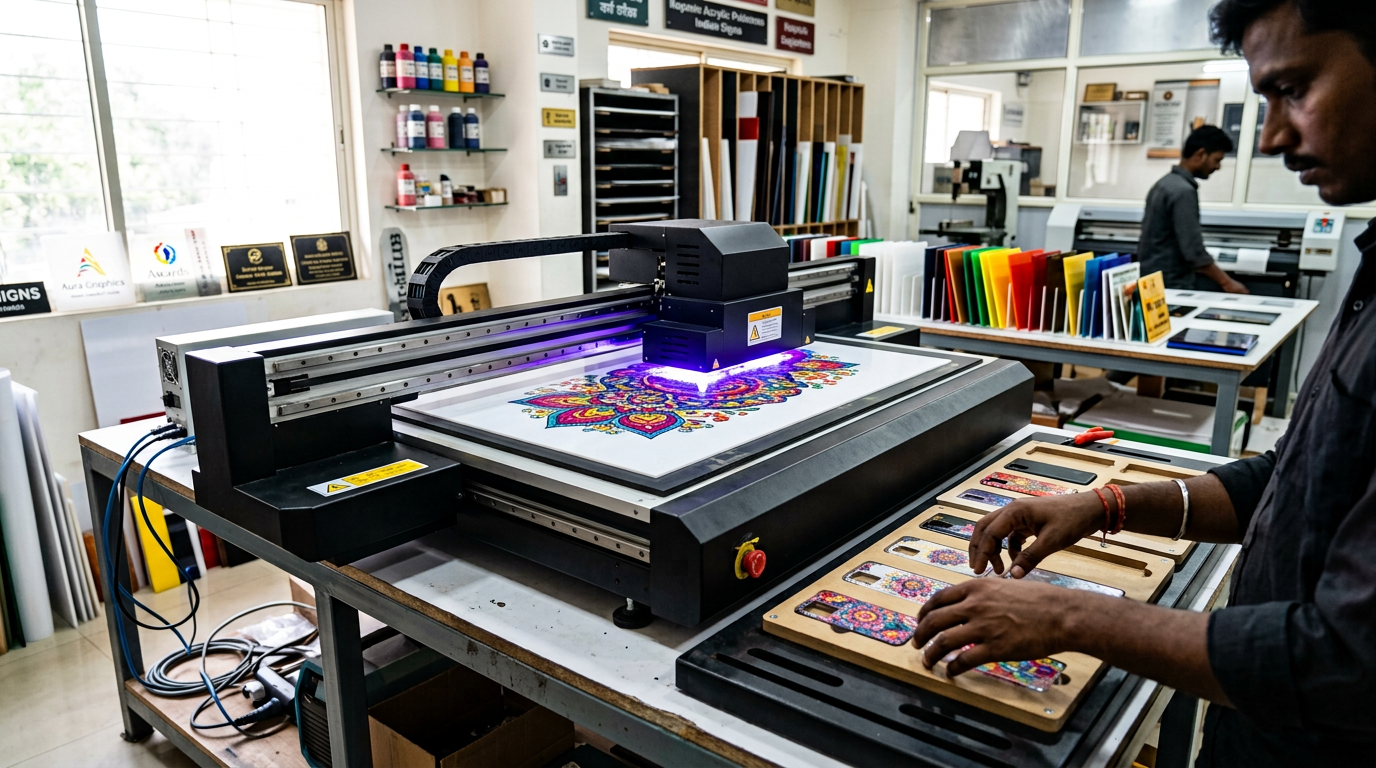
You’ve watched the videos: a machine printing a full-colour phone case in 40 seconds, a glossy acrylic nameplate coming out embossed and premium, a metal trophy plate that looks factory-made. And now you’re searching one question — “UV printer price in India” — and getting answers from ₹45,000 to ₹85,00,000. Both numbers are real. The difference between them is the difference between a toy and a production asset.
UV printing is the fastest-growing segment in Indian digital printing because it does what no other technology can: prints directly on almost anything rigid or flexible — acrylic, sunboard, glass, wood, metal, ceramic, leather, phone cases, bottles, pens — with ink that cures instantly under UV light, no drying time, no coated media required. That versatility is why a single 60×90 cm flatbed can anchor six different businesses.
But it’s also the segment with the widest quality spread and the most misleading pricing in the industry. This guide fixes that. We’ll give you the real 2026 price table by machine type, decode the printhead hierarchy that drives 60% of the price, expose the hidden costs dealers don’t quote, show running-cost math per product, and finish with a buyer’s checklist that filters out the junk. Whether your budget is ₹1.5 lakh or ₹15 lakh, you’ll know exactly what that money should buy.
What Is a UV Printer? (The 60-Second Version)
A UV printer uses special ink that stays liquid until hit by ultraviolet light from LED or mercury lamps mounted beside the printhead. The instant the droplets land, the lamp passes over them and they polymerize — turning from liquid to solid plastic in a fraction of a second. Three consequences follow:
- Any substrate works. The ink doesn’t need to soak in or react with a coating — it sits as a thin polymer layer bonded to the surface. Uncoated wood, raw acrylic, brushed steel, ceramic tile: all printable.
- Zero drying time. Prints come off bone-dry and ready for handling, packing, or second layers — including raised/embossed effects and glossy varnish in the same pass.
- White ink becomes practical. CMYK + White + Varnish channels let you print on dark, black, or transparent materials — printing white first (or last), which eco solvent simply cannot do.
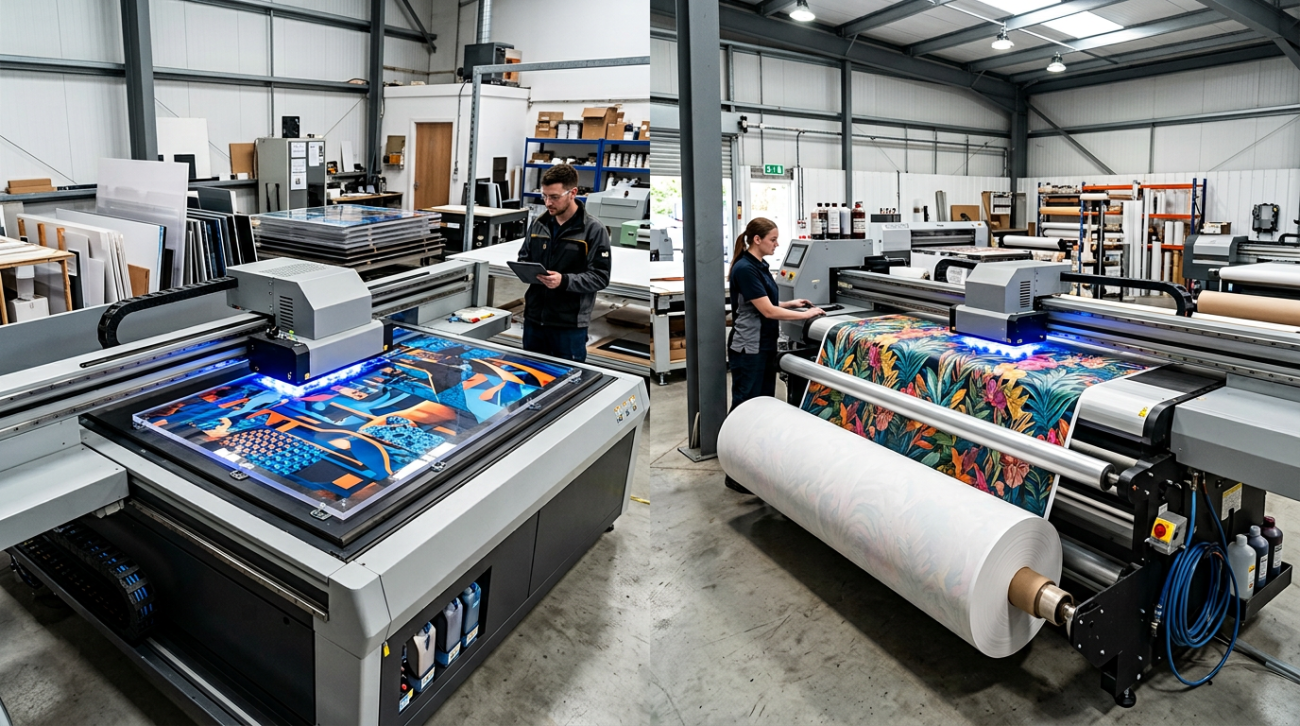
UV printers come in three physical families — flatbed (print stationary objects laid on a bed), roll-to-roll (print flexible media from rolls, like banners/films), and hybrid (both) — plus the newer UV DTF machines that print transfer films instead of objects. The family decides the price band more than anything else, so let’s go straight to the numbers.
UV Printer Price in India 2026: The Full Price Table
These are realistic market ranges for GST-billed machines from established suppliers, landed and installed. Below-market quotes exist — we’ll cover why “cheap” usually costs more within this industry.
| Machine Type (Bed/Width) | Typical Printhead | Price Range (₹) | Best For |
|---|---|---|---|
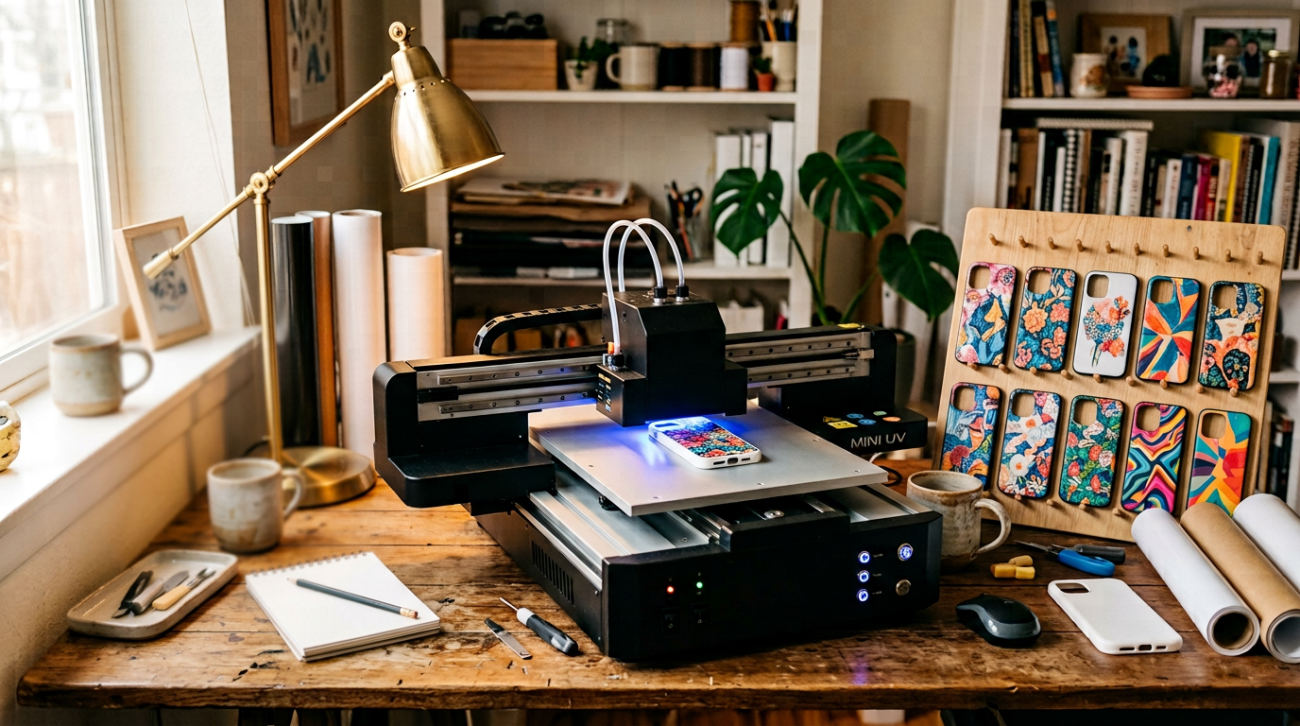
| Desktop A4/A3 UV flatbed (30×50 cm) | Epson XP600/L1800-based | ₹80,000 – 2,20,000 | Phone cases, pens, cards, keychains — gifting startups |
| 6090 flatbed (60×90 cm) | 1–2× Epson i3200-U / Ricoh G5i | ₹4,50,000 – 9,50,000 | The small-business sweet spot — acrylic, sunboard, plaques, signage |
| 9060/13090 flatbed (90×60 to 130×90 cm) | 2–3× Ricoh Gen5/Gen6 | ₹9,00,000 – 18,00,000 | Volume signage, door/window prints, institutional work |
| 2513 large flatbed (250×130 cm) | 2–4× Ricoh Gen5/Gen6 | ₹14,00,000 – 30,00,000 | Full sheets of acrylic/sunboard, furniture panels, factory work |
| Roll-to-roll UV (1.6–1.8 m) | 2–4× Epson i3200-U / Ricoh | ₹6,50,000 – 16,00,000 | Films, wallpapers, flex alternatives, car decals on uncoated media |
| Roll-to-roll UV (3.2 m) | 3–4× Ricoh/Konica | ₹15,00,000 – 40,00,000 | Trade/wholesale volume, wallpapers, exhibition graphics |
| Hybrid UV (flatbed + roll, 1.8–2.5 m) | 2–3× Ricoh Gen5/Gen6 | ₹12,00,000 – 28,00,000 | Mixed rigid+roll shops wanting one machine |
| UV DTF (A3 / 30–60 cm roll) | 2–3× Epson XP600-U/i3200-U | ₹1,50,000 – 6,50,000 | “Crystal” transfer stickers for bottles, helmets, gadgets, curved items |
| Cylinder/bottle rotary UV (dedicated) | Epson/Ricoh + rotary jig | ₹5,00,000 – 15,00,000 | Bottles, tumblers, candles — 360° printing |
Three patterns to notice. First, the printhead dictates the price tier: an Epson-based 6090 sells at ₹5–7 lakh while a Ricoh Gen6 6090 sells at ₹8–12 lakh — same bed size, different production engine. Second, UV DTF machines are the cheapest serious entry into the UV ecosystem right now. Third, once you cross ₹12–15 lakh, you’re buying factory-class throughput that only makes sense against signed B2B volume.
The Printhead Hierarchy: Where 60% of the Price Lives
Two machines with identical beds can differ by ₹4 lakh purely because of the heads inside. Here’s the hierarchy in the Indian market today:
| Printhead | New Head Price (₹) | Nozzles / Native Quality | Life (Typical) | Found In |
|---|---|---|---|---|
| Epson XP600 / TX800 (UV-modified) | ₹18,000 – 35,000 | 1,440 nozzles; good detail, slower | 8–15 months | Desktop A3/A4 units, entry flatbeds, UV DTF |
| Epson i3200-U / i1600-U | ₹55,000 – 85,000 | 3,200 nozzles; excellent quality-speed balance | 18–30 months | The modern mid-range standard (6090s, hybrids, UV DTF) |
| Ricoh Gen5 (MH5420) | ₹1,20,000 – 1,60,000 | 1,280 nozzles, industrial duty cycle, greyscale | 3–5 years | Serious flatbeds 9060 and up |
| Ricoh Gen6 / G5i | ₹1,50,000 – 2,40,000 | Faster firing, finer drops; current industrial king | 4–6 years | Premium flatbeds, high-speed hybrids |
| Konica 1024i / Toshiba CE4M | ₹90,000 – 1,80,000 | Industrial middle tier | 3–5 years | Large 3.2m roll machines, some flatbeds |
The classic trap: a dealer quotes a “6090 UV printer at ₹2.9 lakh” — unbelievable value, until you discover one grey-market XP600 head inside that will need replacement every year at ₹25,000 while printing at half i3200 speed. An honest ₹5.5 lakh dual-i3200 machine out-earns it by the second quarter. Never compare UV machines on bed size alone — compare printhead model, head count, and channel configuration first.
Channel configuration is the second quiet spec. UV machines run CMYK + White + Varnish (sometimes + Light Cyan/Light Magenta). On single-head machines, all channels share one head — white and varnish share firing slots with colour, slowing layered jobs dramatically. Dual/three-head machines dedicate heads to colour vs white/varnish — which is why the same bed can print a white-backed transparent acrylic piece 3× faster.
Configuration Deep-Dive: The Specs That Actually Matter
| Spec | What to Look For | Red Flag |
|---|---|---|
| Ink channels | CMYK + W + V standard; Lc/Lm optional for photo work | “CMYK only” machines sold as UV — no white = no dark/transparent substrates |
| Curing lamp | LED lamp (cool, 20,000+ hr life, instant on/off) | Old mercury lamps — hot, 1,000-hr bulbs, cooks thin media, slow startups |
| Bed vacuum suction | Adjustable-zone vacuum holds media flat | No vacuum = warped sheets = head strikes (the #1 flatbed killer) |
| Print height clearance | 10 cm+ adjustable Z (box printing, thick objects) | Fixed 3–5 cm height — severely limits product range |
| Anti-collision sensors | Carriage stops on object contact | No sensors: one misaligned plaque = ₹80,000 head damage |
| RIP software | Licensed Maintop/Onyx/PhotoPrint/PrintFactory with white-layer tooling | Cracked RIP, no white-ink channel control, dongle “to be given later” |
| White ink circulation + stirring | Auto agitation & circulation system | Static white ink system = settled pigment = clogged white channel in weeks |
| Ball screw / linear rails | HIWIN/THK-grade linear motion | No-name rails — banding appears as they wear, unfixable |
When two quotes differ by ₹1.5 lakh on the “same” specs, this table is where the missing money hides. Ask for the machine’s spec sheet in writing with brand names — rail brand, RIP version, lamp type, pump brand — and vague answers become impossible.
What Each Price Tier Really Buys (₹1.5L vs ₹6L vs ₹15L vs ₹30L)
- ₹80,000–2.2 lakh (Desktop A3/A4): Your garage/turnkey entry into gifting. Phone cases, pens, ID cards, keychains, small plaques. Realistic output: 80–150 phone cases/day. Perfect first machine; will be outgrown — and that’s fine, that IS the plan.
- ₹4.5–9.5 lakh (6090 flatbed, the sweet spot): The full product menu: acrylic signage, sunboard, A2 frames, awards, door prints, glass panels, boxes — plus jigs that print 24 phone cases at once. This tier runs proper businesses; most successful UV shops in India live here.
- ₹9–18 lakh (9060+, Ricoh-powered): Adds speed and industrial heads. For shops with recurring dealer/institutional orders where the 6090’s speed becomes the ceiling.
- ₹14–30 lakh (2513 large format): Full 8×4 ft sheets off the shelf — the furniture panel, signage factory, exhibition-fabricator market. This is not a “startup machine”; it’s a capacity play against existing order flow.
- ₹1.5–6.5 lakh (UV DTF): Different beast: prints transfer films, not objects. Insanely profitable per square foot for curved/odd items (bottles, helmets, appliances) that flatbeds can’t hold. Often bought ALONGSIDE a flatbed, not instead of one.
The Hidden Costs: Your Real Setup Budget
The machine is 65–75% of the true bill. Budget honestly for the rest:
| Item | Realistic Cost (₹) | Notes |
|---|---|---|
| UV ink starter set (CMYK+W+V, 500ml–1L each) | 18,000 – 45,000 | Dealers often include partial sets — confirm quantities in writing |
| Air compressor (for vacuum bed/air cooling) | 8,000 – 18,000 | Oil-free type preferred; sized to bed area |
| UPS/servo stabilizer (3–5 kVA) | 25,000 – 50,000 | Non-negotiable — power spikes kill UV boards and lamps |
| Chiller (for LED lamp/Ricoh head cooling loops) | 15,000 – 35,000 | Required on most Ricoh machines; sometimes bundled — check |
| Work table, jigs, fixtures stock | 10,000 – 30,000 | Acrylic jigs for phone cases/lighters etc. — you will make many |
| Sample substrates starter stock | 8,000 – 15,000 | Acrylic sheets, sunboard, phone cases, glass panes for practice/sampling |
| Exhaust/ventilation fitting | 3,000 – 8,000 | UV LED smell is mild but present; ventilate the room |
| RIP PC (if not included) | 40,000 – 60,000 | 16–32GB RAM, SSD — white-layer files are heavy |
| Freight + insurance | 10,000 – 30,000 | 2513 machines are 500–800 kg crated — forklift/unloading clarity needed |
Rule of thumb: machine price × 1.35 = your honest at-the-door number. A “₹5 lakh machine” is a ₹6.7 lakh working setup. Dealers know this math; the good ones quote it upfront.
Running Costs per Print: The Unit Economics
UV ink pricing (2026, quality Indian/Chinese brands): ₹2,400–4,500/litre for CMYK; white runs 10–20% dearer; varnish similar to CMYK. Consumption is remarkably low per item because drops are small and layers thin:
| Product | Ink per Piece (approx) | Ink Cost/Piece (₹) | Typical Sell Price (₹) | Ink % of Price |
|---|---|---|---|---|
| Phone case (CMYK+W) | 0.4 – 0.7 ml | 2 – 5 | 250 – 600 | <2% |
| Acrylic keychain | 0.2 – 0.4 ml | 1.5 – 3 | 80 – 250 | <3% |
| Metal/MDF trophy plate (A5) | 1 – 2 ml | 5 – 12 | 350 – 900 | ~3% |
| 12×18″ acrylic photo print | 6 – 10 ml | 25 – 60 | 800 – 2,500 | ~4% |
| 8×4 ft sunboard sign | 40 – 70 ml | 150 – 350 | 2,500 – 6,000 | ~6% |
| UV DTF transfer (10×15 cm) | 0.5 – 0.9 ml + film | 8 – 18 (with film) | 120 – 300 | ~6–8% |
The revelation for newcomers: ink is NOT your cost problem in UV — substrates and time are. The business wins or loses on product sourcing and order flow, which is why UV economics reward value-added products (awards, decor, branded gifts) over commodity printing.
New vs Grey Import vs Refurbished
- New, Indian assembler with GST bill: The recommended route. You get installation, training, local warranty (heads typically 3–12 months conditional), spares access, and someone to call. Pay the premium; it’s cheaper than the alternative by month four.
- Direct China import (Alibaba, self-imported): 20–30% cheaper headline… plus 28–37% landed duty/GST/freight, zero onsite warranty, RIP dongles that phone home to China, and Indian voltage/power your machine never met. Chosen only by experienced operators with a local technician friend.
- Refurbished/demo machines: Can be excellent (dealer demos, trade-ins at 40–60% of new) or catastrophic (sun-dried white ink systems = ₹1.5 lakh of nozzle surgery). Insist on live demo printing white on black acrylic, and get head hours/counter readings photographed.
Financing & EMI Reality Check
Most established suppliers offer finance tie-ups: typically 20–30% down, 12–36 month EMIs, and rates that translate to ₹3,000–3,400/lakh/month on 3-year terms. On the 6090 sweet-spot machine, expect roughly ₹15,000–22,000 EMI/month. The coverage math: a 6090 printing just phone cases (₹4 ink, ₹80 substrate, ₹350 sale = ~70% margin) needs roughly 85–90 cases/month to cover EMI alone — about 3–4 cases/day. Add acrylic signage and corporate gifting, and the EMI becomes background noise within a quarter. MSME/Udyam registration unlocks collateral-free schemes and easier machinery loans — register before applying.
Buyer’s Checklist: 12 Verifications Before You Pay
- Machine demonstrated live printing CMYK + white + varnish on black acrylic and on transparent glass — the two tests that expose every weakness.
- Printhead model, count, and channel split written on the quotation (not “Epson-type” — the exact model).
- RIP name, version, licensed in your name, dongle in hand at delivery.
- White ink circulation/stirring system demonstrated working.
- LED lamp brand and rated life; chiller requirement confirmed (included or extra?).
- Vacuum bed zones tested with a warped sunboard sheet.
- Anti-collision sensor tested with an obstinate object under the carriage.
- Warranty terms in writing: heads (months?, ink conditions), boards, lamps, onsite labour.
- Spare parts price list for the machine (heads, dampers, pumps, lamps) attached to the invoice.
- Installation + training days specified (2–4 days standard), trainer’s name known.
- GST invoice with full machine value — no bill, no warranty, no input credit.
- Two reference customers running this model for 6+ months — called, not just named.
City-Wise Buying Reality: Where You Buy Changes What You Pay
UV machine supply in India concentrates in a handful of hubs, and your distance from them shows up on the invoice. Delhi NCR (the largest assembler cluster), Ludhiana, Ahmedabad/Surat, Mumbai, Bengaluru, and Hyderabad hold most serious suppliers; other cities are often served through dealers adding 8–15% margins and thinner service benches.
| Scenario | Price Effect | Service Reality |
|---|---|---|
| Buying in your metro’s assembler hub (NCR, Ahmedabad, Mumbai, Bengaluru) | Base price; negotiation room 3–7% | Same/next-day engineer; spares off the shelf |
| Buying through a regional dealer (tier-2/3 cities) | +8–15% dealer margin | First-line local support, escalations to principal — verify response times in writing |
| Buying from a hub, shipping to tier-3 city | Base price + ₹15,000–40,000 freight & insurance | Remote diagnostics + engineer travel days — negotiate AMC terms at purchase, not after |
| Direct China import | −20–30% headline, then duty/GST/freight close the gap to −5–10% | You are the service department. For experienced operators only |
The sweet spot most smart buyers use: shortlist two hub assemblers + your nearest dealer, get all three quotes on paper, then decide on total cost of ownership and service distance — not the invoice number alone.
The Demo-Day Script: What to Test in the Seller’s Showroom (90 Minutes)
Never buy a UV machine on videos. Blocks of 90 focused minutes in front of the actual machine reveal more than any spec sheet:
- White-on-black acrylic print, high coverage (15 min). The single most revealing test: white density, white/colour registration, and curing completeness all expose themselves. Scratch the fresh print with a fingernail after 5 minutes — properly cured UV shrugs it off.
- Transparent glass/acrylic print with white backing (15 min). Layers in the wrong order or weak white opacity kill most backlit/nameplate jobs; this test is their preview.
- Embossed/varnish effect pass (10 min). Asks the machine for stacked layers; watch alignment drift between passes.
- Drop a warped sunboard sheet on the bed. Does the vacuum hold it flat enough? Is anti-collision armed? Sellers slightly anxious at this test have reasons.
- Open the white-ink system (5 min). Circulation pump running? Stirring motor? Sight tubes clean or milky-coated with settled pigment? The machine’s white-ink maintenance discipline is visible here at a glance.
- Ask the RIP operator to build a white layer from YOUR design file (15 min). You’re testing the RIP’s white tooling AND the trainer’s competence simultaneously.
- Print YOUR file at production quality, timed. Not their demo file tuned for speed — yours. Note square-feet-per-hour at sellable quality; that number, not the brochure’s, feeds your ROI math.
- Photograph head-hours counters and serial plates. On demo/refurb machines this is forensic; on new machines it’s baseline proof.
A supplier uncomfortable with this script has just told you the answer. The right supplier usually adds two tests of their own — they’re proud of exactly the things bad actors deflect.
Season of Purchase: Timing the Deal
UV machine pricing has a soft seasonality worth using. Quarter ends (June/September/December/March) and pre-Diwali bring scheme windows — free ink sets, extended warranties, 3–5% price flexibility — as assemblers chase targets. The worst times to demand discounts: the exact weeks of festive production peaks, when service benches are stretched and sellers don’t need you. The best month to place an order for calm installation and training: late January to March — vendor benches are free, your machine gets unhurried commissioning, and you’re calibrated before the wedding/festive gifting rushes.
Three Real Buyer Sketches (and What They Should Spend)
Sketch 1 — Priya, home-gifting startup, Jaipur: Instagram audience, mostly phone cases and photo frames, budget ₹2 lakh total. Correct buy: Tier-1 desktop A3 at ₹1.4–1.7 lakh all-in. Wrong buy: stretching to a 6090 and starving the ink/samples budget. Her 6090 arrives in month 10, paid by Tier-1 profits.
Sketch 2 — Ramesh, trophy & awards shop, Indore: Existing engraving customers, adding full-colour+emboss. Budget ₹7 lakh. Correct buy: dual-i3200 6090 with varnish emphasis and rotary jig for mugs/bottles; negotiate two extra training days for embossed layering. Wrong buy: cheaper single-head 6090 saving ₹1.2 lakh — his award jobs are white/varnish-layer-heavy; the single head becomes his bottleneck from week three.
Sketch 3 — Signage fabricator, Ahmedabad: CNC router running acrylic letters; panels outsourced. Correct buy: 9060 Ricoh flatbed at ₹14–17 lakh, justified BY the outsourcing bills (bring the math: current monthly panel spend × margin = machine EMI covered plus profit). Wrong buy: the “economical” entry flatbed that can’t hold his 8×4 workflows and sits half-idle while outsourcing continues.
The pattern: the right machine is the one whose monthly output capacity matches your nearest constraint — demand for Priya, layering speed for Ramesh, sheet size for the fabricator. Price tiers follow constraints; constraints never follow price.
5 Questions That Expose a Bad UV Machine Quotation (Ask Every Seller)
- “Which printhead model, count, and channel split — written on the quote?” “Epson-type” or “high-speed industrial” answers hide the 60% price driver. No head model in writing → no deal.
- “Is the white-ink circulation and stirring system included and demonstrated?” Static white systems clog in weeks; sellers deflecting this question already know it.
- “Show me the RIP dongle and license in my name — before final payment.” A machine without licensed RIP is a shell; the ₹15,000–60,000 you “saved” arrives as software captivity.
- “Attach the spare-parts price list for this model to the quotation.” Heads, dampers, cap tops, pumps, lamps — sellers confident in their supply chain attach it in five minutes; traders go quiet.
- “Give me two customers running this exact config for 6+ months — I’ll call them myself.” The single most honest-making sentence in machinery buying.
The Price-History Lens: Where UV Prices Are Heading
Context for negotiation expectations: 6090-class prices declined steadily through 2023–2025 as Indian assembly matured (the dual-i3200 6090 that asked ₹8–9 lakh in 2022 asks ₹5–7.5 lakh now), while Ricoh industrial tiers held value thanks to genuine capability differences. Expect gentle further softening in Epson-class tiers through 2026 as more assemblers enter — but don’t wait for the “bottom”: a machine’s productive months out-earn any price dip you’re waiting for. A good machine working from Diwali beats the same machine ₹30,000 cheaper in March. Buy on readiness (yours and the market’s), not on speculation about next quarter’s pricing.
The One-Line Rule of UV Machine Buying
After the tables, checklists, and math of this guide, the decision compresses into one sentence that veterans repeat to every newcomer: buy the printhead configuration and the after-sales network, not the bed size and the discount — because in UV printing, the machine is the smallest part of what you’re actually purchasing. What you’re buying is uptime, output quality, and the phone number that answers in month nine. Price those correctly, and every ₹ in the machine table makes sense; price only the machine, and none of them protect you.
The Post-Purchase Regret Index (and How to Dodge Each One)
| Regret (Ranked by Frequency) | Prevention |
|---|---|
| “Bought too-small Z-height; can’t print boxes/bottles” | Specify 10–15 cm clearance on day one; the ₹20–40k upgrade is permanent capability |
| “Single head makes layered jobs crawl” | Dual-head configurations for any W/V-heavy product plan |
| “Cheap white-ink system; constant channel trouble” | Circulation+stirring demonstrated before signature, non-negotiable |
| “No local service; week-long downtimes” | Service-distance verified with two reference customers before purchase |
| “Compressed the UPS/compressor budget; boards suffered” | Power/air infrastructure at 100% commitment, always |
Every line in that regret index was available as a free decision at purchase time. They become expensive only afterwards — buy deliberately, and hindsight never gets its chance.
The 30-Day Post-Purchase Plan (What Success Looks Like After Delivery)
| Days | Focus | Done Means |
|---|---|---|
| 1 – 3 | Commissioning + training recorded | All SOPs documented; first perfect white-on-black print archived |
| 4 – 10 | Substrate hunting: every material you’ll ever sell | Printed samples across 12+ substrates; settings diary per substrate started |
| 11 – 15 | Product samples + jig templates | 6 flagship products flawless and photographed; jigs built |
| 16 – 22 | Soft-launch to warm network | 10+ paid orders at introductory pricing; review collection rolls |
| 23 – 30 | Rate card freeze + B2B outreach | Price-list published; first 10 B2B visits done; order-book forming |
The mistake alternative common enough to warn explicitly: weeks of “still testing/machine aayi abhi” paralysis — month one IS marketing time. A 6090 quietly printing samples invisible to the world is an EMI, not a business. Publish, price, and visit customers in week one; your competence and your cash flow grow together or not at all.
Quote-Normalization Worksheet (Compare Like a Professional)
When three quotes land, this is the normalization discipline: rewrite every quote into the SAME component list (machine+heads spec, licensed RIP, ink sets with litres stated, freight, installation days count, training days, warranty parsed as parts/labour/response clocks, parts price list attached or not). The total at the bottom — everything included, everything owned — is the comparable number. Quotes that resist normalization (uncounted extras to follow later) have answered the comparison already.
Frequently Asked Questions (FAQs)
What is the price of a UV printing machine in India in 2026?
From ₹80,000 for desktop A4/A3 units to ₹40 lakh for industrial 3.2m roll machines, most serious small businesses buy the 6090 flatbed class at ₹4.5–9.5 lakh with Epson i3200-U or Ricoh heads.
Which UV printer is best for a small business in India?
A 60×90 cm flatbed with dual Epson i3200-U heads, CMYK+White+Varnish, LED curing, vacuum bed, and auto-circulating white ink — from an assembler with local service. It covers ~90% of profitable UV products.
How much does UV ink cost per litre?
Quality CMYK UV ink: ₹2,400–4,500/litre; white and varnish 10–20% higher. Per-product ink cost is tiny (₹2–5 on a phone case that sells for ₹300+).
Can a UV printer print on metal, glass, and wood?
Yes — directly, without coating, though adhesion promoters/pretreatment improve scratch resistance on glass and glossy metals. That substrate freedom is UV’s core advantage.
What is the difference between UV flatbed and UV DTF?
Flatbeds print objects placed on the bed; UV DTF prints onto transfer film whose “crystal sticker” you apply by hand to curved/awkward items. They’re complementary, not competitors.
Is UV printing business profitable in India?
Among the most profitable print segments: 60–80% gross margins on value-added products, low ink costs, and undersupplied local markets outside metros. The winners pick product niches; the losers try printing everything for everyone.
How long do UV printheads last?
Epson-based: 8–30 months depending on model and care; Ricoh industrial heads: 3–6 years. White-ink discipline (circulation, daily nozzle checks) is the biggest life factor.
Final Verdict: Which UV Printer Should You Buy in 2026?
For most readers still comparing prices at midnight: the answer is a 6090 flatbed with dual i3200-U heads at ₹5–7.5 lakh, from an assembler you can visit, with 1.35× budgeted for the full setup. It’s the highest ROI square foot in Indian digital printing right now — small enough for a 150 sq ft room, big enough for the entire IndiaMart catalogue of profitable UV products.
Tight budget? Enter through a quality desktop A3 unit or UV DTF machine at ₹1.5–2.5 lakh, prove demand, and let the 6090 be your second machine bought from profit. Signed B2B volume already in hand? Jump straight to Ricoh-powered 9060/2513 territory and don’t look back. But whatever the tier, buy the printhead, the brand names, and the after-sales network — never the bed size and the discount.
Want honest machine options at real prices? Explore our UV printer range — flatbeds, hybrids and UV machines with Epson i3200-U and Ricoh heads, licensed RIPs, installation, training and pan-India spares support. Tell us your product plan and city, and we’ll recommend a configuration with transparent, GST-billed pricing.