



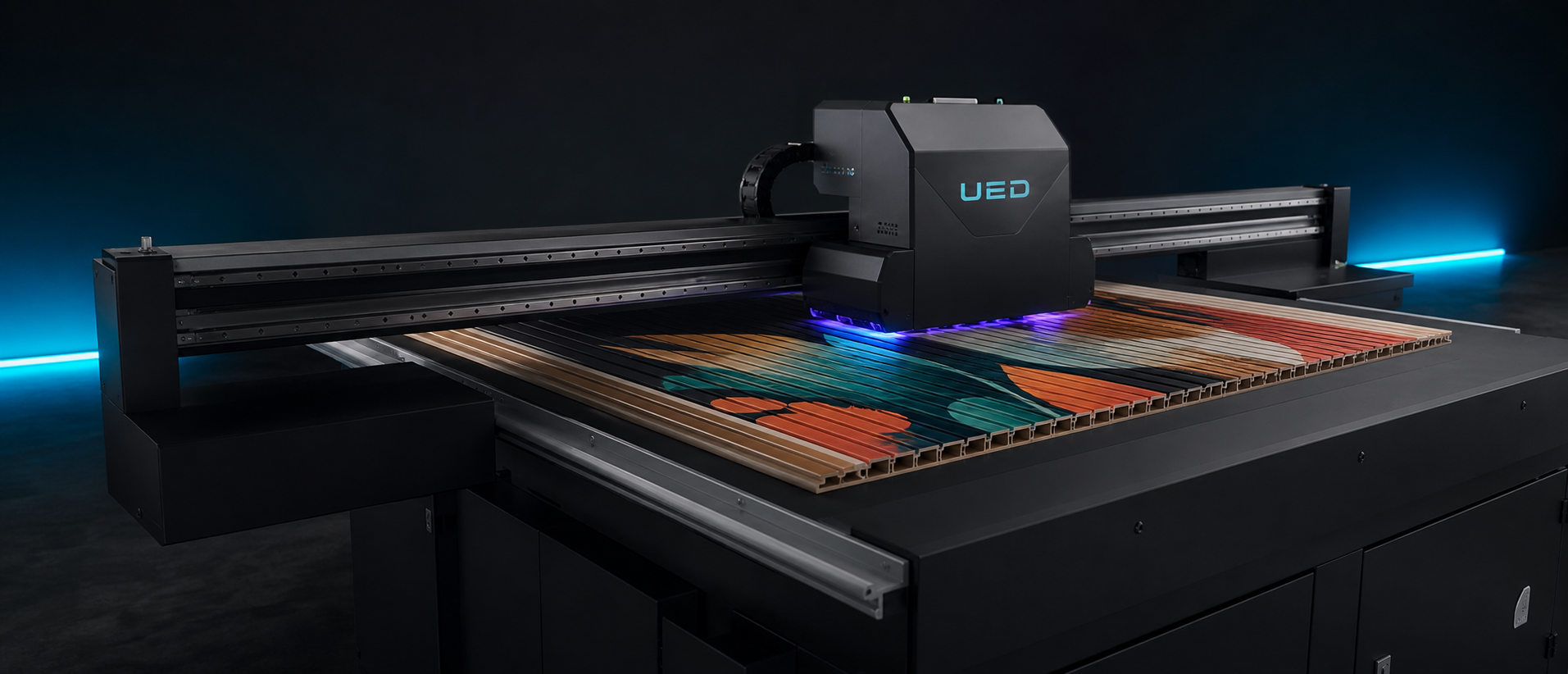
WPC — wood-plastic composite — is one of the fastest-growing materials in Indian interiors and exterior decking, and it presents a genuinely interesting challenge and opportunity for UV print shops. WPC boards (foamed WPC for cabinetry and wall cladding, and denser composites for decking and fencing) are waterproof, termite-proof and dimensionally stable, which makes them superior to MDF for many applications. Printing them directly with UV ink extends that appeal into branded, decorative and wood-grain finishes. Here is how to do it properly.
What WPC is and why it behaves differently
WPC is a blend of wood fibre or flour and thermoplastic (PVC or PE), extruded into boards. The plastic matrix that gives WPC its waterproof strength is also a lower-surface-energy material than solid wood, so ink adhesion is the central engineering question. Unlike porous MDF, WPC does not absorb ink; unlike glass, it is not perfectly smooth. The surface is slightly waxy and can carry extrusion lubricants or release agents from manufacture. All of this means that preparation and ink choice matter more than on almost any other rigid substrate.
Adhesion: test first, always
Because WPC formulations vary by manufacturer — different wood/plastic ratios, additives and surface treatments — adhesion is not uniform across brands. The professional habit is to print a test swatch on the exact board you will use, cure it fully, then run a cross-hatch tape test and a light scratch test. If the lattice lifts, you need an adhesion promoter or a different ink set. Many flexible UV inks bond acceptably to PVC-based WPC after a wipe-down; PE-based composites are the harder case and often need primer or flame/plasma treatment.
Surface preparation for WPC
- Wipe the print face with isopropyl alcohol to remove extrusion lubricants, dust and handling grease.
- Lightly abrade glossy co-extruded caps (common on decking) with a fine abrasive pad to give the ink a key.
- Where adhesion is marginal, apply a compatible adhesion promoter and let it flash off.
- Ensure boards are at ambient temperature; cold WPC can fog with condensation.
- Support long boards fully on the bed — WPC can bow slightly and change head gap.
Applications where printed WPC wins
The demand is real and growing. Interior cladding and ceiling panels printed with wood grain or stone replace costlier finishes and survive damp rooms where MDF fails. Kitchen and bathroom cabinetry in foamed WPC takes printed doors that will not swell. Exterior decking, fencing and pergola components can carry subtle tinted or grain effects. Retail and exhibition builders use WPC for durable, reusable branded structures. Because WPC is routed and fixed like wood, a printed panel drops straight into normal carpentry workflows.
Machine choice for WPC
WPC boards are rigid and frequently long — cladding and decking profiles run several metres. A UV flatbed printer with a long bed or the ability to handle oversize boards is the natural fit; a UV hybrid printer adds roll capability for shops that pair WPC panels with flexible graphics. Because adhesion often depends on laying a slightly heavier, flexible ink film, machines with good ink lay-down control and a white channel (for printing on dark or coloured WPC) are advantageous.
White ink, colour and realistic grain
Much WPC is sold in mid or dark tones, so a white under-base is often required to make a printed wood grain or light décor read correctly. UV white ink handles this well. For realistic wood effects, print the grain in layers and finish with a matte varnish — a gloss finish over a wood grain reads as fake, while a matte or textured varnish sells the illusion. The combination of WPC’s durability with a convincing printed grain is exactly the product that interior contractors now ask for.
Durability expectations and honest selling
A correctly prepared and printed WPC panel is durable for interior cladding, cabinetry and sheltered exterior use, and the substrate itself remains waterproof and rot-proof. Full-sun, weather-exposed prints (open decking, fencing) will fade over time like any printed exterior graphic; a UV-protective varnish extends life and should be quoted for outdoor work. Being clear about interior versus exterior ratings builds trust and avoids warranty disputes.
Cost and margin
WPC board costs more than MDF, but the finished, printed product competes with veneers, laminates and painted finishes at healthy margins. Ink cost is ordinary; the value is in turning a commodity extrusion into a specified decorative product. Print shops that serve the modular-furniture and cladding trades find printed WPC a strong recurring line, because once a specifier approves a grain or colour, repeat orders follow across whole projects.
Common mistakes to avoid
- Assuming all WPC brands print the same — formulations differ, so test each one.
- Skipping the abrasion step on glossy co-extruded surfaces.
- Printing through dust or lubricant and blaming the ink for adhesion failure.
- Using a gloss varnish over wood grain and undercutting the realism.
- Quoting open-exterior work without a UV varnish and a fade disclaimer.
Frequently asked questions
Is WPC better than MDF for printed cabinetry?
For wet or humid areas, yes — WPC will not swell. For fine routed detail and paint-grade edges, MDF still has the edge. Many shops offer both.
Can I print on the capped side of decking boards?
Yes, after light abrasion and a wipe-down; the cap is the hardest surface, so adhesion testing is essential.
Do I need primer on every WPC job?
No. PVC-rich WPC often bonds with a simple wipe. Keep an adhesion promoter on hand for PE-rich or problematic boards.
Interior versus exterior: specifying correctly
Interior WPC work — cladding, ceilings, cabinetry, retail fixtures — is the sweet spot: the print is protected from weather and the substrate’s waterproof nature solves every moisture problem MDF has. Exterior work is possible but must be specified: use a UV-protective varnish, prefer lighter inks (dark colours fade faster), and set customer expectations on fade life for full-sun exposure. Decking and fencing are more often tinted or grain-enhanced than fully imaged, which is both faster to print and more forgiving of fade. Drawing this interior/exterior line clearly in quotes prevents most disputes.
Printed WPC versus MDF, PVC foam and laminate
Against MDF, WPC wins anywhere moisture, termites or dimensional movement matter; MDF wins on routed detail and cost. Against PVC foam board, WPC is stiffer and more screw-holding, better for structural fixtures, while PVC foam is lighter for hanging signage. Against laminate, printed WPC offers bespoke designs with no minimum and faster turnaround. Knowing these trade-offs lets you recommend the right board per job and print it confidently, which is exactly the consultative service that wins trade accounts.
Profiles, routing and fixing after print
WPC routes, saws and screws like timber, so a printed board drops into normal site workflows. Cut after printing with a sharp blade, and seal or cap cut ends for exterior boards. For cladding, print full lengths then groove for the fixing system, taking care that grooves land in unprinted or tolerance areas. Because boards are long, a printer with a long bed or good support rollers matters; a UV hybrid printer is a sensible choice where you also print the flexible graphics that accompany WPC fit-outs.
Sustainability and the specification conversation
WPC is often chosen partly for its green story: it uses wood waste and recyclable plastic and avoids harvesting solid timber. UV printing complements that story — it is a low-VOC, low-waste decoration method with no solvent emissions and no offcuts of laminate. For architects and developers with sustainability targets, a waterproof board decorated by a dry, low-emission process is an easy specification. Lead with durability and low maintenance, support with the environmental angle, and back it with a printed sample pack.
Quality control and maintenance for composite work
Because adhesion varies by board brand, keep a test log: board brand, prep method, ink, cure, and tape-test result. Re-run the test whenever a board supplier changes a batch. Maintain white ink circulation for dark boards, keep the bed clean of composite dust (WPC cutting dust is abrasive and must not live near your printer), and store boards flat so they do not bow into the head path. This discipline makes WPC a dependable, repeatable product line.
Who buys printed WPC
Modular furniture and kitchen makers, cladding and false-ceiling contractors, retail and exhibition builders, decking and fencing installers offering tinted finishes, and interior designers specifying feature walls. The common thread is a trade that already buys WPC and now wants it decorated — making printed WPC a natural upsell for any print shop serving the interior and construction trades.
Building a sample pack that sells for you
Because WPC adhesion and finish quality vary by board, your most powerful sales tool is a physical sample pack: the same grain printed on three or four board brands, each with its prep method noted, plus a textured example, a white-on-dark example and an exterior-varnished example. Contractors and designers specify from what they can hold. A good pack shortens every sales conversation, pre-answers the “will it stick?” question, and positions you as the expert. Update it whenever you qualify a new board or ink, and keep the tape-test results that back each sample so your claims are provable.
Pricing printed WPC work
Price WPC by the finished value, not the ink. Interior cladding and cabinetry projects are quoted per square foot of decorated board with premiums for texture, white under-base on dark boards and exterior varnish. Because WPC board itself costs more than MDF, pass the substrate through transparently and take your margin on the decoration and service. For trade accounts, a small per-project design fee plus a per-board rate keeps margins honest across large fit-outs. The repeatability of approved grains means later phases of a project reprint at near-zero design cost, which is pure margin.
Troubleshooting adhesion on problem boards
When a tape test fails, work the variables in order: cleanliness (alcohol wipe again), abrasion (a finer or coarser pad), cure (ensure full lamp power and correct speed so the ink is fully cured before testing), then promoter. Only after those, consider a different ink set. Log the winning combination per board brand so the next operator does not re-derive it. Remember that some capped decking boards are designed to shed everything, including ink; for those, mechanical keying through abrasion plus promoter is the reliable route, and if a cap simply will not hold, print the uncapped back or a trim piece instead and be honest with the customer.
Where the market is heading
WPC adoption in Indian interiors continues to rise as builders and consumers learn its waterproof, termite-proof advantages, and decoration is the natural next step after installation. As more cladding and cabinetry brands offer printed finishes, the shops that qualified adhesion early and built sample libraries will hold the specification relationships. UV printing’s ability to run one-off panels also supports the customisation trend across interiors. In short, printed WPC is an early-market opportunity with durable demand behind it — a good line to build now.
Getting started with WPC this quarter
A sensible first month is: source three or four WPC board brands your trade already uses, run prep and tape tests on each, print a small library of grain and colour samples with matte and textured varnish, and assemble a sample pack with the prep method written on the back of every piece. Then take it to the five accounts most likely to specify cladding or cabinetry and offer a pilot panel at cost. One approved specification typically turns into a project, and a project turns into a standing line item. WPC rewards the shop that proves adhesion before selling, and the barrier to entry is diligence rather than expensive equipment.
Conclusion
WPC is a growth substrate: waterproof, stable and increasingly specified, and UV printing is the technology that gives it a decorative face. Success comes from respecting its low-energy surface — test, wipe, abrade, and prime where needed — and from selling realistic grain and texture finishes with the right varnish. If you are adding WPC to your offering, look at our UV flatbed printers for rigid boards or talk to us about ink adhesion options for composites.
