

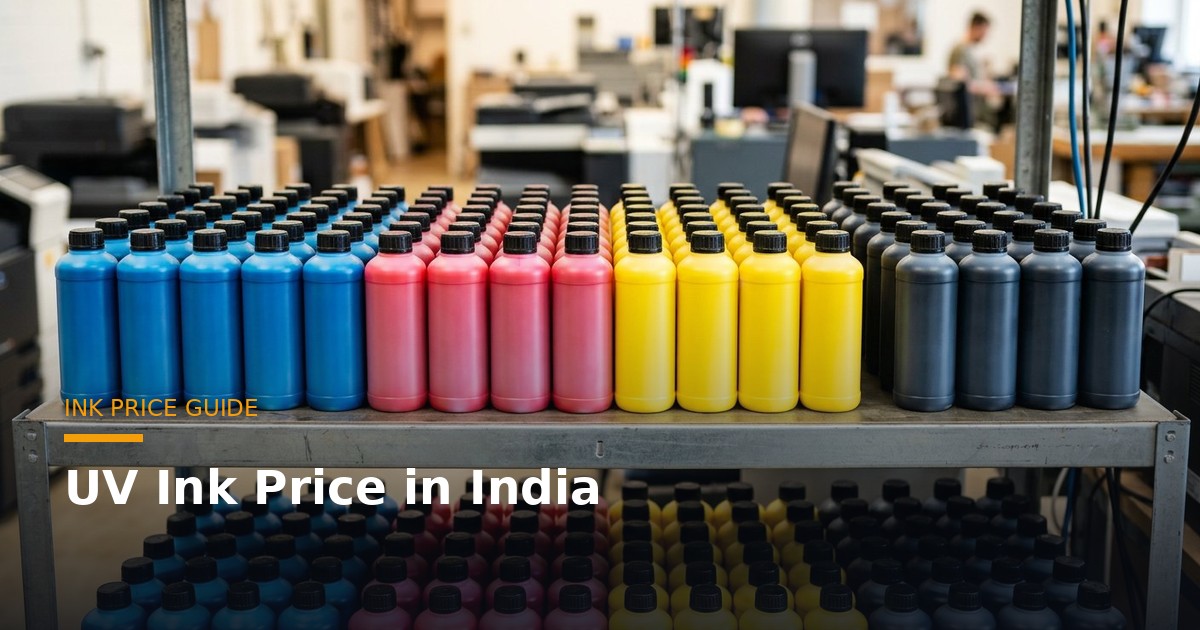
UV ink powers the fast-growing UV printing segment in India — printing directly onto acrylic, wood, glass, metal, PVC and more for signage, décor, packaging and personalised products. It is a specialised, premium ink, and its cost is a significant part of running a UV printer. This guide gives you current per-litre UV ink prices in India across the different types (CMYK, white and varnish), explains what drives the cost, shows how to calculate your ink usage, and helps you buy quality UV ink that protects your printer and your output.
UV Ink Price in India (Per Litre)
UV ink is a premium product, priced higher than solvent or eco-solvent ink because of its specialised UV-curable formulation. Indicative market ranges for 2026:
| UV Ink Type | Indicative Price (per Litre) | Notes |
|---|---|---|
| Standard UV CMYK ink | ₹1,500 – ₹3,000 | Base colours for most UV work |
| Premium UV CMYK ink | ₹3,000 – ₹5,000+ | Best colour, adhesion, cure |
| UV white ink | ₹2,500 – ₹5,000 | Opaque white for dark/transparent media |
| UV varnish / gloss ink | ₹2,000 – ₹4,000 | Gloss and texture effects |
UV ink costs significantly more per litre than solvent inks, but UV printing serves higher-value applications — premium signage, décor, awards, industrial parts — where the output commands better prices that justify the ink cost.
What UV Ink Is and How It Works
UV ink is fundamentally different from solvent ink. Instead of drying by evaporation or absorption, UV ink cures instantly when exposed to UV light — the UV energy triggers a chemical reaction that hardens the ink onto the surface. This is why UV printing can print on almost any rigid or flexible material, including non-porous surfaces like glass, metal and acrylic that solvent ink cannot adhere to. The instant cure also means no drying time and no solvent fumes. This unique chemistry is what makes UV ink more expensive — it contains specialised photoinitiators and resins — but it is also what gives UV printing its remarkable versatility and durability.
The Different Types of UV Ink
UV printing uses several ink types, each with a specific role. CMYK inks provide the four process colours for full-colour printing. White ink is essential for printing on dark or transparent media — it lays an opaque white base so colours show correctly, and is central to much UV work. Varnish (gloss) ink adds glossy or textured finishes for premium effects. Some UV printers also use speciality inks for specific effects. White and varnish inks are typically priced higher than standard CMYK because of their specialised formulations. Understanding which inks your typical jobs require helps you budget accurately, since white-heavy or varnish-heavy work uses more of the pricier inks.
What Affects UV Ink Prices
UV ink pricing is driven by several factors. Formulation quality is paramount — premium UV inks with better photoinitiators, resins and pigments cure more reliably, adhere better and produce superior colour, and cost more. Brand and origin matter, with imported premium inks costing more than local options. Ink type affects price, with white and varnish typically costing more than standard CMYK. Raw-material and import costs feed through, so prices track the rupee–dollar rate and chemical costs. And volume buying usually earns a better per-litre price. Because UV ink is already premium, quality matters even more — poor UV ink cures badly, adheres poorly and can damage expensive UV printheads.
How Much UV Ink Does Your Printer Use?
UV ink consumption depends on coverage, the number of ink layers (white base plus colour, for example) and print settings. Because UV work often involves white underbase and varnish layers, usage can be higher per square foot than simple solvent printing. As a rough guide, UV printing might use 10–25 ml per square foot depending on the job — a simple colour print uses less, while a white-plus-colour-plus-varnish job on rigid media uses considerably more. At around ₹2,500 per litre for CMYK (₹2.5 per ml), that is roughly ₹25–₹60+ of ink per square foot. UV ink is a major cost, which is why UV output is priced at a premium.
Why UV Ink Costs More — and Why It’s Worth It
UV ink’s higher cost is justified by what it enables. It prints on virtually any material — rigid, flexible, porous or non-porous — opening markets solvent printing cannot reach: acrylic signage, wood and glass décor, metal panels, packaging prototypes, personalised products and industrial parts. The instant cure means fast turnaround with no drying time. The output is durable, scratch-resistant and vibrant. And UV printing serves premium applications where customers pay higher prices for the quality and versatility. So while UV ink costs more per litre, the work it produces commands higher margins. For a UV printing business, the ink cost is an investment in capability, not just an expense.
Cheap vs Quality UV Ink: A Critical Choice
With UV ink, quality is even more critical than with solvent inks, because UV printheads (Ricoh, Konica, Toshiba) are expensive and UV ink’s fast-curing nature makes poor ink especially damaging. Cheap UV ink can cure incompletely, adhere poorly, produce inconsistent colour, and — most expensively — clog and damage premium printheads that cost ₹90,000–₹1,50,000 each. A UV machine may have six or eight such heads, so the exposure is enormous. Saving money on cheap UV ink is one of the most dangerous false economies in printing. Always use quality UV ink recommended for your specific printer and heads — it protects a very significant investment and ensures the premium output your customers pay for.
Compatibility with Your UV Printer
UV ink must be precisely matched to your printer and printheads. Different UV printers and heads require specific ink formulations, and using the wrong ink can cause poor curing, adhesion failure or head damage. Ricoh, Konica and Toshiba UV heads each have ink requirements, and the curing system (UV lamps) must also suit the ink. Always use ink recommended for your exact machine, and never switch UV ink brands casually without confirming compatibility. Your machine supplier is the best source of the correct ink. Given the value of UV printheads and the importance of proper curing, using the right, quality UV ink is essential — not optional.
Where to Buy UV Ink in India
Because UV ink is specialised and quality-critical, buy it from reliable sources. Your machine manufacturer or authorised distributor is the best source — they supply ink formulated for your exact printer and heads, ensuring proper curing, adhesion and head safety. Established UV ink distributors can also be good for consistent quality and competitive bulk pricing. Avoid unknown cheap sources, since incompatible or poor UV ink can damage expensive heads and ruin output. When buying, confirm the ink suits your printer and curing system, and consider bulk purchasing for better pricing within shelf life. Quality, compatibility and reliability matter far more than the lowest price with UV ink.
Storage, Shelf Life and Handling
UV ink is light-sensitive — it cures when exposed to UV light — so storage is important. Keep it in its opaque, light-blocking containers, sealed and away from any UV or strong light, in a cool, dry place. UV ink has a shelf life of roughly six months to a year. Stir or circulate as recommended, especially white ink, whose pigment settles. Handle with care and follow safety guidance, since uncured UV ink can irritate skin. Use first-in-first-out rotation and avoid over-buying. Proper light-protected storage preserves the ink’s curing performance and ensures consistent, quality output.
Frequently Asked Questions
What is the UV ink price in India?
Roughly ₹1,500–₹5,000+ per litre for CMYK, ₹2,500–₹5,000 for white, and ₹2,000–₹4,000 for varnish. Premium imported inks cost more.
Why is UV ink more expensive than solvent ink?
Its specialised UV-curable formulation with photoinitiators and resins costs more to produce. It also enables printing on almost any material, which justifies the premium.
How much UV ink does a printer use per square foot?
Roughly 10–25 ml depending on the job — more for white-plus-colour-plus-varnish work. That is roughly ₹25–₹60+ of ink per square foot.
Can I use cheap UV ink?
It is strongly discouraged. Cheap UV ink can cure poorly and damage expensive UV printheads. Always use quality ink recommended for your machine.
Does UV ink need special storage?
Yes — it is light-sensitive, so store it sealed in opaque containers, away from UV light, in a cool dry place, with a shelf life of about six months to a year.
Do you supply UV ink?
Yes. Unified Engineering Dynamics supplies quality UV ink matched to our UV printers and printheads, ensuring proper curing and head safety.
UV Ink and Curing: Getting Consistent Results
UV ink quality and the curing process are inseparable. UV ink cures only when exposed to the right amount of UV energy, and the ink’s formulation determines how well it cures under your machine’s lamps. Poorly formulated UV ink may cure incompletely, leaving a tacky surface, poor adhesion or an inconsistent finish — problems that no amount of adjusting the lamps will fully fix if the ink itself is the issue. Quality UV ink cures predictably, bonds well to a wide range of substrates and gives a consistent, durable finish. This is why UV ink quality shows up so clearly in the finished product, and why cutting corners on UV ink is especially visible in the results.
White and varnish add further nuance. White UV ink must stay evenly suspended and cure cleanly to give an opaque, even base, while varnish must cure to the intended gloss or matte finish. Both are more demanding than plain colour ink. Working with quality ink, keeping your UV lamps maintained at the right power, and understanding how your ink behaves under your machine are the keys to consistent UV output. Printers who master this — matching good ink to well-maintained curing — produce the crisp, durable, premium results that justify UV printing’s premium pricing and win high-value work.
Planning Your UV Ink Budget
UV ink is a significant cost, so budget it on measured output. Estimate your monthly printed area in square feet, multiply by your usage (around 10–25 ml per square foot, higher with white and varnish) and by your cost per ml. A business printing 3,000 square feet a month at 18 ml per square foot uses roughly 54 litres — at ₹3,000 a litre that is over ₹1.6 lakh a month. Track actual usage and watch for spikes, since a rise usually means a head or curing issue. Remember to budget separately for white and varnish, which are used on a subset of jobs but cost more.
Tie your ink planning to your job mix. UV work spans signage, packaging, personalisation, promotional items and industrial marking, each with different ink usage — packaging with white and varnish uses far more ink than a simple colour-only print. Costing your ink accurately by job type lets you price each category correctly rather than averaging everything and losing money on ink-heavy jobs. Buy in sensible volumes, store ink properly, and keep your curing system maintained so ink cures efficiently and nothing is wasted on reprints. A disciplined UV ink budget protects the healthy margins that make UV printing worthwhile.
UV Ink Across Different Substrates
UV ink’s ability to print on almost any rigid or flexible substrate is its great strength, but each substrate interacts differently with the ink. On non-porous surfaces like acrylic, glass, metal and PVC, the ink cures onto the surface and adhesion depends on both the ink formulation and surface preparation. On some tricky substrates — certain plastics with low surface energy, or oily metals — adhesion can be weak without a primer or pretreatment. Understanding how UV ink behaves on your specific substrates, and using primer or pretreatment where needed, is essential for durable, professional results that will not flake or scratch off.
Substrate choice also affects ink usage and finish. Smooth, non-absorbent substrates need less ink and give a crisp result; textured or porous surfaces may need more ink or a white base to look good. Because UV work spans so many materials — signage board, packaging, promotional items, industrial parts — understanding the ink-substrate relationship per material lets you deliver reliable results across the range. Printers who know their substrates, prepare them properly and match ink and curing accordingly can confidently take on the diverse, high-value UV work that makes the technology so profitable.
Buy the Right UV Ink — Protect a Premium Investment
UV ink is a specialised, quality-critical product, so buy it wisely: use ink matched to your printer, choose quality to protect your expensive heads, and buy from a reliable source. Unified Engineering Dynamics supplies quality UV ink formulated for our UV printers, with genuine products and expert nationwide support.
Get UV ink pricing and advice from UED → Tell us your UV printer and typical work, and we will recommend the right inks at a competitive price.
Related Reading
- How to Choose the Right Ink for Your Printer: Complete India Guide
- Printer Ink Consumption & Cost per Print: How to Calculate (2026)
- Why Cheap Ink Ruins Your Printhead (And What It Really Costs You)
- Sublimation Ink Price in India: Cost, Quality & Where to Buy
- DTF Ink Price in India: White + Colour Ink Cost & Best Options
Unified Engineering Dynamics supplies quality printer inks and machines with expert support across India. Get in touch for ink advice and pricing →
