

DTF (direct-to-film) printing has become one of the most popular garment decoration methods in India, and DTF ink is at the heart of it. Unlike other printing, DTF relies heavily on white ink — laid beneath the colours so designs show on any garment colour — alongside the standard CMYK colours. This makes understanding DTF ink costs, especially white ink, essential for any T-shirt or apparel business. This guide gives you current per-litre DTF ink prices in India, explains the white-ink factor, shows your real cost per print, and helps you buy quality ink that protects your printer and output.
DTF Ink Price in India (Per Litre)
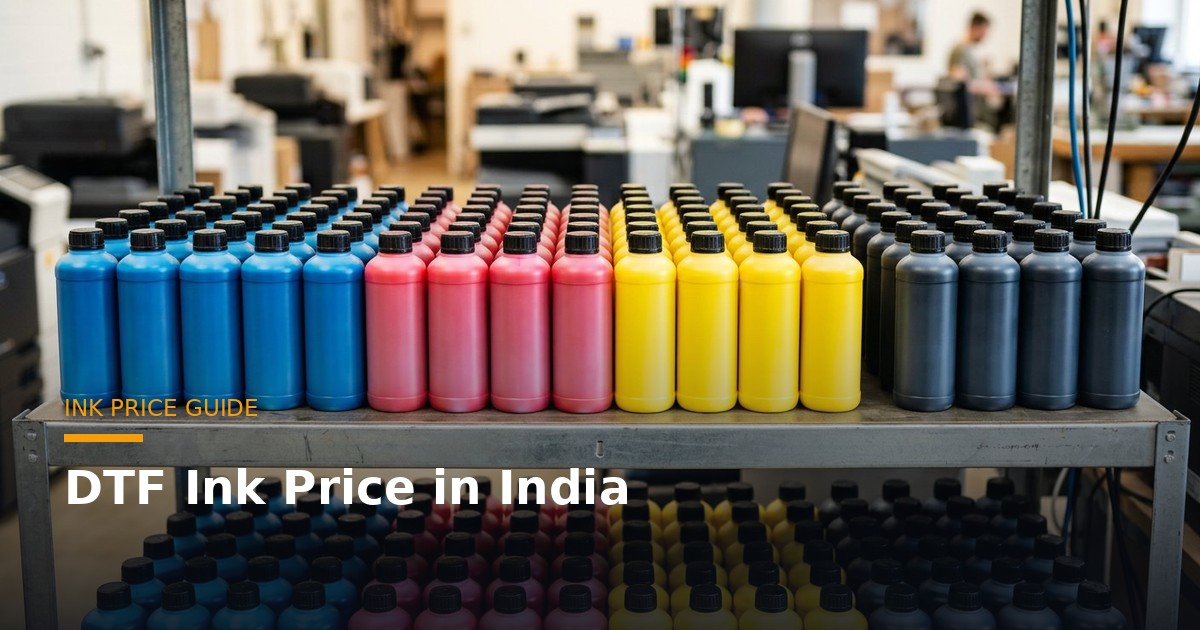
DTF ink comes in CMYK colours plus white, and prices vary with quality and brand. Indicative market ranges for 2026:
| DTF Ink Type | Indicative Price (per Litre) | Notes |
|---|---|---|
| DTF colour ink (CMYK) | ₹900 – ₹1,800 | Standard process colours |
| DTF white ink | ₹1,200 – ₹2,500 | Opaque white underbase |
| Premium DTF ink set | ₹1,800 – ₹3,500+ | Best colour, white opacity, head safety |
White ink typically costs more than colour ink because of its opaque titanium-based pigment. Since DTF uses white on almost every print, white ink is a major part of your ink cost — a factor many new DTF businesses underestimate.
Why White Ink Matters So Much in DTF
White ink is what makes DTF uniquely versatile. In DTF, the design is printed onto a film, and a layer of white ink is laid down beneath the colours. This white underbase means the design shows up vibrantly on any garment colour — black, navy, red, anything — not just white shirts. This is DTF’s great advantage over methods like sublimation, which only works on white or light polyester. But it also means white ink is used on virtually every DTF print, making it a significant and recurring cost. Understanding and budgeting for white ink consumption is essential, since it can be as large a cost as the colour inks combined on white-heavy designs.
What Affects DTF Ink Prices
Several factors drive DTF ink pricing. Quality and brand lead — premium inks with consistent pigment, good white opacity and reliable flow cost more than economy options. White ink formulation particularly affects price, since achieving strong, consistent opacity with a pigment that does not settle or clog is technically demanding. Raw-material and import costs feed through, so prices track the rupee–dollar rate and chemical costs. Volume buying usually earns better per-litre pricing. And supplier reliability matters — consistent, quality ink protects your printhead, while inconsistent ink causes clogging and poor output. For DTF, where white ink is demanding on printheads, quality is especially important.
How Much DTF Ink Does Your Printer Use?
DTF ink consumption depends on design coverage and white-ink usage. As a rough guide, a typical DTF transfer uses around 10–20 ml of total ink per A3-size transfer, split between colour and white, depending on the design. Designs with heavy white coverage use more white ink. Since DTF is often priced per transfer or per garment, understanding your ink cost per transfer is key. At around ₹1,200/litre for colour and ₹1,800/litre for white, a typical transfer’s ink cost might be roughly ₹15–₹40, depending on size and white coverage. This per-transfer ink cost is a core part of pricing your garments profitably.
Calculating Your Cost per Transfer
To price DTF work profitably, calculate your cost per transfer. Add the ink cost (colour plus white, based on coverage), the film cost, the powder cost, and your labour and overheads. Ink is a major component, and white ink is often the largest single ink cost. For example, a transfer using 8 ml colour at ₹1.2/ml and 8 ml white at ₹1.8/ml costs about ₹24 in ink alone, before film, powder and labour. Knowing this precisely lets you price each garment or transfer with a healthy margin, rather than guessing and discovering later that white ink ate your profit. Accurate costing is what separates profitable DTF businesses from struggling ones.
Cheap vs Quality DTF Ink: Protecting Your Printhead
DTF printheads — especially the industrial Epson i3200 used in production machines — are expensive and sensitive, and white ink is particularly demanding on them. Cheap DTF ink, especially poor white ink, is a leading cause of clogged nozzles and premature head failure. White pigment settles and can clog fine nozzles if the ink is poorly formulated or not circulated properly. An i3200 head costs ₹55,000–₹85,000; saving a few hundred rupees a litre on ink that clogs it is a terrible trade. Quality DTF ink, with consistent pigment and good white formulation, flows reliably, resists clogging and protects your head. For a DTF business, quality ink is not an expense — it is insurance for your most valuable component.
White Ink Maintenance: A Critical Factor
Because white pigment settles, DTF white ink requires specific maintenance that colour ink does not. Most DTF printers circulate or agitate white ink to keep the pigment suspended — if your machine has white circulation, use it. Stir or shake white ink before use if recommended. Run white-ink maintenance cycles as advised. Never let white ink sit stagnant in the head or lines, since settled pigment clogs nozzles quickly. This maintenance is essential regardless of ink quality, but quality white ink with good pigment suspension makes it far easier. Understanding and following white-ink maintenance is one of the most important habits for keeping a DTF printer running and avoiding costly head replacements.
Compatibility with Your DTF Printer
DTF ink must be matched to your printer and printhead. Epson-head DTF machines — using the i3200, i1600 or XP600 — need ink formulated for those heads, since the fine industrial nozzles are demanding, especially with white. Using incompatible or poor-quality ink is a leading cause of clogging and head damage. Always use DTF ink recommended for your specific machine, and avoid switching brands casually, since different formulations may not mix well and white ink behaviour varies. Your machine supplier is the best source of the correct ink. Given the cost of DTF printheads and the demands of white ink, using the right, quality ink is essential to reliable production.
Where to Buy DTF Ink in India
Buy DTF ink from reliable sources, prioritising quality and consistency over the lowest price. Your machine supplier or an authorised DTF ink distributor is the best source — they stock ink matched to your printer and heads, with consistent quality and reliable white formulation. Established distributors can offer competitive bulk pricing. Be wary of unknown cheap sources, since inconsistent DTF ink — especially white — can clog heads and ruin output. Consider bulk buying for better pricing, but only what you can use within shelf life. The goal is consistent, quality, printer-compatible DTF ink that protects your printhead and delivers vibrant, reliable transfers.
Storage, Shelf Life and Handling
DTF ink has a shelf life of roughly six months to a year, with white ink often needing more careful handling. Store ink in a cool, dry place away from heat and sunlight, sealed tightly. White ink must be kept agitated or stirred before use and stored to minimise pigment settling. Use first-in-first-out rotation and avoid over-buying, since expired or settled ink causes poor output and clogging. Follow safety guidance when handling inks. Proper storage — especially keeping white ink properly suspended — ensures consistent colour and white opacity, protects your printhead, and gets you the quality you paid for.
Frequently Asked Questions
What is the DTF ink price in India?
Roughly ₹900–₹1,800 per litre for colour ink and ₹1,200–₹2,500 for white ink. Premium ink sets cost more. White typically costs more than colour.
Why is DTF white ink more expensive?
Its opaque titanium-based pigment costs more and is technically demanding to formulate so it stays suspended and does not clog printheads.
How much does DTF ink cost per transfer?
Roughly ₹15–₹40 per A3 transfer depending on size and white coverage — ink is a major part of your per-garment cost.
Can I use cheap DTF ink to save money?
It is risky, especially with white ink and expensive i3200 heads. Cheap ink clogs nozzles and damages heads. Quality ink is the economical choice.
Does DTF white ink need special care?
Yes — white pigment settles, so it must be circulated, agitated or stirred to prevent clogging. This maintenance is essential for reliable DTF printing.
Do you supply DTF ink?
Yes. Unified Engineering Dynamics supplies quality DTF ink, including reliable white ink, matched to our DTF printers and printheads.
DTF Ink and Your Business Model
Because DTF is usually a per-garment business, understanding ink cost at the transfer level is essential to your pricing and profitability. Every design you sell carries a specific ink cost driven by its size, colour coverage and white coverage. Designs that are large, full-colour or heavy on white use considerably more ink than small, simple logos. This means two transfers that take the same time to press can have very different ink costs, and pricing them the same would quietly erode your margin on the ink-heavy ones. Costing your ink accurately per design type lets you price your garments or transfers so that every job is profitable rather than only the average one.
White ink deserves special attention in your costing, since it is used on almost every DTF print and often represents the largest single ink cost. Businesses that price DTF work without properly accounting for white ink frequently discover they are barely breaking even. Build white ink into your cost-per-transfer calculation from the start, and review your prices as ink costs change. Printers who understand their true per-transfer ink cost — including white — price confidently, protect their margin, and avoid the trap of high-volume, low-profit work that looks busy but earns little. Ink costing is one of the most practical levers for a profitable DTF business.
Planning Your DTF Ink Budget
Set your DTF ink budget on expected transfer volume. Estimate how many transfers you print a month and the average ink per transfer, or work from total area at around 10–20 ml per A3 transfer. A business printing 3,000 transfers a month at an average 15 ml (split colour and white) uses roughly 45 litres — at a blended ₹1,400 per litre that is around ₹63,000 a month, a major cost to budget precisely. Track actual usage and watch for spikes, which usually indicate a clogging issue, white settling or a settings change wasting ink.
Connect ink planning to the rest of your DTF costs. Ink is significant, but film and powder are also substantial consumables, so cost all three together per transfer. Buy ink in sensible volumes for better pricing, store it well — especially keeping white properly agitated — and keep your machine maintained so it uses ink efficiently and avoids waste from failed transfers. Because DTF margins depend on volume, efficient ink use and accurate costing compound directly into your bottom line. A disciplined, measured approach to DTF ink budgeting, with white ink properly accounted for, is one of the clearest habits of a profitable garment-printing business.
Choosing a Reliable DTF Ink Supplier
Because DTF ink quality so directly affects your printhead and output, choosing a reliable supplier matters as much as the ink itself. A good supplier provides ink that is consistent batch to batch, correctly formulated for your printer’s heads, and with reliable white that stays well suspended. They stock it reliably so you are never caught short mid-production, and they support you when issues arise. Inconsistent supply or variable ink quality disrupts production and risks expensive head damage, so a dependable supplier is a key partner in a DTF business, not just a vendor.
Look for a supplier who understands DTF specifically — the demands of white ink, the sensitivity of i3200 and i1600 heads, and the importance of consistency. They should be able to advise on the right ink for your machine, help troubleshoot clogging or colour issues, and supply ink that protects your equipment. Buying purely on the lowest price from an unknown source risks exactly the head damage and inconsistent output that cost far more than the ink saving. A knowledgeable, reliable DTF ink supplier is an investment in smooth production, consistent quality and the longevity of your printer’s most valuable component.
Buy Quality DTF Ink — Protect Your Printer and Margins
DTF ink — especially white — is a major cost and a critical factor in printer reliability. Buy quality ink matched to your machine, maintain white ink properly, and cost your transfers accurately. Unified Engineering Dynamics supplies quality DTF ink matched to our printers, with genuine products and expert nationwide support.
Get DTF ink pricing and advice from UED → Tell us your DTF printer and volumes, and we will recommend the right inks at a competitive price.
Related Reading
- How to Choose the Right Ink for Your Printer: Complete India Guide
- Printer Ink Consumption & Cost per Print: How to Calculate (2026)
- Why Cheap Ink Ruins Your Printhead (And What It Really Costs You)
- Sublimation Ink Price in India: Cost, Quality & Where to Buy
- UV Ink Price in India: Cost per Litre, Types & Buying Guide
Unified Engineering Dynamics supplies quality printer inks and machines with expert support across India. Get in touch for ink advice and pricing →
