

This anonymised case study follows a packaging and commercial print business that saw an opportunity in short-run, customised and prototype packaging — a growing market that traditional printing could not serve economically. By adding a UED UV flatbed printer, the business entered this high-value niche, won new clients and improved its margins. Here is how digital UV packaging transformed the business and what it teaches about finding profitable niches.
The Business and Its Challenge
The business — a commercial print and packaging operation — served clients with conventional printing for larger runs. But it noticed a growing demand it could not serve: short-run packaging, customised and personalised packaging, seasonal and promotional packs, and packaging prototypes. Brands increasingly want small, customised runs — for product launches, e-commerce, special editions and testing — that traditional plate-based printing cannot produce economically at low volumes. This was a growing, high-value niche, but serving it required digital printing capability the business did not have.
The Situation Before
Before adding UV, the business could only serve packaging clients economically at larger volumes, where conventional printing made sense. The growing short-run and customised packaging market — where brands pay a premium for flexibility and small quantities — was closed to it. Clients needing short runs, prototypes or customisation went elsewhere. The business watched this segment grow without being able to participate. It also faced the commoditisation of conventional print, where margins were squeezed. The owner recognised that digital UV packaging offered a route into a growing, higher-margin niche that played to the business’s existing print expertise and client relationships.
Machine at a Glance
| Specification | Detail |
|---|---|
| Machine | UED UV Flatbed Printer (2.5 × 1.3 m) |
| Printheads | Epson i3200-U1 (industrial) |
| Ink channels | CMYK + White + Varnish |
| Substrates | Board, acrylic, PVC, foam, metalised board, more |
| Best for | Short-run, customised and prototype packaging |
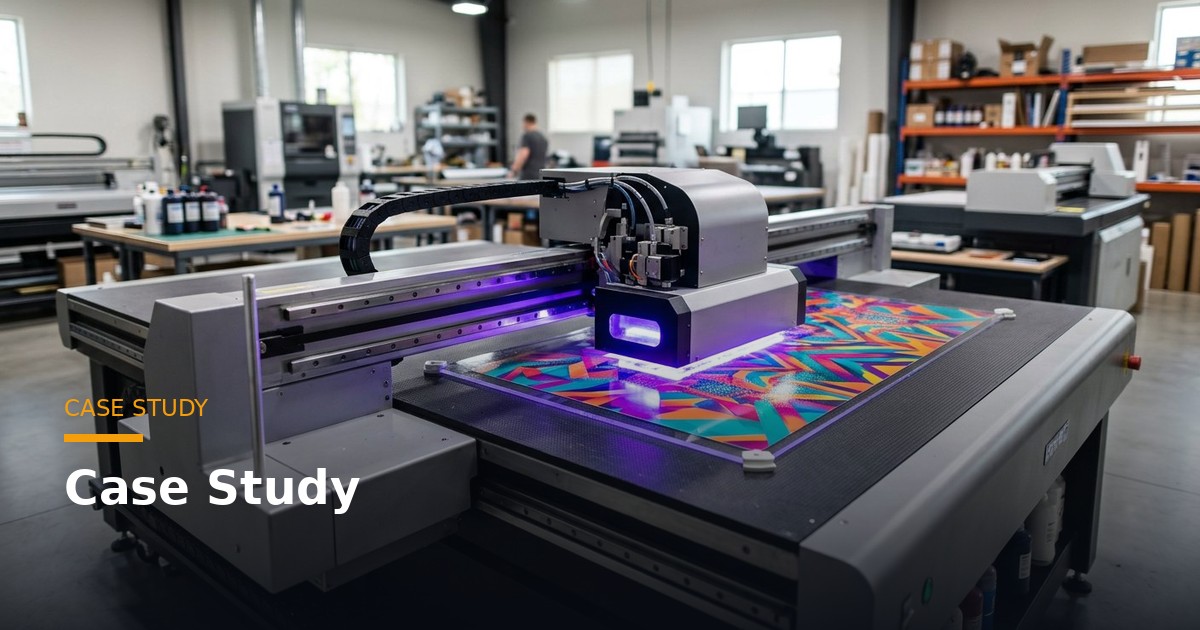
The UV flatbed was ideal for digital packaging. It prints directly onto rigid and semi-rigid packaging materials — board, acrylic, PVC and more — with no plates, screens or long setup, making short runs economical. The white ink channel allowed printing on kraft, dark and metalised boards, while varnish enabled premium gloss, matte and textured finishes that make packaging stand out on the shelf. The i3200-U1 heads delivered the sharp detail and consistent colour that brand packaging demands. This capability let the business serve the short-run, customised packaging market that conventional printing could not touch.
The Solution and Approach
The business positioned its new UV capability around the packaging niches that conventional printing could not serve: short runs, customisation, prototypes and premium finishes. It offered brands the ability to produce small, customised packaging runs economically — for launches, e-commerce, seasonal promotions and market testing — along with high-quality prototypes for design approval. The white and varnish capabilities enabled premium, shelf-standout packaging. Rather than competing with conventional print on long runs, the business carved out the profitable short-run and customisation niche where digital UV excels and clients pay for flexibility.
Implementation and Support
The business invested in learning UV packaging properly. Operators were trained on the flatbed, substrate handling, white and varnish techniques, curing and colour management. The business also learned the specific requirements of packaging — material behaviour, finishing, and the quality standards brands expect. UED’s installation, training and support helped the business become productive quickly. Within a few months, it was producing short-run and customised packaging confidently, and its sales team was actively pursuing the new niche with existing and new clients who had short-run and customisation needs the business could now serve.
The Results
Adding UV packaging opened a profitable new market. Indicative results:
| Aspect | Before UV | After UV |
|---|---|---|
| Packaging runs | Long-run only | Short-run + long-run |
| Customisation | Not offered | Personalised, variable |
| Prototypes | Not offered | High-quality samples |
| Premium finishes | Limited | White, varnish, texture |
| Margins | Commoditised | Improved in new niche |
The business won new clients who needed short-run and customised packaging it could now serve, and grew existing accounts by offering packaging flexibility they previously had to source elsewhere. Short-run and customised work commanded premium pricing — clients pay for the flexibility and small quantities that digital enables. The prototyping capability also won design-approval work and led to larger production runs. Within its first year, digital UV packaging was a growing, high-margin revenue stream that differentiated the business from conventional printers.
The Financial Impact
The financial logic was strong. Although the UV flatbed and its ink cost more than conventional equipment, the short-run and customised packaging it enabled earned premium prices — clients pay significantly more for small, customised runs than for commodity long runs. The business also benefited from the low setup cost of digital (no plates), which makes short runs profitable where conventional printing would lose money. And the new capability grew existing accounts and won new ones. Based on the premium short-run work, the owner estimated a solid return within the machine’s first couple of years, plus the strategic value of a differentiated, growing niche.
Why It Worked
Several factors drove the success. First, the business identified a genuine, growing niche — short-run and customised packaging — that conventional printing could not serve and where clients pay a premium. Second, it chose the right tool: a UV flatbed with white and varnish, ideal for digital packaging. Third, it learned UV packaging properly, meeting the quality standards brands expect. Fourth, it leveraged its existing print expertise and client relationships to sell the new capability. And fifth, it positioned itself in a differentiated niche rather than competing on commodity long runs. The business succeeded by finding where digital UV creates unique value and building a profitable niche there.
The Owner’s Perspective
The owner saw the UV flatbed as a way to stop competing purely on price. “In conventional print, everyone is fighting over the same long runs on price,” the owner noted. “Short-run and customised packaging is different — clients come to us because we can do what the big conventional printers cannot.” That differentiation was the real prize. By serving a niche that conventional printing structurally could not, the business escaped commoditisation and built a higher-margin, growing segment. The machine enabled it, but the strategic insight — finding where digital creates unique value — was what made it profitable.
Key Takeaways
Print and packaging businesses can draw clear lessons. First, digital UV opens the growing, high-margin short-run and customised packaging market that conventional printing cannot serve economically. Second, the right equipment — a UV flatbed with white and varnish — is essential for quality packaging on varied substrates. Third, learning UV packaging properly and meeting brand quality standards is what wins and retains clients. And fourth, positioning in a differentiated niche, rather than competing on commodity long runs, is the path to better margins. Businesses that find where digital creates unique value can build profitable niches that conventional competitors cannot follow.
This is an anonymised, representative case study based on typical UED machine performance. Individual results vary with market, management, utilisation and local conditions.
Understanding Digital Packaging Economics
The economics of digital packaging differ fundamentally from conventional printing, and understanding this was key to the business’s success. Conventional printing has high setup costs — plates, screens and make-ready — that only amortise over long runs, making short runs uneconomical. Digital UV has almost no setup cost, so a run of fifty boxes costs proportionally little more per unit than a run of five hundred. This flips the economics: digital makes short runs profitable where conventional printing would lose money. The business built its niche precisely here — the short-run and customised work that conventional printers structurally cannot serve profitably, and where clients willingly pay a premium for the flexibility.
This also changes how the business priced and sold. Rather than competing on unit price for long runs, it sold the value of flexibility: small quantities, fast turnaround, customisation, versioning and no plate costs. Brands pay a premium for the ability to run a small promotional batch, test a design, or personalise packaging without a huge minimum order. Understanding this value proposition — and pricing for the flexibility rather than against commodity long-run prices — let the business earn healthy margins in its niche. The economics of digital packaging reward those who understand that they are selling flexibility and speed, not just ink on board.
Sustainability and Short-Run Trends
The business’s move into digital packaging aligned with powerful market trends. Short-run and on-demand packaging is growing as brands seek flexibility, faster time-to-market and lower inventory risk — printing what they need, when they need it, rather than huge runs that may go unused. Digital also supports sustainability: shorter runs mean less overproduction and waste, and the ability to update packaging quickly supports seasonal and regional variants without obsolete stock. Brands increasingly value this agility and reduced waste. By offering digital short-run packaging, the business positioned itself at the intersection of these trends, serving brands that want flexible, responsive, lower-waste packaging.
Customisation is another growing trend the business tapped. From personalised e-commerce packaging to variable-data promotions and limited editions, brands increasingly want packaging that varies — something only digital can do economically. The business’s UV flatbed, especially with white and varnish for premium effects, let it serve this customisation demand. These trends — short-run, on-demand, sustainable and customised packaging — are reshaping the industry, and businesses with digital UV capability are positioned to ride them. The business’s investment was not just in a machine but in aligning itself with where packaging demand is heading.
Winning Brand Packaging Clients
Winning brand packaging clients required demonstrating quality and reliability, since brands are protective of their packaging. The business built a portfolio of sample work showcasing its UV packaging quality — the sharp detail, vibrant colour, white on kraft and premium varnish finishes that brands want. It emphasised what brands value: quality that reflects well on their product, consistency, reliability and the flexibility of short runs and prototypes. The prototyping capability was especially valuable — offering fast, high-quality prototypes for design approval built trust and often led to production work.
The business also leveraged its existing commercial-print relationships, cross-selling digital packaging to clients who already trusted it. This was efficient — selling a new capability to an existing client is far easier than winning a new one. By combining quality sample work, a focus on brand needs and cross-selling to existing relationships, the business built its packaging niche steadily. Winning brand packaging clients is about demonstrating that you can protect and enhance their brand through quality packaging — and once you prove that, the flexibility of digital makes you a valued, recurring partner.
Could This Be Your Business’s Story?
This case study reflects a real opportunity for print and packaging businesses. If you are competing on price in conventional long-run print, the short-run and customised packaging market offers a route into higher-margin work that conventional printing structurally cannot serve. Digital UV is the key that opens it — no plates, economical short runs, white on any board and premium varnish finishes. The businesses that succeed in this niche invest in a capable UV flatbed, learn digital packaging properly, and position themselves around the flexibility and speed that brands increasingly value.
The timing is favourable. Short-run, on-demand, customised and lower-waste packaging is a growing demand, driven by brands seeking agility and sustainability. Businesses with digital UV capability are positioned to serve it, while conventional printers cannot follow into uneconomical short runs. For a print business looking beyond commoditised long-run work, digital UV packaging offers a differentiated, growing, higher-margin niche. It is an opportunity to escape price competition by offering something conventional printing simply cannot — and to build a profitable segment that plays to the unique strengths of digital.
In a market where conventional packaging printers compete on price for long runs, digital UV packaging is a genuine opportunity to differentiate. It is not about printing cheaper — it is about offering the flexibility, speed and customisation that modern brands increasingly want and cannot get elsewhere. For a print business with the vision to serve that demand, digital packaging is a profitable, growing niche worth building.
Ready to Enter Digital Packaging?
Short-run and customised packaging is a growing, high-margin market. Unified Engineering Dynamics supplies UV flatbed printers with white and varnish, quality inks and expert support.
Explore UV packaging printing with UED → Tell us your packaging goals, and we will recommend the right UV printer.
