

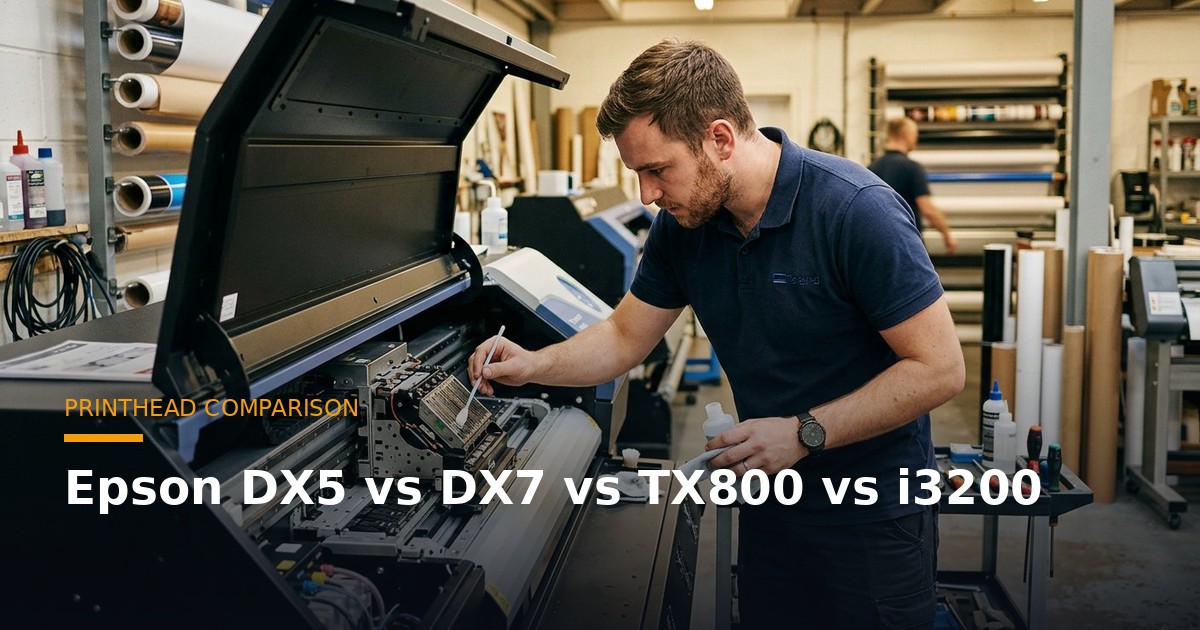
Epson printheads dominate the eco-solvent and solvent printing market in India, and four models come up constantly: the veteran DX5, its successor the DX7, the affordable TX800, and the modern industrial i3200. Each suits a different budget and production level, and choosing the wrong one means either overspending on capacity you do not need or under-buying and outgrowing your machine. This guide compares all four so you can pick the right Epson head for your business.
The Four Epson Heads at a Glance
| Specification | DX5 | DX7 | TX800 | i3200 |
|---|---|---|---|---|
| Nozzles | 1,440 | 1,440 | ~1,000+ | 3,200 |
| Class | Established solvent | Refined solvent | Mid-range | Industrial |
| Speed | Moderate–high | High | Moderate–high | Very high |
| Typical price (India) | ₹25,000 – ₹40,000 | ₹40,000 – ₹60,000 | ₹20,000 – ₹38,000 | ₹55,000 – ₹85,000 |
| Lifespan | ~1–2 yrs | ~1.5–2.5 yrs | ~1–2 yrs | Multiple years |
| Best for | Budget solvent | Quality solvent | Value eco-solvent | Production |
In short: the DX5 and TX800 are affordable workhorses, the DX7 refines the DX5 for better quality, and the i3200 is the industrial head for serious production.
Epson DX5: The Established Workhorse
The DX5 is one of the most widely used solvent heads ever made, with 1,440 nozzles and a proven track record in eco-solvent and solvent machines. It is affordable, reliable and easy to source, which made it the backbone of countless Indian sign and flex shops. While newer heads have surpassed it, the DX5 remains popular for its low cost and dependability in standard signage work.
Epson DX7: The Refined Successor
The DX7 builds on the DX5 with improved durability, better ink handling and refined output quality, while keeping the same 1,440-nozzle foundation. It costs more than the DX5 but delivers better consistency and a somewhat longer life. For businesses that want the familiar DX platform with improved performance, the DX7 is the natural step up.
Epson TX800: The Value Option
The TX800 is an affordable multi-nozzle head that offers good speed and solid quality at a lower price than the DX7 or i3200. It is a popular choice in mid-range eco-solvent machines, giving sign shops dependable output without a premium head’s cost. It is more capable than entry heads like the XP600 and remains a practical, economical option.
Epson i3200: The Industrial Standard
The i3200 is Epson’s modern industrial head, with 3,200 nozzles and construction built for sustained production. It is dramatically faster and longer-lived than the DX-family and TX800 heads, which is why serious DTF and eco-solvent production machines use it — often in dual-head configurations. It costs more, but its speed and durability deliver a lower cost per print at volume.
Speed and Productivity
- TX800 / DX5: moderate-to-good speed for standard signage volumes.
- DX7: higher speed and consistency than the DX5.
- i3200: the clear speed leader — built for production throughput.
If your business depends on turnaround and volume, the i3200’s speed advantage compounds into real revenue. For moderate volumes, the DX-family and TX800 are perfectly capable.
Price in India
| Printhead | Indicative Price (ex-GST) | Position |
|---|---|---|
| Epson TX800 | ₹20,000 – ₹38,000 | Value |
| Epson DX5 | ₹25,000 – ₹40,000 | Budget workhorse |
| Epson DX7 | ₹40,000 – ₹60,000 | Refined quality |
| Epson i3200 | ₹55,000 – ₹85,000 | Industrial production |
The affordable heads lower your machine’s entry cost; the i3200 raises it but pays back through speed and longevity at volume. Match the head to your production level and budget.
Lifespan and Durability
Longevity tracks with class: the DX5 and TX800 typically last 1–2 years of regular use, the DX7 a bit longer, and the i3200 multiple years in production. For all of them, ink quality, filtration and daily maintenance are the biggest determinants of life. A well-maintained head consistently outlasts a neglected one of the same model.
Which One Should You Buy?
- Tight budget, standard signage: TX800 or DX5 — affordable and dependable.
- Better quality on the DX platform: DX7 — refined output and durability.
- Production eco-solvent or DTF: i3200 — speed and longevity at volume.
- Startup getting into the market: TX800 or DX5 — low entry cost while you grow.
- Growing business planning scale: i3200 — the head that grows with you.
Frequently Asked Questions
Which Epson eco-solvent head is best?
For production, the i3200 — it is fastest and longest-lived. For budget and standard signage, the TX800 and DX5 offer excellent value, with the DX7 refining quality.
Is the DX7 better than the DX5?
Yes — the DX7 offers improved durability, ink handling and output consistency over the DX5, at a higher price.
Which is the cheapest to run?
The TX800 and DX5 have the lowest upfront and replacement cost. The i3200 costs more but wins on cost per print at volume.
Which head lasts longest?
The i3200, being an industrial head, outlasts the DX-family and TX800 in production use.
Can I upgrade a DX5 printer to an i3200?
Generally no — the heads differ in size and electronics, so machines are built for one. Plan the upgrade as a new machine.
Which head does UED recommend?
It depends on your volume and budget. Tell us what you print and how much, and we will recommend the right Epson head and machine.
How Epson’s Printheads Evolved
Understanding the lineage helps you choose. Epson’s solvent heads began with the DX5, which became an industry workhorse thanks to its 1,440 nozzles and affordability. The DX7 refined that formula with better durability and ink handling. Alongside these, the TX800 offered a value-focused alternative for mid-range machines. More recently, Epson introduced the i3200 — a true industrial head with 3,200 nozzles, built for the sustained speed and reliability that modern DTF and eco-solvent production demand. The progression is clear: from affordable workhorses to industrial production heads. Where your business sits on that spectrum decides which head fits.
Which Head for Which Business Type
- New sign shop on a budget: TX800 or DX5 — low entry cost, dependable output.
- Established shop wanting better quality: DX7 — refined output and durability.
- Production DTF / T-shirt business: i3200 — speed and longevity at volume.
- High-volume eco-solvent signage: i3200 — throughput that wins deadlines.
- Side business / light duty: TX800 or DX5 — affordable and adequate.
The mistake to avoid is mismatching the head to your volume: an i3200 for occasional light use wastes money, while a DX5 for heavy production wears out fast.
Ink and Maintenance by Head
All four heads need quality ink and daily care, but their tolerance differs. The DX5, DX7 and TX800 are relatively forgiving but still suffer with poor ink. The i3200, with its finer industrial nozzles, is more sensitive to ink quality and filtration — using recommended ink and keeping it clean is essential to protect it during long production runs. Across all of them, the same rules apply: recommended ink, daily nozzle checks, proper capping and a clean workshop. Good habits are cheap insurance for an expensive component.
Cost of Ownership Over Three Years
| Head | Head Price | Typical Life | Replacements in 3 yrs (heavy use) |
|---|---|---|---|
| TX800 | ₹20,000 – ₹38,000 | 1–2 yrs | 1–2 |
| DX5 | ₹25,000 – ₹40,000 | 1–2 yrs | 1–2 |
| DX7 | ₹40,000 – ₹60,000 | 1.5–2.5 yrs | 1 |
| i3200 | ₹55,000 – ₹85,000 | Multiple yrs | 0–1 |
At heavy volumes, the i3200’s longer life can mean fewer replacements — plus its speed produces more saleable output over the same period. For light use, the cheaper heads keep total cost down. Match the head to your real usage to optimise cost.
Common Myths About Epson Heads
- “More nozzles always means better.” Nozzles affect speed; quality also depends on droplet control, ink and machine tuning.
- “All Epson heads use the same ink.” Different heads suit different ink formulations — always use recommended ink.
- “A cheap head saves money.” Counterfeit and low-quality heads fail fast and can damage your printer.
- “You can upgrade the head later.” Machines are built for a specific head; upgrades usually mean a new machine.
More Epson Head Questions
Which Epson head is best for DTF?
The i3200 is the production standard for DTF, valued for speed and durability. Light-duty DTF can start on the TX800.
Is the DX7 worth the extra cost over the DX5?
If you want better consistency and a longer life on the DX platform, yes. For tight budgets, the DX5 remains a capable workhorse.
Making Your Epson Head Decision
With four capable Epson heads to choose from, the decision comes down to matching the head to your volume, quality needs and budget. Start with volume, because it is the biggest determinant. If you print occasionally or in light volumes, the affordable TX800 or DX5 gives you dependable output at the lowest cost, and there is no reason to spend more. If you produce steadily and want better consistency and a longer-lived head without moving to full industrial cost, the DX7 is the refined middle path. If you run real production — daily DTF, high-volume eco-solvent, bulk orders where speed and durability directly affect your profits — the i3200 is the head that keeps up and lasts.
Then layer in quality and budget. The DX7 offers a quality step over the DX5 for a modest premium. The i3200 costs significantly more but delivers far more speed and a much longer life, which usually makes it cheaper per print at volume. The mistake to avoid is buying for the wrong volume: an i3200 for light occasional use wastes money on capacity you will never touch, while a DX5 pressed into heavy production will wear out quickly and cost more in replacements and downtime than you saved upfront.
Planning for Growth
Many successful printing businesses follow a natural progression: they start on an affordable head like the TX800 or DX5, prove their market, and then upgrade to i3200-based production machines once volumes justify the investment. This staged approach manages risk — you are not committing to industrial capacity before you have the orders to fill it. Because you generally cannot retrofit a machine from one head to another, plan these upgrades as additional or replacement machines rather than head swaps, and budget accordingly.
Whatever stage you are at, buy genuine heads with a warranty, maintain them well, and match the head to your real production level. An Epson head is the heart of your printer, and choosing the right one — neither under-specifying nor over-spending — sets the foundation for a profitable, reliable printing business. If you are unsure which head fits your current volume and growth plans, an experienced machine builder can assess your output and recommend the configuration that maximises your return both today and as you grow.
Your Next Step
Choosing among the Epson DX5, DX7, TX800 and i3200 does not have to be complicated. Match the head to your volume and budget: the TX800 and DX5 for affordable, dependable entry and light-duty work; the DX7 for refined quality on the proven DX platform; and the i3200 for real production where speed and longevity pay. Buy genuine with a warranty, maintain the head with good ink and daily care, and plan upgrades as your volumes grow rather than over-buying capacity you cannot yet fill.
If you are still unsure which head fits your business today — and where you want it to be tomorrow — that is exactly the conversation worth having before you invest. An experienced machine builder can look at what you print, how much, and at what quality, then recommend the head and machine that give you the best return. Get that decision right and your printer becomes a reliable engine of profit rather than a source of cost and downtime.
A Final Note on Buying Epson Heads
Whichever Epson head you choose, always buy genuine with a warranty from an authorised source. Counterfeit and mislabelled heads are common, and a cheap fake that fails quickly — or damages your printer — costs far more than a genuine head ever will. Pair a genuine head with good ink and daily maintenance, and it will deliver the reliable, consistent output your business depends on. The right head, bought genuine and cared for, is the foundation of a profitable printing operation, so make that part of the decision carefully and you will not regret it.
Get the Right Epson Head for Your Business
From the affordable TX800 and DX5 to the refined DX7 and the industrial i3200, the right Epson head depends on your volume, quality needs and budget. Unified Engineering Dynamics builds eco-solvent, solvent and DTF printers on genuine Epson heads — matched to your business, with genuine spares, warranty and support across India.
Ask UED which Epson printhead fits your business → Share your requirements and we will recommend the ideal head and machine configuration.
