

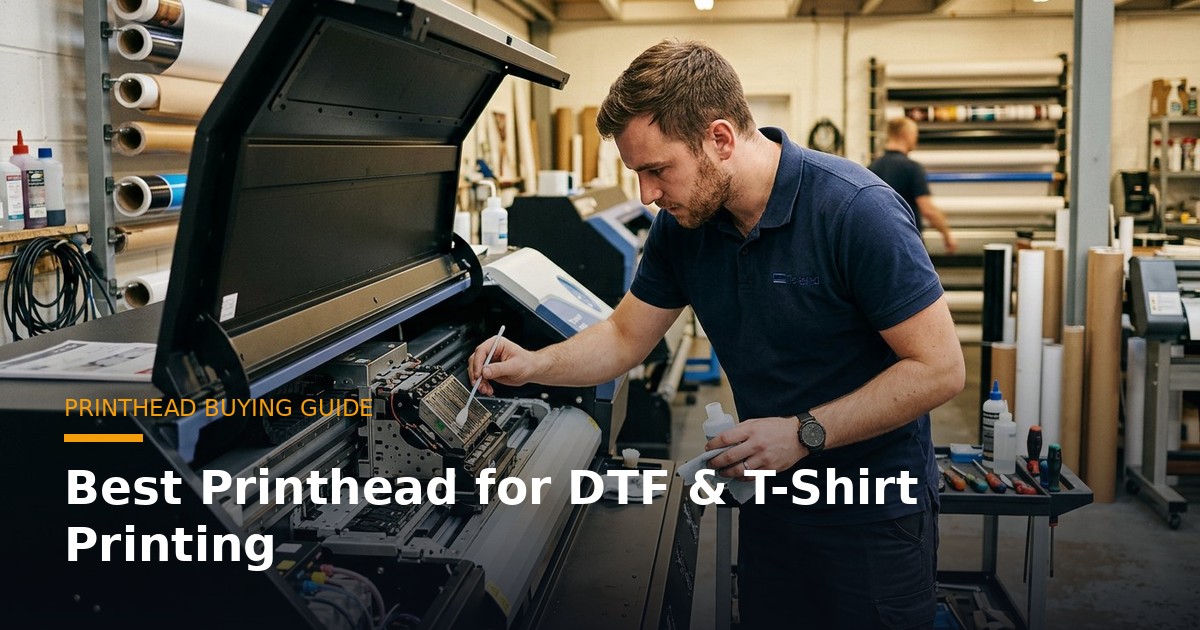
DTF (direct-to-film) printing has become one of the fastest-growing garment decoration methods in India, powering T-shirt and apparel businesses from small startups to large production houses. At the heart of every DTF printer is an Epson printhead, and the head you choose shapes your speed, quality, running cost and ability to grow. The three Epson heads that dominate DTF are the i3200, the i1600 and the XP600. This guide compares them and recommends the right one for your DTF business.
What DTF Printing Demands from a Printhead
DTF printing has particular requirements that shape the ideal printhead. First, it uses white ink heavily — DTF lays a white underbase beneath colours so designs show on any garment colour, so the head must handle white ink reliably without clogging. Second, DTF is often a production business, fulfilling bulk apparel orders, so speed matters for turnaround and profitability. Third, quality counts — smooth colour, fine detail and consistent white coverage make transfers look professional. Fourth, because DTF heads work hard and white ink is demanding, durability and reasonable replacement cost are important. A good DTF head balances white-ink reliability, speed, quality and longevity.
Epson i3200: The DTF Production Standard
The Epson i3200 is the printhead behind most serious DTF production machines in India, and it has earned that position. With 3,200 nozzles and an industrial build, it delivers the speed and durability that daily, high-volume DTF demands. It handles white ink well, produces excellent quality, and lasts significantly longer than entry heads under sustained production — which is why production DTF and apparel businesses standardise on it, often in dual-head configurations for even higher throughput. If DTF is your core business and you fulfil meaningful volumes, the i3200 is the head that keeps up, produces consistently, and protects your profitability through its speed and long life. It costs more than entry heads, but its output and durability justify the investment for production work.
Epson i1600: The Capable Mid-Option
The Epson i1600 is a smaller sibling to the i3200, with around 1,600 nozzles, offering a middle path between entry and full industrial production. It delivers good speed and quality at a lower cost than the i3200, making it attractive for growing DTF businesses that need more than an entry head but do not yet require full production capacity. The i1600 handles white ink competently and provides solid, consistent output for small-to-mid volumes. For a DTF business scaling up from light duty toward production, the i1600 can be a sensible, cost-effective choice — though businesses with serious volume ambitions often move to the i3200 for its greater speed and durability.
Epson XP600: The Affordable Entry Point
The Epson XP600 is the most affordable DTF head and the entry point for countless startups. Derived from desktop printer technology, it is inexpensive and widely available, making it possible to start a DTF business with low capital. For light-to-moderate volumes — a boutique, a side business, a shop testing the market — the XP600 gets the job done affordably. The trade-off is durability: because it is not built like an industrial head, it wears faster under sustained production and is more sensitive to ink quality and white-ink demands. The XP600 is a great way to start, but heavy users typically graduate to the i1600 or i3200 as volumes grow.
Speed and Productivity Compared
Speed directly affects a DTF business’s profitability, since faster printing means more orders fulfilled. The i3200 is the clear speed leader, built for production throughput and often used in dual-head setups that double output. The i1600 offers good mid-range speed for growing businesses. The XP600 is the slowest, adequate for light volumes but not built for back-to-back production. If your DTF business lives on turnaround and bulk orders, the i3200’s speed advantage compounds into real revenue — it lets you take more work and meet deadlines that slower heads cannot. For light or occasional printing, the XP600’s speed is sufficient.
Quality and White Ink Performance
All three heads produce good DTF quality for their class, with the industrial heads ahead on consistency. The i3200 and i1600 deliver smooth colour, fine detail and reliable white coverage over long runs, which is what professional transfers require. The XP600 produces acceptable quality for light-duty work but is less consistent under production demands and more prone to white-ink clogging if not carefully maintained. Because white ink is central to DTF and is demanding on any head, the industrial heads’ better white-ink tolerance is a real advantage for production businesses. For quality-sensitive apparel brands, the i3200’s consistency is worth the investment.
Cost and Running Economics
| Printhead | Indicative Price | Class | Best For |
|---|---|---|---|
| Epson XP600 | ₹10,000 – ₹20,000 | Entry | Startups, light duty |
| Epson i1600 | ₹30,000 – ₹50,000 | Mid-range | Growing businesses |
| Epson i3200 | ₹55,000 – ₹85,000 | Industrial | Production DTF |
The XP600 minimises entry cost; the i3200 costs more but delivers far more speed and a much longer life, making it cheaper per print at volume. The i1600 sits between. For a business printing real volumes, the i3200’s higher upfront cost is recovered through throughput and fewer replacements; for a startup, the XP600’s low cost reduces risk while you prove your market.
Best DTF Printhead by Business Stage
- Startup testing the market: XP600 — low entry cost, adequate for light volumes.
- Growing small business: i1600 — more speed and durability than the XP600 at moderate cost.
- Production DTF / bulk apparel: i3200 — the speed and longevity serious volume demands.
- Quality-focused apparel brand: i3200 — consistent, professional output.
- Scaling operation: dual-i3200 — maximum throughput for large order books.
Many DTF businesses follow this exact progression: start on the XP600, prove the market, then invest in i3200 production machines as volumes justify it.
Maintenance for DTF Heads
DTF heads work hard, and white ink is demanding, so maintenance is critical. Use recommended, well-filtered DTF ink — cheap ink clogs nozzles fast, especially with white. Agitate and circulate white ink as recommended to prevent settling. Run daily nozzle checks and clean promptly when jets drop. Cap the head properly at the end of every day so it never dries. Keep the workshop clean. These habits protect all three heads, but especially the industrial i3200 and i1600, whose finer nozzles reward good ink and consistent care. A well-maintained DTF head produces consistently and lasts far longer, protecting both your output quality and your investment.
Frequently Asked Questions
Which printhead is best for DTF printing?
For production, the Epson i3200 — it is the industry standard for speed, quality and durability. The i1600 suits growing businesses, and the XP600 is the affordable entry point.
Is the i3200 better than the XP600 for DTF?
Yes, significantly — the i3200 is an industrial head that is far faster, longer-lived and more consistent, especially with white ink. The XP600 is for light-duty entry use.
What is the Epson i1600 good for?
It is a mid-range option for growing DTF businesses that need more than the XP600 but not full i3200 production capacity.
Which head handles white ink best?
The industrial i3200 and i1600 handle demanding white ink more reliably than the XP600, which is more prone to clogging.
Can I start DTF with an XP600 and upgrade later?
Yes — many businesses start on the XP600 and move to i3200 production machines as volumes grow. Plan the upgrade as a new machine, not a head swap.
Single-Head vs Dual-Head DTF Machines
DTF machines come in single-head and dual-head configurations, and the choice affects your throughput and cost. A single-head machine — with one XP600, i1600 or i3200 — suits startups and small-to-mid volumes, offering an affordable entry into DTF. A dual-head machine, typically built on two i3200 heads, roughly doubles throughput and can separate functions, such as one head handling white and the other colour, or both printing colour for speed. Dual-i3200 machines are the backbone of serious DTF production in India, where fulfilling bulk apparel orders quickly is essential to profitability. When choosing, match the configuration to your volume: a single head for light-to-moderate work, and dual heads when your order book demands production speed. Because you cannot easily add a head later, consider where your volumes are heading, not just where they are today.
The head model and the configuration work together: a dual-i3200 machine is a serious production investment, while a single-XP600 machine is an affordable starting point. Understanding this combination helps you invest at the right level — enough capacity to serve your customers and grow, without over-buying production capability you cannot yet fill.
What the Printhead Controls in DTF Output Quality
Your printhead directly determines several aspects of DTF output quality that your customers see. It controls colour smoothness and detail — finer, more consistent droplet placement produces smoother gradients and sharper fine detail in designs. It governs white coverage — reliable white-ink firing produces an even, opaque underbase so colours show correctly on any garment, which is central to professional DTF transfers. And it affects consistency across a run — an industrial head like the i3200 holds quality steady over a long production day, while an entry head may drift or clog. For an apparel business, where transfer quality directly affects how the finished garment looks and how customers perceive your brand, the head’s contribution to quality is significant. This is why quality-focused and production DTF businesses invest in the i3200 — its consistency and white-ink reliability produce transfers that look professional, order after order.
Common DTF Printhead Problems — and Fixes
DTF heads work hard, and white ink is demanding, so a few problems recur. White-ink clogging is the most common, since white pigment settles and dries — prevent it by circulating and agitating white ink as recommended and never leaving the head idle uncapped. Nozzle loss from dried ink is addressed with prompt cleaning and proper daily capping. Inconsistent white coverage usually points to ink settling or partial clogging rather than a worn head. Only persistent nozzle loss after genuine cleaning indicates a head that needs replacing. Because DTF heads — especially the industrial i3200 — are a significant investment, a disciplined routine of recommended ink, white-ink circulation, daily nozzle checks and proper capping is essential. Good habits keep output consistent and protect the head, avoiding the cost and downtime of premature replacement in a business that depends on steady production.
The Bottom Line for DTF Businesses
For DTF and T-shirt printing, the Epson i3200 is the clear production standard — the head that serious apparel businesses build on for its speed, white-ink reliability, consistency and long life. The i1600 is a capable mid-option for growing businesses, and the XP600 is the affordable entry point that has launched countless DTF startups. The right choice depends on your volume: start affordable if you are testing the market, and invest in the i3200 when your order book demands production capability. Many successful businesses follow exactly this path, growing from an XP600 into dual-i3200 production as demand justifies it.
Whichever head you choose, remember that DTF is demanding on printheads, especially with white ink, so maintenance is everything. Use recommended ink, circulate your white ink, run daily nozzle checks, and cap the head properly every night. These habits keep output consistent and protect your investment, because in a business built on fulfilling orders reliably, a well-maintained head is the difference between steady production and costly downtime. Choose the right Epson head for your volume, care for it well, and it will power your garment business profitably for years.
Choose the right Epson head for your volume, maintain it well, and your DTF printer will deliver the consistent, professional transfers that build a loyal garment-brand customer base and a profitable business.
Get the Right DTF Printer and Head
Whether you start on the affordable XP600 or scale into i3200 production, the machine around the head matters. Unified Engineering Dynamics builds DTF printers on genuine Epson heads, matched to your volume and budget — with genuine spares, warranty and nationwide support.
Ask UED which DTF printhead fits your business → Tell us your volumes and we will recommend the ideal head and machine.
