

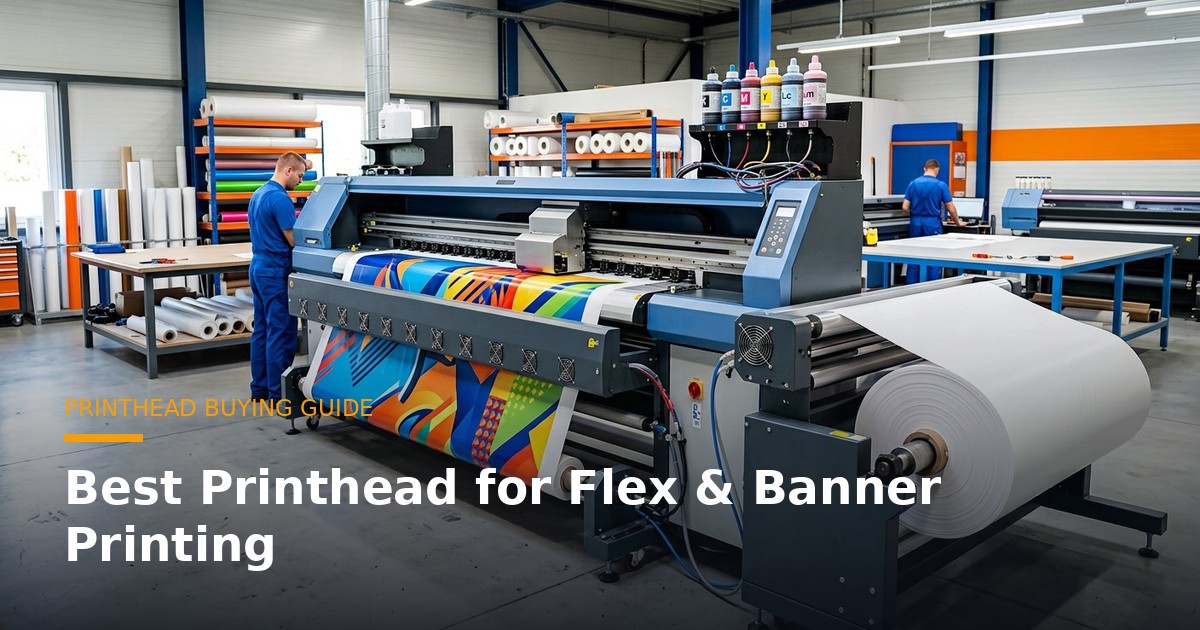
Flex and banner printing is the volume engine of the Indian sign industry — hoardings, shop boards, political banners, event graphics and vehicle wraps, printed by the thousand square feet. At the heart of every flex printer is a printhead, and the head you choose determines how fast you can print, how good the output looks, what it costs to run, and how long the machine stays productive. With Konica, Epson and Ricoh all offering heads used in flex and solvent machines, choosing the right one matters. This guide compares the best options for flex and banner work and gives clear recommendations by business type.
What Flex and Banner Printing Demands from a Printhead
Flex and banner printing has a specific set of demands that shape which printhead suits it best. First is speed — flex is a volume business, and shops win work by turning jobs around quickly, especially during peak political and festive seasons. Second is durability — flex printers run long hours in often dusty, hot workshops, so the head must be robust and forgiving. Third is cost — because flex is price-competitive, both the machine’s entry cost and the head’s replacement cost matter to your margins. Fourth is adequate quality — flex is usually viewed from a distance, so bold, clean, consistent output matters more than photographic fine detail. A head that balances these four demands — fast, tough, affordable and good enough — is what a flex business needs.
Konica Heads: The Flex Industry’s Favourite
Konica heads dominate Indian flex printing for good reason. The KM512i is the affordable workhorse found in countless flex and solvent machines — robust, forgiving on ink, easy to maintain, and delivering clean, bold output perfect for banners and signage. Its low replacement cost suits the price-competitive flex market. For higher volumes, the KM1024i brings roughly double the output per head, making it the choice for busy flex shops that need serious throughput. Both heads handle the solvent inks used in flex printing well and tolerate demanding workshop conditions. If you run a flex or banner business, a Konica-based machine — KM512i for standard volumes, KM1024i for high production — is the natural, proven choice.
Epson Heads: Versatile and Widely Used
Epson heads are also widely used in flex, eco-solvent and solvent printing, spanning affordable to industrial models. The TX800 and DX5 are popular in mid-range eco-solvent machines, offering good speed and solid quality at modest cost. The DX7 refines the DX5 with better durability and output. For higher production, the industrial i3200 delivers excellent speed and long life, and is increasingly used in eco-solvent and DTF production. Epson heads are a strong choice for eco-solvent flex and banner work, particularly where a shop wants the versatility of a head that also handles other applications. The trade-off is that entry Epson heads like the XP600 wear faster under sustained flex production than a Konica industrial head.
Ricoh Heads: Premium, Mostly for UV
Ricoh heads — the Gen5, Gen5i and Gen6 — are premium industrial heads best known for UV printing, where their precision and fine image quality shine. They are less common in mainstream solvent flex printing, where Konica and Epson dominate on cost and ruggedness. However, Ricoh heads do appear in some high-end solvent and UV roll-to-roll machines used for premium banner and display work. If your “flex” work is actually premium, quality-sensitive display or backlit graphics — closer to UV than to standard hoarding flex — a Ricoh-based machine can deliver superior quality. But for standard flex and banner volume printing, Ricoh’s premium is usually unnecessary; Konica and Epson offer better value for the work.
Speed: Which Head Prints Flex Fastest?
For a volume business, speed is money. Among the common flex heads, the Konica KM1024i is the speed leader, with its 1,024 nozzles and wide swath delivering very high throughput — the reason high-volume flex shops choose it. The Konica KM512i and Epson i3200 are also fast, well suited to steady production, and multi-head configurations scale speed further. The Epson TX800, DX5 and DX7 offer respectable speed for standard volumes. The entry XP600 is the slowest and best kept to light duty. If your business competes on turnaround and prints large flex volumes, prioritise the KM1024i or a multi-head configuration built for throughput.
Quality: How Good Does Flex Output Need to Be?
Flex and banner output is typically viewed from several metres away, so the quality bar is different from close-viewed premium work. What matters is bold, clean, consistent output — solid colours, crisp text and no banding — rather than fine photographic gradation. All the mainstream flex heads (Konica KM512i/KM1024i, Epson TX800/DX5/DX7/i3200) comfortably meet this bar when well maintained. You generally do not need a premium head’s fine-detail capability for standard flex, which is why the affordable workhorses dominate the segment. The exception is premium backlit or close-viewed display work, where a higher-quality head (KM1024i with variable droplet, or a Ricoh head in a UV/roll machine) produces smoother, more refined output worth paying for.
Running Cost and Replacement
Because flex is price-competitive, running cost matters. The Konica KM512i and Epson TX800/DX5 have low replacement costs (roughly ₹20,000–₹55,000), keeping ownership affordable. The KM1024i and i3200 cost more to replace (₹55,000–₹1,40,000) but last longer and print faster, so their cost per square foot is competitive at volume. Remember that flex machines often use multiple heads, so your replacement exposure is multiplied — budget accordingly and consider keeping a genuine spare. Across all heads, ink is your largest ongoing cost, and daily maintenance is what keeps the head alive and avoids premature replacement. The cheapest head to own is the one you maintain well and don’t have to replace early.
Best Printhead by Business Type
| Your Business | Recommended Head | Why |
|---|---|---|
| Standard flex & banner shop | Konica KM512i | Affordable, robust, low replacement cost |
| High-volume flex production | Konica KM1024i | Fastest throughput for deadlines |
| Eco-solvent signage | Epson TX800 / DX7 | Good quality and value |
| Production eco-solvent / DTF too | Epson i3200 | Speed and longevity |
| Premium backlit / display | KM1024i or Ricoh (UV/RTR) | Finer quality |
| Startup on a budget | Konica KM512i / Epson TX800 | Low entry cost |
For the large majority of Indian flex and banner businesses, a Konica-based machine is the proven, economical choice — the KM512i for standard volumes and the KM1024i where throughput is critical.
Maintenance: Keeping Flex Heads Alive
Flex printing is hard on printheads — long hours, solvent ink, and dusty workshops. Protecting your head is essential to keep costs down. Use recommended, well-filtered solvent or eco-solvent ink, since poor ink is the fastest route to clogged nozzles. Run a nozzle check every day and clean promptly when jets drop. Cap the head properly at the end of every shift so it never dries out. Keep the capping station, wipers and carriage clean, and control dust in the workshop. Follow a regular maintenance schedule rather than reacting only when output suffers. These habits cost minutes a day and routinely add a year or more to a head’s life — a very high return on a component that costs tens of thousands to replace.
Frequently Asked Questions
Which printhead is best for flex printing?
For most flex and banner shops, the Konica KM512i offers the best balance of cost, robustness and quality. For high-volume production, the Konica KM1024i is the speed leader.
Are Epson heads good for flex?
Yes — the TX800, DX5, DX7 and i3200 are all used in eco-solvent and solvent flex machines. The i3200 is best for production; the TX800 and DX5 for standard volumes.
Is Ricoh used in flex printers?
Ricoh heads are mostly for UV printing. They appear in some premium solvent/UV roll machines for high-quality display work, but Konica and Epson dominate standard flex.
Which head is cheapest to run for flex?
The Konica KM512i and Epson TX800/DX5 have the lowest replacement cost. At high volume, the KM1024i and i3200 offer better cost per square foot.
Which head lasts longest in flex printing?
Industrial heads like the KM1024i and i3200 outlast entry heads under sustained production, provided they are well maintained with good ink.
Understanding Printhead Configurations in Flex Printers
When you shop for a flex printer, you will see machines described by their head configuration — “2-head,” “4-head,” and so on — and this matters as much as the head model itself. Because a single head covers a limited width, machines mount several heads in a row, or in staggered rows for different colours, to build both speed and colour capability. A four-head KM512i machine, for example, uses four of the affordable workhorse heads to deliver solid mid-volume output, while a two- or four-head KM1024i machine uses fewer, larger, faster heads for higher throughput. More heads generally mean more speed and more colour channels, but also higher cost and more maintenance points. When comparing flex printers, always look at the whole configuration — how many heads, of which model — because that combination defines real-world output far more than the head name alone.
This is also why the head choice at purchase is so important: you generally cannot change a machine’s head model later, since the carriage, electronics and mounting are engineered around a specific head. A shop that expects to grow should consider whether a KM512i machine will meet future volumes or whether investing in a KM1024i-based machine now avoids an early replacement. Thinking about the configuration in the context of where your business is heading, not just where it is today, leads to a much better long-term purchase.
Real Flex Shop Scenarios: Choosing the Head
Consider how the decision plays out for real businesses. A neighbourhood flex shop producing shop boards, banners and hoardings in moderate volumes is well served by a KM512i machine — affordable to buy, cheap to re-head, and producing exactly the bold, clean output the work needs. A larger printer serving political campaigns and retail chains, where turnaround speed wins contracts during peak season, benefits from the KM1024i’s throughput, which lets it fulfil big orders fast. An eco-solvent shop doing finer vinyl graphics and decals might choose an Epson TX800 or DX7 machine for good quality and versatility. And a startup testing the market can begin affordably on a KM512i or TX800 machine, then scale up as volumes justify it. In each case, the right head is the one matched to the shop’s actual volume, media and budget — not simply the most expensive or the most nozzles.
Common Flex Printhead Problems — and Fixes
Flex printing is demanding on heads, so knowing the common problems helps you fix them cheaply rather than replacing prematurely. The most frequent issue is nozzle loss from clogging, usually after idle time or with poor ink — the fix is a proper clean and flush, not a new head. Banding across prints often points to clogged nozzles, misalignment or a dirty encoder strip, all fixable with cleaning and alignment. Inconsistent colour can indicate ink or maintenance issues rather than a worn head. Only when nozzles stay dead after genuine cleaning, or output has degraded overall despite maintenance, is the head truly worn and needing replacement. Most “head problems” in flex printing are actually maintenance problems, and a disciplined cleaning routine resolves them for a fraction of a replacement cost — which is why daily care is so valuable in this hard-working segment.
The Bottom Line for Flex Printers
For the overwhelming majority of Indian flex and banner businesses, the answer is straightforward: a Konica-based machine, with the KM512i for standard volumes and the KM1024i where throughput is critical, offers the best combination of speed, robustness, quality and affordable running cost. Epson heads are an excellent choice for eco-solvent work, and Ricoh belongs to the premium UV world rather than standard flex. Whichever you choose, buy genuine, maintain the head daily, and match the machine’s head configuration to your real volumes. Do that, and your flex printer will be a fast, reliable, profitable workhorse — producing the bold, clean signage your customers expect, at a cost that keeps your business competitive in a price-sensitive market.
Get the Right Flex Printer and Head
Whether you need the affordability of the KM512i or the throughput of the KM1024i, the machine around the head matters just as much. Unified Engineering Dynamics builds flex, solvent and eco-solvent printers on genuine Konica and Epson heads, matched to your volume and budget — with genuine spares, warranty and nationwide support.
Ask UED which printhead fits your flex business → Tell us what you print and how much, and we will recommend the ideal head and machine.
