



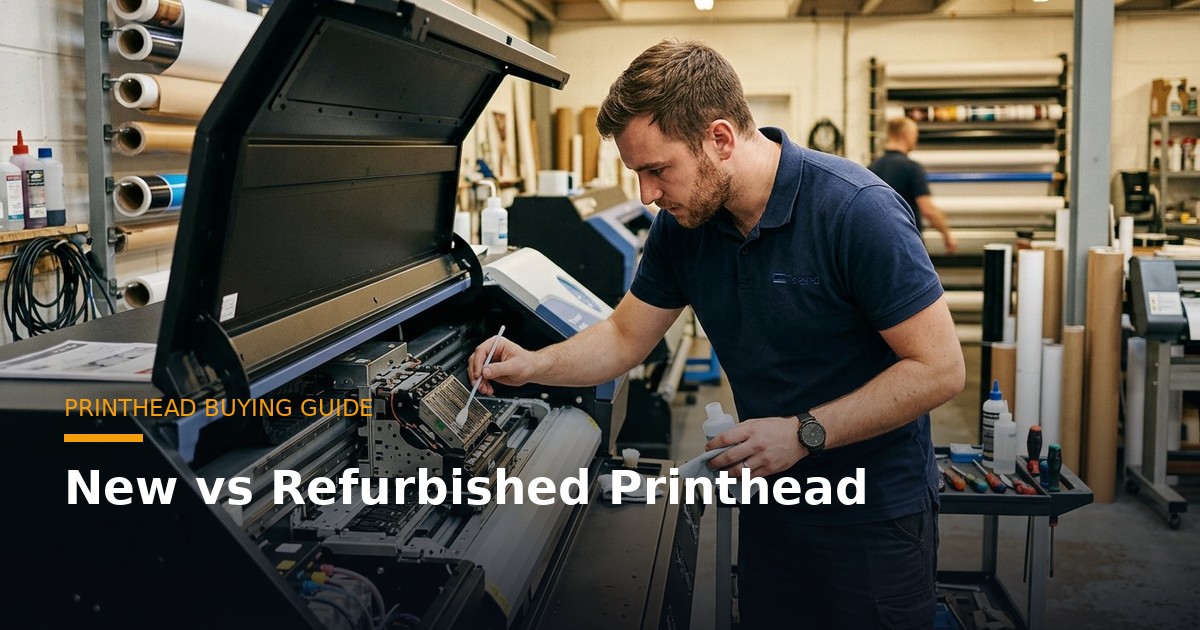
When a printhead needs replacing, the price of a genuine new unit can prompt an obvious question: can I save money with a refurbished head instead? Refurbished printheads are widely available in India at a significant discount, and for some situations they are a sensible choice. But they also carry real risks — shorter life, limited warranty, and variable quality — that can make them a false economy. This guide compares new and refurbished printheads honestly, so you can decide which is the smarter buy for your business and your budget.
What Is a Refurbished Printhead?
A refurbished printhead is a used head that has been cleaned, tested and restored to a working condition, then resold. In the best case, it is a genuine head that had plenty of life left, professionally reconditioned and tested before sale. In the worst case, it is a worn or damaged head given a superficial clean and sold with an exaggerated claim about its condition. That gap between best and worst case is the crux of the refurbished decision: a well-refurbished head from a trusted source can be a good value, while a poorly refurbished one is little better than a counterfeit in terms of reliability. Unlike a new head, whose condition is guaranteed, a refurbished head’s quality depends entirely on who refurbished it and how honestly they describe it.
New vs Refurbished: The Price Difference
Price is the main attraction of refurbished heads — they typically cost 40–60% less than new. Here is a rough comparison of indicative prices in India:
| Printhead | New (Genuine) | Refurbished |
|---|---|---|
| Epson XP600 | ₹10,000 – ₹20,000 | ₹6,000 – ₹12,000 |
| Epson i3200 | ₹55,000 – ₹85,000 | ₹30,000 – ₹50,000 |
| Konica KM512i | ₹35,000 – ₹55,000 | ₹22,000 – ₹32,000 |
| Konica KM1024i | ₹85,000 – ₹1,40,000 | ₹50,000 – ₹80,000 |
| Ricoh Gen5i | ₹90,000 – ₹1,50,000 | ₹55,000 – ₹85,000 |
On the surface, the saving is substantial. But price is only one factor — the real question is what that saving costs you in lifespan, reliability and risk.
Lifespan: The Hidden Cost of Refurbished
The biggest difference between new and refurbished is lifespan. A new genuine head starts with its full service life ahead of it — typically several years for industrial heads. A refurbished head has already been used, so it has less life remaining, and how much less is often unknown. A well-refurbished head with plenty of life left might serve you for a year or more; a poorly refurbished one might fail within months. This uncertainty is the core problem: with a new head you know what you are getting, while with a refurbished head you are partly gambling. When you compare the price saving against the likely shorter life, the cost per month of service is often closer than it first appears — and sometimes the new head is actually the better value.
Warranty: New Heads Win Clearly
Warranty is where new heads clearly outperform refurbished ones. A new genuine head from an authorised dealer comes with a proper written warranty covering manufacturing defects and early failure. A refurbished head usually comes with little or no warranty — perhaps a short “worked on arrival” guarantee, but nothing that protects you over time. This matters because a head’s problems often emerge after some use, not immediately. With a new head, a defect within the warranty period is the seller’s problem. With a refurbished head, once it is fitted and working, you typically own any subsequent failure outright. For an expensive industrial head, that lack of warranty is a significant risk.
When Refurbished Makes Sense
Despite the risks, there are situations where a refurbished head is a reasonable choice. If you need a stopgap to keep an older machine running while you plan a replacement or upgrade, a refurbished head can bridge the gap economically. If the machine itself is near the end of its life and you are not willing to invest in a new head for it, refurbished makes financial sense. If you are a hobbyist or run very light volumes where a head failure is an inconvenience rather than a crisis, the lower cost may justify the risk. And if you can buy from a genuinely trusted source that tests the head and offers at least a short warranty, refurbished can be decent value. The key is matching the refurbished head to a lower-stakes situation where its shorter life and limited warranty are acceptable.
When New Is Clearly the Better Buy
For most production businesses, a new genuine head is the better choice. If your machine earns your living and downtime is expensive, the reliability and full lifespan of a new head are worth the premium. If you print quality-sensitive work, a new head delivers consistent output that a worn refurbished head may not. If you need warranty protection, only a new head provides it. And if the head is an expensive industrial model — Ricoh Gen5i, Konica KM1024i, Starfire — the risk of a refurbished unit failing is simply too great relative to the saving. In these cases, the modest extra cost of new buys you reliability, longevity, warranty and peace of mind, which is exactly what a production business needs.
The Refurbished Risk Checklist
If you do decide to buy refurbished, protect yourself. Buy only from a source that tests the head and can show or describe the test results — ideally with a nozzle-check printout. Ask about the head’s remaining life and how it was used. Insist on at least a short warranty or a “works on arrival” return window. Verify it is a genuine head being refurbished, not a counterfeit dressed up. Do a nozzle test immediately on fitting, while you can still return it. And be realistic: treat a refurbished head as a temporary or lower-stakes solution, not as an equal alternative to new for critical production.
Cost of Ownership: The Real Comparison
The fairest way to compare new and refurbished is cost per unit of service, not sticker price. A new head costs more but lasts longer, carries a warranty, and delivers consistent quality — so its cost per month of reliable production is often competitive with, or lower than, a cheaper refurbished head that fails sooner and must be replaced again. Add the downtime and wasted media that an unreliable head causes, and the new head frequently wins on total cost for any business where production matters. The refurbished head only clearly wins when its shorter life is acceptable — in low-stakes, stopgap or end-of-life-machine situations.
Frequently Asked Questions
Are refurbished printheads worth it?
Sometimes — as a stopgap, for an old machine, or for light-duty use from a trusted tested source. For production, new genuine is usually the better value.
How much cheaper is a refurbished printhead?
Typically 40–60% less than new. But factor in the shorter life and lack of warranty when judging real value.
Do refurbished printheads come with a warranty?
Usually little or none — perhaps a short “works on arrival” guarantee. New genuine heads come with proper written warranties.
Can a refurbished head damage my printer?
A poorly refurbished or counterfeit head can cause problems, including to the electronics. Buy only tested heads from trusted sources.
Which should a production business choose?
New genuine. The reliability, lifespan and warranty justify the cost when downtime is expensive and quality matters.
How Refurbished Printheads Are Made
Understanding how refurbished heads are produced helps you judge their value. In the best case, a genuine used head with plenty of life remaining is professionally cleaned — often ultrasonically — to remove dried ink and clear nozzles, then tested to confirm it fires correctly, and sold with an honest description of its condition. Done well, this restores a head to good working order and represents genuine value. But the quality of refurbishment varies enormously. Some sellers do a thorough, tested job; others give a worn head a superficial clean and sell it with exaggerated claims about its remaining life. There is no standard certification for “refurbished,” so the term means whatever the seller says it means. This variability is the core risk: unlike a new head with a guaranteed condition, a refurbished head’s quality depends entirely on the integrity and skill of whoever refurbished it, which is why the source matters so much.
Real Scenarios: Choosing New or Refurbished
Consider a few common situations. A busy DTF shop whose i3200 fails mid-season needs reliable output immediately, and downtime is expensive — a new genuine head is the clear choice, because its full life and warranty protect the business. An owner of an eight-year-old solvent machine that is otherwise near retirement needs a head to keep it going for another year but does not want to invest heavily — a tested refurbished head from a trusted source makes financial sense. A startup on a tight budget, printing light volumes where a head failure is an inconvenience rather than a crisis, might reasonably choose refurbished to conserve cash. And a production business replacing an expensive industrial head like a Ricoh Gen5i should choose new, because the risk of a refurbished premium head failing is too great. The right answer depends on the stakes: the higher the cost of failure, the more the balance tips toward new.
Questions to Ask a Refurbished Head Seller
If you decide refurbished is right for your situation, put the seller to the test before buying. Ask whether the head is genuinely refurbished from an original brand head, not a counterfeit. Ask how it was tested and whether they can show a nozzle-check result. Ask about the head’s remaining life and how it was previously used. Ask what warranty or return window they offer — even a short “works on arrival” guarantee is far better than none. Ask whether they will accept a return if the head fails its nozzle test on fitting. A trustworthy seller answers these readily and stands behind the head; a dishonest one becomes evasive. If you cannot get clear answers, that is your signal to buy new instead, because a refurbished head you cannot verify is simply a gamble with your production.
Making Your Decision
Choosing between a new and a refurbished printhead is ultimately about matching the head to the stakes of your situation. When your machine earns your living, when downtime is expensive, when quality matters and when the head is an expensive industrial model, a new genuine head is the clear choice — its full lifespan, warranty and reliability are worth the premium many times over. When the situation is lower-stakes — a stopgap, an ageing machine, light-duty use, or a tight budget — a tested refurbished head from a trusted source can be sensible value, provided you accept its shorter life and limited warranty.
The mistake to avoid is treating refurbished as simply “cheaper new.” It is not: it is a used component with unknown remaining life and little protection, and it should be judged as such. Weigh the price saving against the shorter life, the absent warranty and the risk, and the right answer for your business usually becomes obvious. When in doubt, especially for production machines, new genuine is the safer and often cheaper choice over time. And whatever you choose, buy from a supplier who is honest about the options, supplies genuine parts, and can fit and test the head — so your decision, new or refurbished, is one you will not come to regret.
Make the Right Choice for Your Business
Refurbished heads have their place — as stopgaps, for ageing machines, or in low-stakes use from a trusted source. But for a production business where reliability, quality and warranty matter, a new genuine printhead is usually the smarter investment. Unified Engineering Dynamics supplies genuine new printheads with full warranty, and can advise honestly on the most cost-effective option for your situation, then fit and test the head on your machine.
Get advice and a genuine printhead quote → Tell us your printer and budget, and we will recommend the right option — new or otherwise — for your business.
