

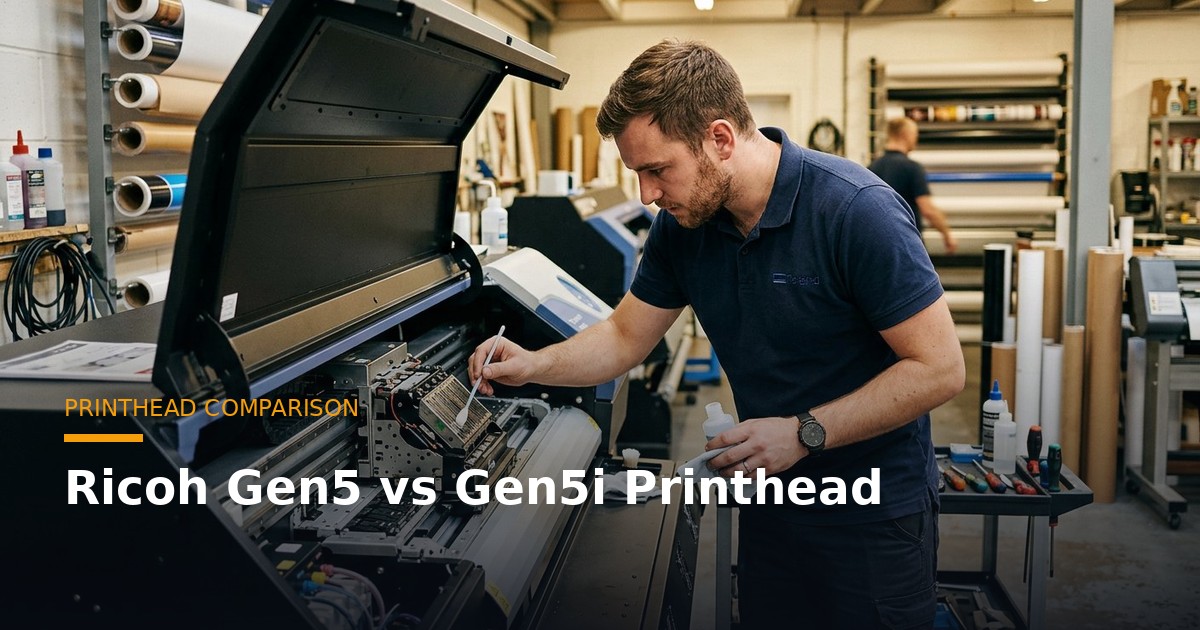
When you buy a UV flatbed or roll-to-roll printer in India, the printhead is the single component that defines its quality and speed — and for most industrial UV machines, that head is a Ricoh Gen5 or the improved Ricoh Gen5i. These two heads power a huge share of the UV printers on the Indian market, from compact flatbeds to wide-format production machines. But they are not the same head, and the differences matter for image quality, ink handling and long-term value.
This guide compares the Ricoh Gen5 and Gen5i in detail — nozzles, resolution, speed, ink compatibility, price in India and lifespan — and explains which one makes sense for the UV work you do. If a UV printer is on your shopping list, this is the head decision you need to get right.
Ricoh Gen5 vs Gen5i at a Glance
| Specification | Ricoh Gen5 | Ricoh Gen5i |
|---|---|---|
| Nozzles | 360 | 360 |
| Native resolution | 300 npi | 300 npi (up to 600 npi modes) |
| Droplet size | ~7–35 pl variable | ~4–35 pl variable (finer minimum) |
| Ink types | UV, solvent, water-based | UV, solvent, water-based (improved compatibility) |
| Grey-scale levels | Multi-level | Improved multi-level (finer gradation) |
| Typical head price (India) | ₹70,000 – ₹1,10,000 | ₹90,000 – ₹1,50,000 |
| Best for | Standard UV flatbed / RTR | High-quality UV, fine detail, production |
The Gen5i is the refined successor to the Gen5: same nozzle count, but a finer minimum droplet, improved grey-scale control and better ink compatibility — which together produce smoother gradients and sharper fine detail.
What Is the Ricoh Gen5?
The Ricoh Gen5 is a widely used industrial piezoelectric printhead with 360 nozzles at 300 npi native resolution. It is known for robustness, good speed and reliable performance with UV inks, which is why it became a default choice for UV flatbed and roll-to-roll printers. For standard UV signage, display graphics and general flatbed work, the Gen5 delivers strong, dependable output at a lower cost than its successor.
The Gen5’s variable droplet technology lets it fire different drop sizes, balancing speed on solid areas with quality on detail. It remains a popular, proven head in the mid-range UV market.
What Is the Ricoh Gen5i?
The Ricoh Gen5i (“i” for improved) keeps the 360-nozzle, 300 npi foundation but upgrades the important details. Its minimum droplet is smaller, its grey-scale gradation is finer, and its ink compatibility — especially with modern UV inks and white/varnish — is improved. The practical result is smoother photographic gradients, cleaner fine text and more consistent output on demanding jobs.
Because of these refinements, the Gen5i has become the preferred head for quality-focused and production UV printers, where image fidelity and reliability justify the higher price.
Key Differences That Matter
- Droplet size: the Gen5i fires a finer minimum droplet, giving smoother highlights and gradients.
- Grey-scale control: improved multi-level greyscale on the Gen5i produces more natural photographic transitions.
- Ink compatibility: the Gen5i handles a wider range of modern UV inks, including white and varnish, more reliably.
- Consistency: the Gen5i holds quality better across long production runs.
- Cost: the Gen5i costs more, both to buy and to replace.
For bold graphics and standard signage, both look excellent. The Gen5i’s advantages show up most in fine detail, smooth gradients and premium output.
Why UV Printers Use Ricoh Heads
Ricoh industrial heads are a mainstay of UV printing because they handle the demands of UV ink well: they fire reliably at production speeds, tolerate the pigmented, fast-curing nature of UV inks, and deliver the resolution UV work needs on rigid and flexible media alike. Alongside Konica, Ricoh is one of the two dominant head families in the UV segment, and the Gen5/Gen5i are its most common models in Indian machines.
Ricoh Gen5 and Gen5i Price in India
Both are premium industrial heads, priced accordingly. Indicative market prices (they vary with supplier, warranty and currency):
| Printhead | Indicative Price (ex-GST) | Notes |
|---|---|---|
| Ricoh Gen5 | ₹70,000 – ₹1,10,000 | Proven, lower-cost UV head |
| Ricoh Gen5i | ₹90,000 – ₹1,50,000 | Improved quality, production favourite |
Because a UV machine uses several heads (often 4, 6 or 8), the total printhead investment is significant — which is why choosing between Gen5 and Gen5i at purchase matters. The Gen5i raises both machine cost and replacement cost, but delivers the quality that premium and production UV work demands.
Which One for Your UV Printer?
- Standard UV signage and display graphics: Gen5 — excellent output at lower cost.
- Premium UV work (photographic, fine detail, retail display): Gen5i — smoother gradients and sharper detail.
- Production UV at volume: Gen5i — better consistency over long runs.
- White ink and varnish-heavy work: Gen5i — improved ink handling.
- Budget-conscious UV buyer: Gen5 — proven performance for less.
Lifespan and Maintenance
With proper care — clean, recommended UV ink, regular maintenance and correct capping — both heads are long-lived, typically serving 2 to 4+ years in production. The Gen5i, like all fine-nozzle heads, asks for consistent ink quality and filtration to protect its nozzles. Neither should be neglected: UV ink cures fast, so a head left idle or uncapped can clog quickly. Daily checks and disciplined maintenance are what keep a Ricoh head producing for years.
Frequently Asked Questions
Is the Ricoh Gen5i better than the Gen5?
Yes, for image quality — the Gen5i has a finer minimum droplet, better greyscale and improved ink compatibility. The Gen5 remains excellent for standard UV work and costs less.
Which head do most UV flatbed printers use?
Both are common; newer and quality-focused machines increasingly use the Gen5i, while the Gen5 remains popular in mid-range UV printers.
How much does a Ricoh Gen5i cost in India?
Roughly ₹90,000–₹1,50,000 (ex-GST) depending on supplier and warranty. The Gen5 is around ₹70,000–₹1,10,000.
Can I upgrade a Gen5 UV printer to Gen5i?
Generally not as a simple swap — machines are engineered around a specific head’s electronics and carriage. Choose at purchase.
How long do Ricoh Gen5/Gen5i heads last?
Typically 2–4+ years in production with good ink and maintenance. UV ink’s fast curing makes regular care especially important.
Which is better for white ink printing?
The Gen5i handles white and varnish inks more reliably thanks to improved ink compatibility, making it the better choice for white-heavy UV work.
Understanding Picolitre Droplet Sizes — and Why They Matter
Both heads use variable droplet technology, but the numbers behind it explain the quality difference. A picolitre (pl) is a trillionth of a litre, and printheads fire droplets measured in single-digit picolitres. The Gen5i can fire a smaller minimum droplet (around 4 pl) than the Gen5 (around 7 pl). Why does that matter? Small droplets build smooth gradients and fine detail — the tiny dots blend into seamless transitions in skies, skin tones and shadows. Larger minimum droplets produce coarser transitions and visible dot structure in delicate areas.
For bold signage viewed from a distance, you will not see the difference. For a photographic backlit, a premium retail panel or fine text, the Gen5i’s finer droplet produces visibly smoother, more refined output. This is the core reason quality-focused UV buyers choose the Gen5i.
Gen5 vs Gen5i Across Real UV Applications
- Standard UV signage and boards: both excellent; the Gen5 saves money.
- Photographic and fine-art UV printing: Gen5i — smoother gradation and finer detail.
- Retail display and premium panels: Gen5i — the quality shows at close viewing distance.
- White and varnish effects: Gen5i — improved ink handling gives more consistent results.
- High-volume general UV production: either works; choose on budget versus quality needs.
The pattern is consistent: the Gen5 covers standard work economically, while the Gen5i earns its premium where quality is visible and valued.
Multi-Head UV Configurations
UV printers rarely use a single head. Machines mount several heads — commonly four, six or eight — arranged for colour channels, white and varnish. Because the Gen5 and Gen5i share the same 360-nozzle, similar-footprint design, machines are built around one or the other. The number of heads determines speed and capability: more heads mean faster output and the ability to run white and varnish alongside colour. When comparing UV printers, always look at the total head count and configuration, not just the head model, because that is what defines real-world throughput.
Common Buyer Mistakes
- Choosing on price alone: the cheaper Gen5 is a false economy if your customers demand Gen5i-level quality.
- Over-buying quality: paying the Gen5i premium for standard signage that the Gen5 handles perfectly.
- Ignoring replacement cost: the head is a consumable — a Gen5i machine costs more to re-head over its life.
- Assuming you can upgrade later: you generally cannot retrofit a Gen5 machine to Gen5i.
Maintaining Ricoh Heads in Indian Conditions
India’s heat and dust are hard on printheads, and UV ink’s fast-curing nature makes neglect costly. Protect your Ricoh head with a disciplined routine: use recommended, filtered UV ink; run daily nozzle checks; clean and cap the head properly at the end of every day; keep the capping station clean and sealed; and control dust in the workshop. A head that dries uncapped even overnight can clog badly. Consistent daily care is what separates a Ricoh head that lasts four years from one that fails in eighteen months.
More Gen5 vs Gen5i Questions
Do both heads need the same ink?
Both run UV inks, but the Gen5i tolerates a wider range of modern UV inks — including white and varnish — more reliably. Always use ink recommended for your specific head.
Is the Gen5i worth it for a small UV business?
Only if your work demands the extra quality. For standard signage, the Gen5 is more economical. For premium, close-viewed output, the Gen5i justifies its cost.
Which head holds output consistency better over a long run?
The Gen5i, thanks to improved design and ink handling, tends to hold quality more consistently across demanding production days.
The Business Case: Matching the Head to Your Market Position
Choosing between the Gen5 and Gen5i is ultimately a business decision, not just a technical one. Ask yourself what your customers actually pay for. If you compete on price and produce standard signage — shop boards, hoardings, basic display panels — then output quality beyond a certain point adds no revenue, and the Gen5’s lower cost is pure advantage. Every rupee you save on the head, and on future replacements, goes straight to your margin. On the other hand, if you serve brands, retailers or designers who scrutinise output closely, who print photographic work, fine gradients and premium panels, then the Gen5i’s smoother detail is not a luxury — it is what wins and keeps those clients. The head should match the tier of customer you serve and the prices you can command.
There is also a growth consideration. A business that starts with standard signage but aims to move upmarket into premium display work may find the Gen5i a better long-term fit, avoiding an early machine replacement. Conversely, a shop firmly positioned in volume signage gains nothing from the Gen5i premium. Be honest about where you are and where you are heading, and the choice becomes clear.
What Buyers in India Actually Choose
In the Indian market, both heads have strong followings. The Gen5 remains common in mid-range UV flatbeds where affordability and proven reliability matter most, and it handles the bulk of general UV signage work admirably. The Gen5i has become the default in newer and quality-focused machines, particularly where white ink, varnish and fine detail are regularly required. Neither is a risky choice — both are genuine Ricoh industrial heads with good support and spare availability in India. The decision comes down to your quality requirements and budget. When in doubt, discuss your actual output mix with a machine builder who can show you sample prints on each head, because seeing the quality difference on your own work is the best way to decide whether the Gen5i premium is worth it for you.
Choose the Right Ricoh Head for Your UV Business
Whether you opt for the cost-effective Gen5 or the quality-focused Gen5i, the machine built around the head matters just as much. Unified Engineering Dynamics builds UV flatbed and roll-to-roll printers on genuine Ricoh heads, matched to your media, quality needs and budget — with genuine spares, warranty and nationwide support.
Ask UED which Ricoh head suits your UV printer → Tell us what you print and we will recommend the ideal head and machine configuration.
