


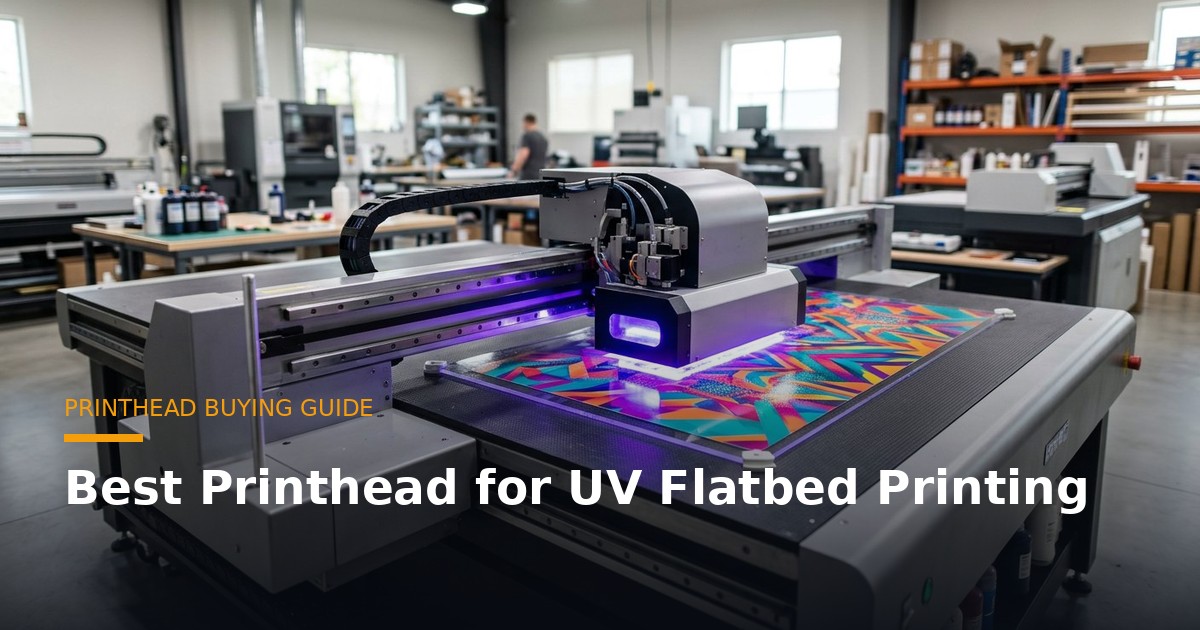
UV flatbed printing has transformed signage, décor, packaging and personalised products, letting businesses print directly onto rigid and flexible media — acrylic, wood, glass, metal, PVC and more. The printhead is the defining component of any UV flatbed printer, governing image quality, speed, white and varnish capability, and long-term cost. The three heads that dominate the UV flatbed market are the Ricoh Gen5i, the Konica KM1024i and Toshiba heads. This guide compares them and recommends the right one for your UV work.
What UV Flatbed Printing Demands from a Printhead
UV printing places specific demands on a printhead that differ from solvent or eco-solvent work. First, the head must handle UV ink, which is pigmented, fast-curing and more demanding than solvent ink — not every head tolerates it well. Second, UV work often needs white ink and varnish, requiring reliable heads that can lay down opaque white and glossy varnish consistently. Third, because UV printing serves premium applications — signage, décor, awards, packaging prototypes — image quality matters more than in flex, with smooth gradients and fine detail expected. Fourth, UV flatbeds are capital machines, so durability and reliability are essential to protect the investment. A UV head must balance ink tolerance, quality, white/varnish capability and robustness.
Ricoh Gen5i: The Quality Leader
The Ricoh Gen5i is arguably the most respected head in UV flatbed printing, and for good reason. Its fine variable droplet, high effective resolution and refined greyscale produce superb image quality — smooth gradients, fine detail and consistent output that premium UV work demands. It handles modern UV inks, including white and varnish, reliably, and its industrial build suits sustained production. The Gen5i has become the default head in quality-focused UV flatbeds, and if your UV business competes on image quality — premium display, photographic panels, close-viewed retail graphics, fine décor — the Gen5i is the head that delivers. Its premium price is justified wherever quality wins work.
Konica KM1024i: The Production Powerhouse
The Konica KM1024i brings its 1,024 nozzles and wide swath to UV printing, delivering very high throughput with good quality. It is the balanced performer — fast enough for serious production, with variable droplet for respectable image quality — and its relative affordability (compared with Ricoh) makes it attractive for high-volume UV operations. The KM1024i is widely used in UV flatbed and roll-to-roll machines where speed and value matter, and it handles UV inks well. If your UV business is driven by volume and turnaround — producing large quantities of signage, décor or industrial parts — the KM1024i offers an excellent balance of speed, quality and cost.
Toshiba Heads: The Fine-Detail Specialist
Toshiba printheads (such as the CE4M series) are used in a number of quality UV flatbed printers, valued for their fine droplet control and consistent, high-resolution output. Toshiba heads are known for reliability and smooth gradation, making them a strong choice for detail-sensitive UV work. They are less ubiquitous in India than Ricoh or Konica, so availability of genuine spares and technical familiarity can be more limited — an important consideration before choosing a Toshiba-based machine. Where they are well supported, Toshiba heads deliver excellent UV quality and are a legitimate alternative to the Ricoh Gen5i for premium, fine-detail applications.
Speed Compared
For throughput, the Konica KM1024i leads, with its high nozzle count and wide swath delivering the fastest production among the three. The Ricoh Gen5i is fast but tuned more toward quality than raw speed. Toshiba heads offer good speed with an emphasis on quality. All three are fast by any standard; the difference matters most if your bottleneck is production volume, in which case the KM1024i’s throughput advantage is significant. For quality-focused work where speed is adequate rather than critical, the Gen5i and Toshiba heads deliver the refinement that wins premium jobs.
Image Quality Compared
For fine detail and smooth gradients, the Ricoh Gen5i and Toshiba heads lead, thanks to their fine droplet control and high effective resolution — ideal for photographic and close-viewed premium UV work. The Konica KM1024i delivers very good quality with excellent speed, more than sufficient for most signage, décor and industrial UV applications. The practical difference shows up in delicate gradients, fine text and smooth highlights: for premium work viewed closely, the Gen5i and Toshiba edges are visible and valuable; for general UV output, the KM1024i is excellent. Match the head to the quality your customers actually see and pay for.
White Ink and Varnish Capability
White ink and varnish are central to much UV printing — white for printing on dark or transparent media, varnish for gloss and texture effects. The Ricoh Gen5i handles white and varnish reliably, with improved ink compatibility that makes it a favourite for white-heavy work. The Konica KM1024i also performs well with white and varnish, and its high flow suits heavy coverage. Toshiba heads deliver fine, controlled white and varnish for quality effects. All three are capable; the choice depends on whether you need heavy, opaque white coverage (KM1024i) or fine, controlled white detail (Gen5i, Toshiba). Confirm the machine’s white and varnish configuration matches your typical jobs.
Cost and Value
| Printhead | Indicative Price | Value Position |
|---|---|---|
| Konica KM1024i | ₹85,000 – ₹1,40,000 | Best speed-per-rupee |
| Ricoh Gen5i | ₹90,000 – ₹1,50,000 | Quality premium |
| Toshiba (CE4M class) | ₹90,000 – ₹1,60,000 | Fine-detail specialist |
Because UV flatbeds use multiple heads, these prices multiply across the carriage. The KM1024i generally offers the best balance of performance and cost; the Gen5i and Toshiba command premiums for their quality strengths. Factor total cost of ownership — heads, ink, maintenance and downtime — not just head price, and choose based on the revenue each head’s strengths enable for your specific UV work.
Best UV Flatbed Printhead by Application
- Premium display and photographic UV: Ricoh Gen5i or Toshiba — finest detail and gradation.
- High-volume signage and décor: Konica KM1024i — speed and value.
- Heavy white and varnish work: Konica KM1024i or Ricoh Gen5i.
- Packaging prototypes and industrial parts: KM1024i — production throughput.
- Close-viewed awards and retail panels: Ricoh Gen5i or Toshiba.
For most UV flatbed businesses, the choice comes down to whether quality (Gen5i/Toshiba) or throughput-and-value (KM1024i) better matches your dominant output.
Frequently Asked Questions
Which is the best printhead for UV flatbed printing?
The Ricoh Gen5i leads for image quality, the Konica KM1024i for speed and value, and Toshiba heads for fine detail. The best depends on whether your work prioritises quality or throughput.
Is Ricoh better than Konica for UV?
For fine image quality, the Ricoh Gen5i has an edge. For high-speed production and value, the Konica KM1024i is excellent. Both are proven UV heads.
Are Toshiba heads good for UV flatbeds?
Yes — Toshiba heads deliver excellent fine-detail UV quality. Just confirm genuine spare availability and support in India before choosing a Toshiba-based machine.
Which head is best for white ink printing?
The Konica KM1024i excels at heavy white coverage; the Ricoh Gen5i and Toshiba handle fine white detail well. Choose based on your white-ink needs.
Which UV head is most affordable?
The Konica KM1024i generally offers the best speed-per-rupee; the Gen5i and Toshiba carry quality premiums.
Understanding UV Printhead Configurations
UV flatbed and roll-to-roll machines are built around multiple heads, and the configuration shapes both capability and cost. Machines mount several heads — commonly four, six or eight — arranged to handle colour channels plus white and varnish. The number and arrangement of heads determine how fast the machine prints and what it can produce: more heads mean higher throughput and the ability to run white underbase and varnish effects alongside colour. Because the compact Ricoh Gen5i and the wide Konica KM1024i differ in size, machines are engineered around one or the other, and the head count reflects that. When comparing UV printers, look beyond the head model to the whole configuration — how many heads, and which channels they serve — because that combination defines the machine’s real capability for your specific UV work, from simple colour printing to white-plus-varnish production.
This also affects your long-term cost. Since UV machines use multiple premium heads, the total printhead investment and eventual replacement cost is substantial, which makes both the head choice and the machine’s build quality important. A well-built machine that protects and maintains its heads well will get far more life from them than a poor one, so the manufacturer matters as much as the head brand when you are investing in UV production.
Choosing by UV Media and Product
The best UV head also depends on what you actually print. If your work is signage and display panels in volume, the Konica KM1024i’s speed and value are ideal. If you print premium retail graphics, awards or close-viewed décor, the Ricoh Gen5i’s fine detail and smooth gradation win the work. If you produce industrial parts, packaging prototypes or heavy-coverage items, the KM1024i’s throughput and deposition suit the job. If your output is photographic or fine-art reproduction, the Gen5i or a Toshiba head delivers the gradation these demand. And if you frequently print on dark or transparent media, prioritise a machine and head with strong white-ink capability. Matching the head’s strengths to your dominant products — rather than buying on brand or specification alone — is what turns a UV printer into a profitable, well-utilised asset.
Common UV Printhead Issues — and Fixes
UV heads face a specific challenge: UV ink cures fast, so a head left idle or uncapped can clog quickly. The most common problem is nozzle loss from cured or dried ink, addressed by prompt cleaning and always capping the head properly — prevention matters more here than in solvent printing. White-ink clogging is another frequent issue, since white pigment settles; circulating and agitating white ink as recommended prevents it. Banding usually points to clogged nozzles or alignment, both fixable. Only persistent nozzle loss after genuine cleaning indicates a worn head needing replacement. Because UV heads are premium components, disciplined daily maintenance — recommended ink, nozzle checks, proper capping, clean environment — is essential to protect a significant investment and avoid costly premature replacement.
The Bottom Line for UV Flatbed Buyers
Choosing a UV flatbed printhead comes down to a simple question: does your business compete on quality or on throughput? If you win work with fine detail, smooth gradients and premium output that customers view up close, the Ricoh Gen5i — or a well-supported Toshiba head — is the quality choice worth its premium. If your UV business is driven by volume, turnaround and value, the Konica KM1024i delivers the speed and cost-effectiveness that keep you competitive. Most UV buyers, once they answer that question honestly, find the decision clear. What matters most is matching the head to your dominant output and buying a well-built machine from a manufacturer who understands the head and will support it.
Whatever you choose, treat the UV head as the significant investment it is. Buy genuine, use recommended ink, maintain it daily so the fast-curing UV ink never clogs it, and cap it properly every time. UV printheads are premium components, and disciplined care is what protects that investment and keeps your flatbed producing beautiful output for years. Get the head right for your work, look after it well, and your UV printer becomes a versatile, profitable asset capable of printing on almost any media your customers can imagine.
In the end, the best UV flatbed printhead is the one whose strengths your customers actually reward. Choose it deliberately, buy it genuine, and maintain it with the discipline a premium UV head deserves, and it will reward you with years of versatile, high-quality output on media ranging from acrylic and wood to glass, metal and beyond.
Build Your UV Flatbed on the Right Head
Whether you prioritise the Gen5i’s quality, the KM1024i’s production value, or Toshiba’s fine detail, the machine around the head must be built right. Unified Engineering Dynamics builds UV flatbed and roll-to-roll printers on genuine Ricoh, Konica and other industrial heads — matched to your work, with genuine spares, warranty and nationwide support.
Ask UED which UV printhead fits your business → Share what you print and we will recommend the ideal head and machine configuration.
