



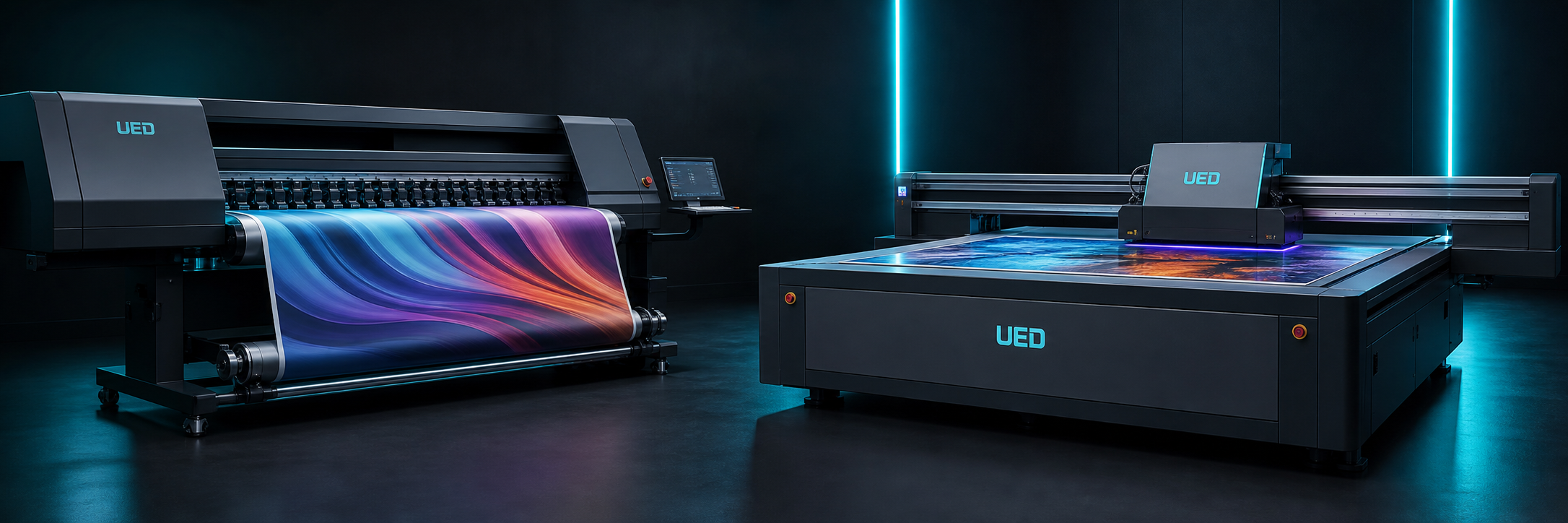
Choosing between a UV roll-to-roll printer and a UV flatbed printer is the single most consequential equipment decision in a modern print shop, because the two machines print fundamentally different things and therefore build fundamentally different businesses. One feeds flexible media from a roll; the other holds rigid sheets and objects on a flat bed. This guide compares what each prints, how they differ in quality, speed, cost and workflow, and gives you a practical buying framework so you invest in the machine your market will actually pay for.
Two architectures, two businesses
A UV roll-to-roll printer unwinds flexible media — banner, vinyl, backlit flex, sticker stock, textile — from a rear roll, prints as it advances, and rewinds or cuts at the front. Its world is flexible signage and advertising media produced by the metre. A UV flatbed printer has a stationary vacuum bed on which you place rigid sheets — acrylic, glass, wood, MDF, metal, tile, foam board — and even three-dimensional objects, and the carriage prints across them. Its world is rigid signage, décor, personalisation and industrial printing. The architecture you choose decides your product catalogue, your customers and your margins, which is why the decision deserves care.
What a UV roll-to-roll printer prints
The roll-to-roll machine is the engine of the advertising and signage trade. It prints frontlit and backlit flex banners, self-adhesive vinyl for vehicle graphics and window films, sticker and label stocks, backlit films for lightboxes, canvas, and even wallpaper and textile media on the right model. Because UV ink cures instantly, it handles these media without drying racks and, crucially, without the lamination step that solvent printing often needs. If your order book is dominated by banners, hoardings, vehicle wraps, window graphics and stickers, the roll-to-roll is the machine that earns.
What a UV flatbed printer prints
The flatbed prints the rigid and the three-dimensional: acrylic for premium and backlit signs, glass for décor and splashbacks, wood and MDF for furniture-grade graphics, metal and ACP for durable signage, tile for murals, PVC foam board for exhibitions, and small objects — phone cases, keychains, awards, bottles with a rotary attachment — for the promotional and gifting market. Where the roll-to-roll sells square metres of flexible media, the flatbed sells finished, high-value pieces. Its customers are signage studios, interior designers, gift shops and industrial buyers rather than the banner trade.
The core differences at a glance
- Media form: roll-to-roll = flexible rolls; flatbed = rigid sheets and objects.
- Handling: roll-to-roll = tension and edge control; flatbed = vacuum and head-height.
- Output: roll-to-roll = metres of media to finish elsewhere; flatbed = near-finished pieces.
- Typical buyer: roll-to-roll = advertising and signage volume; flatbed = décor, gifts, rigid signage.
- Value per piece: roll-to-roll = lower per-metre price, high volume; flatbed = higher per-piece margin.
Print quality and resolution
Both platforms can produce excellent quality; the difference is where quality is hardest to hold. On a roll-to-roll, quality is governed by media advance and tension — banding and step-errors appear if the feed slips, so good tension systems and calibrated advance matter. On a flatbed, quality is governed by head height and substrate flatness — a bowed board or wrong height causes strikes and deflection. In practice a well-set roll-to-roll gives smoother large-area colour for banners, while a well-set flatbed gives crisper detail on rigid pieces and objects. Resolution specs are similar; the real differentiator is media control.
White ink and varnish on both platforms
White ink and varnish are available on both, but they matter differently. On a roll-to-roll, white enables stickers on clear vinyl, backlit films and day-night graphics; varnish is less often used because flexible media are usually laminated or left as-is. On a flatbed, white is essential for dark and transparent rigid substrates, and varnish adds gloss, matte, texture and protection that directly raise the perceived value of a finished piece. If your plan depends on white-ink products, confirm the white channel’s reliability on whichever platform you choose, because white is the highest-maintenance ink on any UV machine.
Speed and throughput in the real world
Roll-to-roll machines are generally faster in raw square metres per hour because they print continuously on wide media, making them the choice for volume banner work. Flatbeds are slower per square metre but each square metre is a higher-value finished piece, and flatbeds print multiple small items ganged in one pass. The honest comparison is not headline speed but revenue per hour: a roll-to-roll earns through volume at thin margins; a flatbed earns through value at fatter margins. A shop should compare machines on the jobs it actually runs, not on brochure numbers.
Cost of machine, ink and media
Entry roll-to-roll UV machines are often cheaper than equivalently sized flatbeds, and flexible media like banner are inexpensive per square metre, so the roll route has lower material cost but also lower selling price. Flatbeds cost more upfront and rigid substrates cost more per sheet, but the finished-piece price is several times the material cost. Ink cost per square metre is comparable; the difference is that flatbed work uses more white and varnish, adding consumable cost that is recovered in the premium price. Model both routes with your local prices before deciding.
Space, workflow and labour
A roll-to-roll needs length for media to feed and exit, plus finishing space for trimming, laminating and grommeting; its labour is in finishing and installation. A flatbed needs a large flat footprint and a prep area for cleaning and priming rigid sheets; its labour is in preparation, handling and finishing small pieces. Neither is difficult, but the skill sets differ: roll work rewards speed and neat finishing; flatbed work rewards careful preparation and adhesion discipline. Consider which skill set your team has or can hire, because workflow fit affects profitability as much as the machine itself.
Which businesses suit a roll-to-roll first
Choose the roll-to-roll first if your market is advertising and signage volume: banner and hoarding production, vehicle graphics, window films, stickers and lightbox media. These are high-frequency, fast-turnaround jobs that keep a machine busy daily and build cash flow. It is the right first machine for shops in busy commercial areas, for advertising agencies bringing production in-house, and for businesses that already sell signage and want to capture the printing margin.
Which businesses suit a flatbed first
Choose the flatbed first if your market is décor, personalisation, rigid signage and industrial printing: acrylic signs, glass and wood décor, gifts and awards, industrial labels and panels. These are lower volume but much higher margin, and they face less price competition than banner work. It is the right first machine for studios, gift and personalisation businesses, and shops targeting interior designers and industrial buyers rather than the banner trade.
When the answer is both — or a hybrid
Many profitable shops eventually run both platforms because their customers buy both flexible and rigid work. Where capital or space allows only one machine but the market needs both, a UV hybrid printer prints rolls and rigid boards on a single frame, trading some specialised performance for versatility and a smaller footprint. The hybrid is a sensible compromise for a mixed shop, while a dedicated roll-to-roll plus a dedicated flatbed remains the highest-performance combination for a shop with clear volume in both.
Buying checklist for a roll-to-roll
- Media width against your largest banner and vinyl jobs.
- Tension and tracking system quality — the heart of roll quality.
- White ink option and reliability for stickers and backlit.
- Ink flexibility for flexible media without cracking.
- Service support and head availability locally.
Buying checklist for a flatbed
- Bed size against your largest rigid sheet (8×4 boards, ACP).
- Vacuum strength and pin registration for double-sided work.
- White and varnish channels for premium rigid work.
- Media-height sensor and Z-clearance for objects.
- Adhesion support: primers, profiles and test data per substrate.
Common mistakes in choosing between them
- Buying a flatbed for a banner market, then watching it sit idle.
- Buying a roll-to-roll for a décor market, then lacking the rigid capability customers ask for.
- Choosing on headline speed instead of revenue per hour on real jobs.
- Ignoring white-ink reliability, then losing the premium products.
- Under-budgeting finishing space and labour for either platform.
Frequently asked questions
Can a roll-to-roll print rigid boards?
No — a true roll-to-roll handles flexible media only. Rigid sheets and objects need a flatbed or a hybrid.
Can a flatbed print banner rolls?
Not efficiently. Some flatbeds accept flexible media laid on the bed, but roll work at volume belongs on a roll-to-roll or hybrid.
Which has lower running cost?
Ink cost per square metre is similar; the roll route has cheaper media and lower prices, the flatbed has costlier media and higher prices. Running cost matters less than the margin each route earns.
A deeper look: reading your order book before you buy
The most reliable way to choose is to audit three months of enquiries and orders and classify each as flexible-roll or rigid-flat. If the majority of revenue and enquiry volume is banners, vinyl and stickers, the roll-to-roll pays first. If the majority is signage boards, décor and personalisation, the flatbed pays first. Most shops find a mix, and the mix ratio tells you the first machine and the second. This simple audit replaces guesswork with evidence, and it usually reveals that one platform will carry the cash flow while the other carries the margin — a pairing, not a rivalry.
A deeper look: payback thinking for the first machine
Model payback with realistic utilisation, not perfect utilisation. A roll-to-roll in a busy advertising market can reach high daily square metres at modest margins, recovering cost through volume within a year or two. A flatbed reaches fewer square metres but at several times the margin per piece, recovering cost through value. Stress-test both with half the assumed volume and see which still pays; the machine that survives the pessimistic case is the safer first buy. Then plan the second machine as the business proves the demand the first one could not serve.
A deeper look: maintenance and consumables compared
Both platforms share UV maintenance basics — head cleaning, capping, white-ink circulation — but their wear points differ. Roll-to-rolls wear in media-path components: rollers, tension brakes, edge guides and take-up motors, plus the finishing tools downstream. Flatbeds wear in the vacuum bed, pins, height sensors and the handling of heavy sheets that can strike heads. Budget consumables accordingly: roll shops spend on media and finishing supplies; flatbed shops spend on primers, varnish, jigs and protective packing. Knowing where each machine’s money goes keeps both profitable.
Choosing by the customer you want, not just the media
Beyond the order book, choose the platform that attracts the customers you want to serve. A roll-to-roll draws advertising agencies, event companies and price-sensitive sign buyers who order often and in volume; relationships are transactional but frequent. A flatbed draws interior designers, retailers, corporates and homeowners who order less often but pay for design, material and finish; relationships are consultative and sticky. There is no wrong answer, but the two machines build different client bases, and picking the one whose customers match your strengths makes selling easier and margins steadier.
The second-machine moment
Whichever machine you buy first, watch for the signal to add the other: a steady stream of enquiries you must decline or outsource. When you are regularly turning away rigid work, the flatbed is overdue; when you are declining banner and vinyl work, the roll-to-roll is overdue. Outsourcing that work once or twice is research; outsourcing it every week is leaked margin. The first machine should be chosen to earn now, and the second timed to capture the demand the first proves but cannot serve.
Conclusion
Roll-to-roll and flatbed are not competitors; they are two different businesses sharing a technology. The roll-to-roll owns flexible advertising volume; the flatbed owns rigid, high-value, personalised work. Read your order book, model payback pessimistically, and choose the platform your market already pays for — then add the other, or a hybrid, as demand proves itself. Browse our digital UV printer range or talk to us to match a machine to your market.
