



PVC is everywhere in print — flexible banner and vinyl on one side, rigid PVC foam board (Sunboard, Forexx) on the other — and UV printing handles both. It is the default substrate for value signage, exhibitions, retail graphics and a hundred short-run applications, which makes it the volume backbone of most UV shops. But PVC also has two distinct personalities: flexible material that must take a flexible ink without cracking, and rigid foam board that must print flat and fast. This guide covers both, plus preparation, white ink, applications and pricing.
Two PVCs: flexible and rigid, and why they differ
Flexible PVC — banner material, self-adhesive vinyl, sticker stock — bends, rolls and stretches. The ink film on it must stretch too, so flexible UV inks are essential; a rigid ink will crack at a fold or edge. Rigid PVC foam board is a closed-cell foamed sheet, light and easy to cut, used for indoor signage, exhibition panels and point-of-sale. It prints with either rigid or flexible inks, but flexible inks give better edge and drill tolerance. Treating the two as one substrate is the classic error; the ink and handling differ.
Adhesion and the plasticiser problem
Flexible PVC contains plasticisers that can migrate to the surface over time, creating a weak boundary layer that undermines adhesion and can even soften ink. Quality banner and vinyl from reputable mills have stable surfaces, but cheap material can be problematic. The professional approach is to buy known-grade media, wipe rigid PVC with isopropyl alcohol to remove handling grease and release agents, and test flexible media for crack resistance by folding a cured sample. For rigid PVC foam board, adhesion is generally straightforward after a wipe; the bigger issues are flatness and static dust.
Preparation and handling for foam board
- Wipe faces with isopropyl alcohol; foam board carries static dust that causes pinholes.
- Use an anti-static pass or cloth before printing large areas.
- Lay boards flat on the vacuum bed; support oversize sheets so they do not bow into the head.
- Set head height from the board surface, not the bed, and re-check on thick 10 mm board.
- Store boards flat and acclimatised to avoid bowing.
White ink and double-sided work
PVC foam board is usually white, so colour prints directly; white ink matters for coloured or transparent PVC and for printing on clear vinyl where a sticker needs opacity. Double-sided foam-board signage (hanging boards seen from both sides) is a very common job; a flatbed with good registration prints side A then side B using pin registration or a jig, and the margin on double-sided boards is strong because the alternative — two boards bonded — is heavier and slower.
Applications: the volume engine
Flexible PVC: banners, hoardings, vehicle-grade graphics, stickers and labels, window vinyl, floor graphics. Rigid PVC foam board: exhibition panels, point-of-sale, site signage, menu boards, property boards, photo mounts and event graphics. Because UV printing on these needs no lamination and cures instantly, a shop can turn a banner or board job in hours. This speed and the low substrate cost make PVC the entry point for most customers and the cash-flow engine for most shops, even as premium substrates carry the margin.
Machine choice across the PVC range
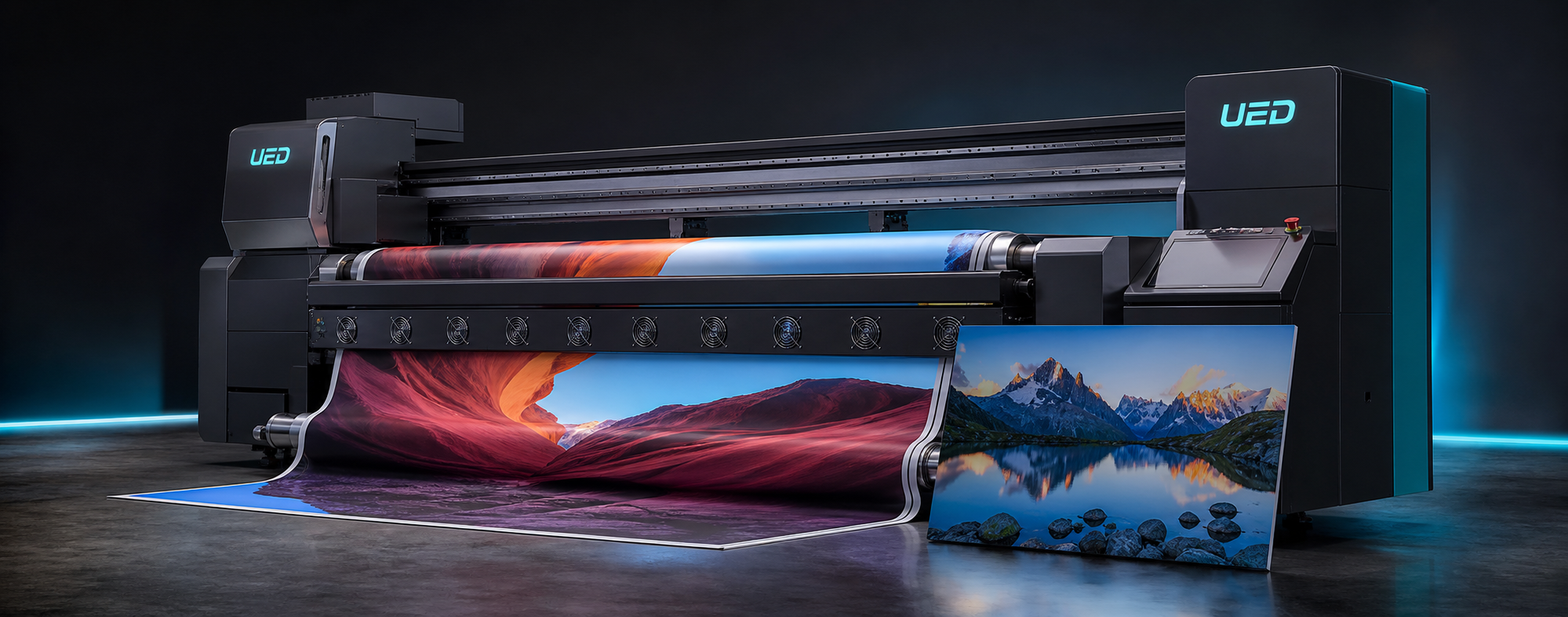
Flexible PVC banner and vinyl are roll media, so a UV roll-to-roll printer is the natural machine, with white ink for stickers and backlit work. Rigid foam board is a UV flatbed printer job. Many profitable shops run both, or a UV hybrid printer that covers rolls and boards on one frame, which is capital-efficient for a mixed PVC business. The critical specs are media handling (tension control for flexible, vacuum for rigid) and white ink reliability.
Durability and honest outdoor claims
UV prints on flexible PVC banners are genuinely outdoor-capable for the banner’s own service life; the banner material degrades before the ink in most cases. Rigid foam board is best indoors or sheltered; in full sun it can warp and the foam edges degrade, so quote it as indoor/sheltered and offer ACP or metal for permanent outdoor. Setting the right substrate-per-application expectation is the mark of a professional and prevents the “my board warped” complaint.
Cost and pricing
PVC is a price-sensitive market, so efficiency is the margin: fast RIP, nested layouts, minimal handling, and same-day turnaround as the selling point. Price flexible banner per square foot competitively, and foam board with premiums for double-sided, cutting-to-shape and installation. The volume in PVC keeps machines busy and staff skilled, and it is the funnel that introduces customers to your higher-margin acrylic, glass and wood work.
Common mistakes with PVC
- Using rigid ink on flexible banner and getting crack lines at folds.
- Printing cheap, plasticiser-heavy vinyl and blaming adhesion.
- Ignoring static dust on foam board and shipping pinholed panels.
- Quoting foam board for permanent outdoor and absorbing warp complaints.
- Skipping pin registration on double-sided jobs and mis-registering sides.
Frequently asked questions
Is UV PVC banner better than eco-solvent?
UV cures instantly and needs no lamination, handles a wider range of media including rigid, and offers white ink. Eco-solvent can be cheaper on pure banner volume. Many shops run both for different jobs.
Can I print stickers and labels on UV?
Yes — UV on self-adhesive vinyl with white ink and varnish produces durable die-cut-ready sticker sheets; it is a strong, high-margin line.
Does foam board need primer?
Generally no; a wipe and anti-static pass suffice. Reserve promoter for unusual coated or coloured PVC.
A deeper look: stickers, labels and the short-run economy
UV printing transformed sticker and label production: no plates, no minimums, white ink for clear vinyl, and a varnish that adds gloss or protection in-line. A shop can profitably run a single sheet of custom die-line stickers, which is exactly what small brands, cafes and creators buy constantly. The economics work because the machine cost per sheet is low and the perceived value is high; the margin lives in design help, fast proofing and a tidy ordering menu. Add a cutting plotter for kiss-cutting and you own the whole chain from artwork to finished sticker. This short-run capability is also the gateway drug to larger branded work from the same clients.
A deeper look: exhibitions and events, PVC’s natural home
Exhibitions run on PVC: foam-board graphics, banner stands, hanging signs, floor stickers and backdrop walls, all needed fast and changed often. A UV shop that offers a 24-hour exhibition package — design check, print, cut, and even fit — becomes the default supplier for event companies and exhibitors, who value reliability over the last rupee. Keep standard sizes and a rapid quoting sheet, hold a small stock of common foam board thicknesses, and build a reputation for “it will be ready before the show.” Event work is seasonal but intense, and it trains your whole operation for speed and accuracy that pays off in every other line.
Backlit and translucent PVC work
Flexible PVC includes backlit flex for lightboxes, a material that rewards UV’s white-ink control. The recipe mirrors acrylic backlit work — white, colour, white — but on a flexible substrate, so ink flexibility and even cure matter to avoid cracking when the panel is tensioned. Lightbox menus and illuminated signage are a steady, well-paid line for malls, restaurants and retail, and UV’s ability to print one-off backlit panels fast is exactly why it has displaced older processes here. Keep a tested backlit profile and a sample lightbox in the showroom; seeing a panel glow sells the job better than any price list.
Floor graphics and short-term retail media
UV on printable floor vinyl with a protective overlaminate produces compliant, scuff-resistant floor graphics for retail promos, wayfinding and events. The keys are the right certified floor media, a varnish or laminate for slip resistance, and honest duration claims (a seasonal promo, not a year of footfall). Similarly, short-term retail media — window vinyl, shelf strips, promo stickers — are high-frequency, fast-turnaround jobs that UV handles with white ink and no lamination. These small jobs are the retail equivalent of the sticker economy: individually modest, collectively a reliable weekly revenue stream that keeps the machine earning between big signage projects.
Foam board versus acrylic, MDF and metal: guiding the customer
Customers often ask “what board should I use?” and the honest answer is application-driven. Foam board for light, indoor, short-to-medium life and tight budget. Acrylic where a premium, glossy, durable face is wanted. MDF for furniture-grade décor and texture. Metal or ACP for permanent outdoor. A print shop that recommends the right substrate — even when it is not the one with the highest margin — wins the long-term account, because the customer learns to trust the specification. Keep a comparison sample board showing the same artwork on foam, acrylic, MDF and ACP; it turns an abstract conversation into a two-minute decision and positions you as the expert.
Efficiency: the real source of PVC margin
Because PVC is price-competitive, profit comes from throughput and waste control. Nest layouts tightly, gang multiple customers’ jobs on one sheet or roll, standardise common sizes to cut decision time, and use the machine’s instant cure to eliminate drying racks and lamination steps. Track waste per week — offcuts, misprints, static pinholes — and attack the biggest source. A shop that runs PVC at high utilisation with low waste quietly out-earns a shop with fancier machines and looser habits. The discipline learned on PVC volume then lifts the margin on every premium substrate you add.
Building a PVC-to-premium customer journey
PVC is the front door: a customer arrives for a cheap banner and discovers you also print acrylic, glass, wood and metal. Design the journey deliberately — a counter display of premium samples next to the banner price list, a follow-up email showing the premium range after a first order, and a small loyalty nudge for upgrading. Over time the same customer who started with a ₹-per-foot banner commissions a reception logo on acrylic and a splashback on glass. The volume substrate acquires the customer; the premium substrates keep and grow them. That journey is the strategic reason to love PVC even when its margins look thin.
Choosing the right PVC capability for your market
Match machines to your actual mix: a banner-heavy shop starts with a UV roll-to-roll printer with white ink for stickers and backlit flex; a signage and exhibition shop starts with a flatbed sized to 8×4 foam board; a mixed shop should look hard at a hybrid that does both on one frame and one footprint. In every case, prioritise media handling — tension control on rolls, vacuum and pin registration on boards — because that is where PVC quality is won or lost. Buy for the jobs you already win, and let the premium substrates you add later justify the next machine rather than the first.
The long game: PVC as your shop’s heartbeat
It is tempting to chase only the premium substrates, but the shops that thrive keep PVC at the centre because it creates rhythm: daily orders, fast turns, steady ink movement and a constantly exercised team. That rhythm is what makes the occasional acrylic, glass or metal job profitable rather than disruptive, because the operation is already tuned for speed and accuracy. Respect PVC, engineer its efficiency, and let it feed the premium lines. A print shop with a healthy PVC heartbeat and a growing premium portfolio is the model that consistently wins in this market, and it is the model our team helps customers build.
From a first banner to a full exhibition package, PVC remains the most accessible way for a customer to discover what a modern UV shop can do, and the most reliable way for the shop to keep its machines, people and cash flow moving. Master it, and everything else becomes easier.
Conclusion
PVC is the volume backbone of UV printing: flexible media on a roll-to-roll, foam board on a flatbed, white ink for stickers, and instant cure for same-day service. Master the two personalities of PVC, keep static and plasticiser in check, and use the volume to feed your premium substrates. See our digital UV printer range or talk to us about configuring flexible and rigid PVC capability.
