



Updated: November 2026 | Figures are estimates (est.)
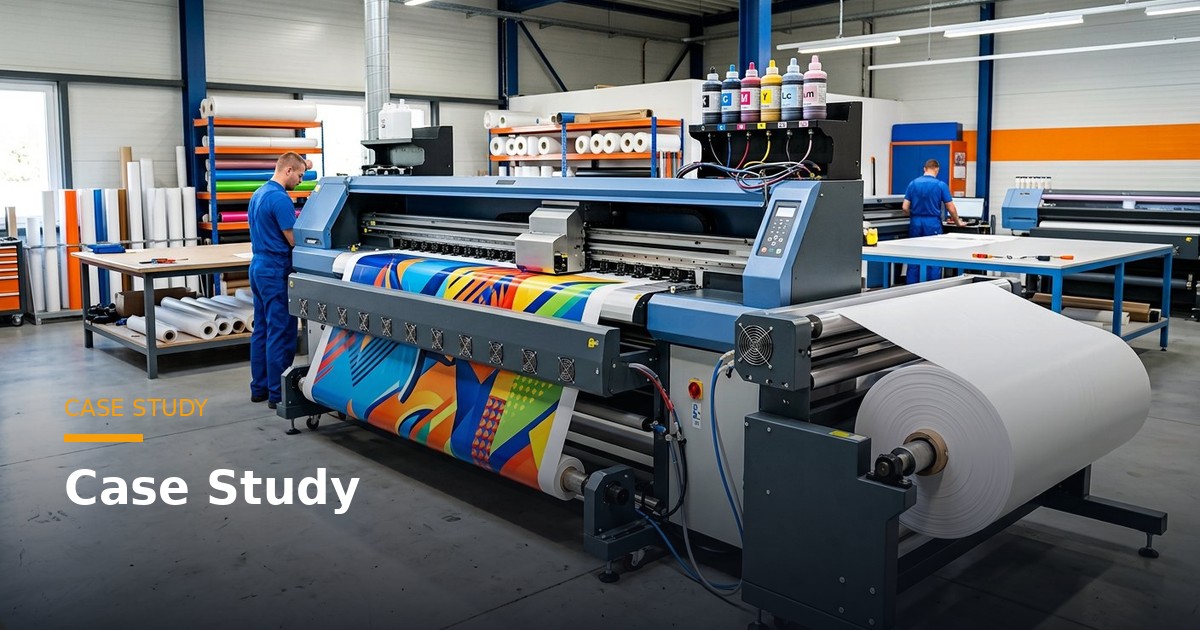
Overview: a DTF production unit set up with roughly Rs 50 lakh in a textile cluster town serving garment brands, uniforms and e-commerce sellers. The unit runs three DTF printers, two shakers and four heat presses, employs seven people, and reaches Rs 9-14 lakh monthly billing within twelve months at 25-32% net margin (est.). This is what the machine list, staffing and month-by-month economics actually looked like – including the mistakes.
The Machine List (est.)
| Item | Qty | Cost |
|---|---|---|
| 60 cm DTF printers, dual head | 3 | Rs 11-16 lakh |
| Automatic powder shakers with ovens | 2 | Rs 9-14 lakh |
| Heat presses, 40×60 cm | 4 | Rs 1.2-2 lakh |
| Laminator and finishing tools | 1 set | Rs 0.8-1.5 lakh |
| RIP software, PCs and design stations | 3 | Rs 1-2.5 lakh |
| Stabiliser, compressor, extraction | – | Rs 1.5-3 lakh |
| Premises deposit and fit-out | – | Rs 4-7 lakh |
| Opening consumables and blanks | – | Rs 4-7 lakh |
| Working capital reserve | – | Rs 6-10 lakh |
| Total | – | Rs 39-63 lakh |
Manpower Structure (est.)
| Role | Headcount | Monthly cost |
|---|---|---|
| Owner / sales lead | 1 | drawings from profit |
| Machine operators | 2 | Rs 18,000-30,000 each |
| Press and finishing staff | 2 | Rs 13,000-20,000 each |
| Designer | 1 | Rs 22,000-35,000 |
| Packing and dispatch | 1 | Rs 12,000-18,000 |
Monthly Economics at Steady State (est.)
| Line | Amount |
|---|---|
| Billing | Rs 9-14 lakh |
| Consumables (film, powder, ink) | Rs 3.2-5 lakh |
| Blanks (when supplied) | Rs 1.5-3 lakh |
| Salaries | Rs 1.1-1.8 lakh |
| Rent and utilities | Rs 60,000-1.1 lakh |
| EMI (if financed) | Rs 60,000-1.1 lakh |
| Net profit | Rs 2.2-4.5 lakh |
What Went Right (est.)
- Two anchor clients – a uniform supplier and an e-commerce seller – covered 45% of capacity from month three.
- Gang sheet discipline kept film waste near 8% instead of the usual 15-20%.
- Two shakers instead of one removed the bottleneck that otherwise caps print output.
- Same-day turnaround priced at a 20-30% premium and won the local brand trade.
What Went Wrong (est.)
- Third printer bought too early – sat underused for five months before volume arrived.
- No dedicated QC – roughly 4% reprints in the first quarter traced to white ink and press settings.
- Underpriced first corporate order – a 3,000-piece uniform job at near cost to win the logo.
- Single operator dependency – one resignation stalled production for nine days.
Lessons for the Next Unit (est.)
| Lesson | Application |
|---|---|
| Buy capacity against signed orders | second and third machines after 70% utilisation, not before |
| Cross-train operators | at least two people able to run each machine |
| Write QC into the process | wash test and press check on every new batch |
| Price corporate work properly | volume discounts yes, loss-leaders no |
Machine and startup context is in the DTF printer price guide and DTF startup guide.
Our Verdict
A Rs 50 lakh DTF unit works when capacity follows signed demand and two anchor clients cover nearly half the load. The failures here were timing errors, not technology errors – premature capacity, thin first contracts and no QC. Read the DTF printer price guide before scaling.
FAQs – Case Study: Rs 50 Lakh DTF Printing Unit
How much does a DTF production unit cost in India? (est.)
A serious unit with three 60 cm printers, two shakers, presses, finishing, premises and working capital lands between Rs 39-63 lakh (est.), with the machines themselves around Rs 22-34 lakh. Working capital and premises deposits are usually underestimated.
How much can a DTF unit earn monthly? (est.)
At Rs 9-14 lakh monthly billing with 25-32% net margins after consumables, salaries, rent and EMI, net profit lands at Rs 2.2-4.5 lakh (est.). Actual results depend on order flow and on keeping film waste below 10%.
How many staff does a DTF unit need? (est.)
Roughly six to seven people: two machine operators, two press and finishing staff, one designer and one for packing and dispatch (est.), plus the owner handling sales. Cross-training at least two people per machine prevents single-person dependency.
What is the biggest mistake when scaling a DTF unit? (est.)
Buying capacity before orders justify it (est.). In this case the third printer sat underused for five months. The healthy trigger is 70% sustained utilisation on existing machines before adding the next one.
How important is quality control in a DTF unit? (est.)
Critical – roughly 4% reprints occurred in this unit’s first quarter without dedicated QC, traced to white ink and press settings (est.). A wash test and press check on every new consumable batch prevents most of it.
Is a Rs 50 lakh DTF unit better than several small shops? (est.)
Different businesses: a unit competes on capacity, turnaround and corporate contracts, while small shops capture local retail margins (est.). The unit wins if it secures two or three anchor clients; without them, the fixed cost base is dangerous.
More case studies: Tier-3 Sublimation Gifting Unit, Flex Unit in a Wedding Town, UV Decor Studio in a Metro, Eco-Solvent Sticker Unit, Laser Jali Workshop, Election Season Printing Unit, Small-Town Mixed Plant. Full index: all digital printing case studies.
Planning something similar? Share your city and budget on the contact page – we reply with a configuration and honest numbers.
