

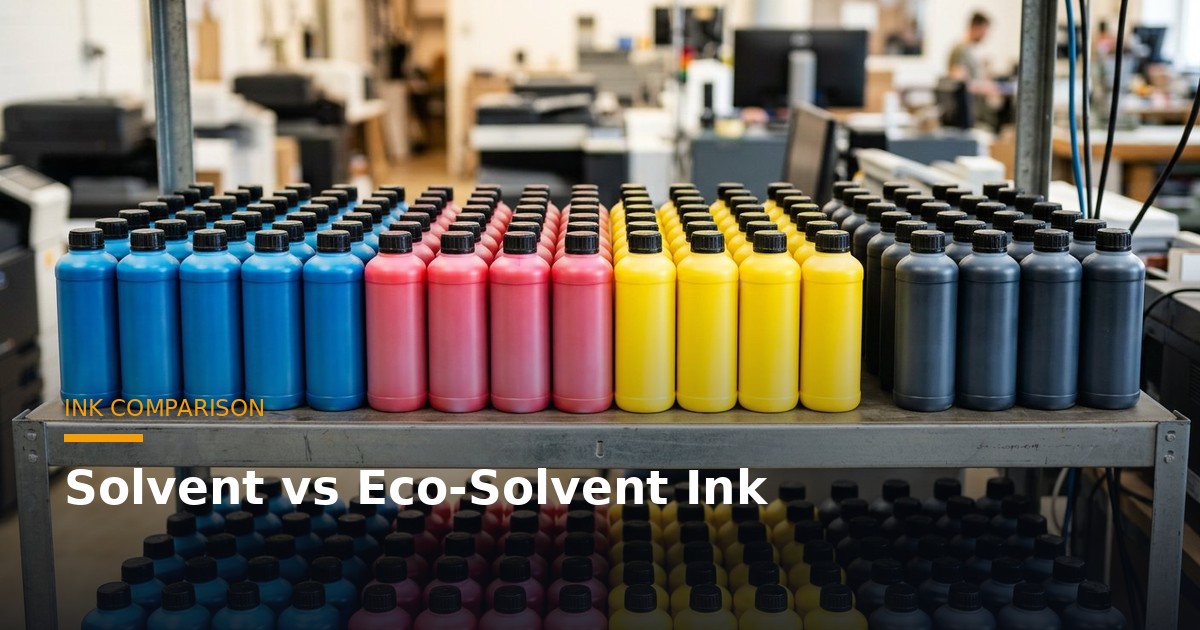
Choosing between solvent and eco-solvent ink is one of the first decisions a wide-format printer makes, and it shapes everything from the media you can print to the ventilation your workshop needs. Both are used for banners, flex, vinyl and signage, but they differ meaningfully in durability, odour, cost and application. Many printers assume one is simply “better”, but the right choice depends on what you print, where you print it and for whom. This guide compares solvent and eco-solvent ink honestly, so you can match the ink to your printer and business rather than guessing.
What Solvent and Eco-Solvent Ink Actually Are
Both inks work on the same basic principle: pigment suspended in a solvent carrier that carries the colour onto the media, then evaporates, leaving the pigment bonded to the surface. The difference is the strength of the solvent. Solvent ink uses strong solvents that aggressively bite into uncoated media like flex and PVC, giving a very durable bond. Eco-solvent ink uses milder, gentler solvents that are lower in odour and less harsh, but need coated media that can accept the ink. This single difference — strong versus mild solvent — drives almost every other difference between the two, from odour and ventilation to media compatibility and durability.
Durability and Outdoor Performance
Solvent ink has a genuine edge in durability, especially for demanding outdoor use. Its strong solvents bite into the media, creating a bond that is highly resistant to weather, UV exposure, abrasion and moisture. This makes solvent ideal for outdoor flex banners, hoardings, billboards and vehicle graphics that face sun, rain and physical wear for years. Eco-solvent ink is durable too, and perfectly adequate for most outdoor signage, but for the harshest, longest-exposure applications — large billboards, long-term vehicle wraps — solvent’s extra bite gives it an advantage. If your work is heavily outdoor and long-term, solvent’s durability is a real benefit.
Odour, Fumes and Ventilation
This is where eco-solvent clearly wins, and it matters more than many buyers realise. Solvent ink gives off strong fumes, which is why solvent printing traditionally needs dedicated, well-ventilated space. In India, where many shops operate in compact urban premises, this can be a genuine constraint — strong fumes in a small room are unpleasant for operators and can raise health concerns. Eco-solvent ink is much lower in odour, making it far more practical for indoor or compact workshops, retail print shops and businesses without industrial ventilation. For most Indian printing businesses, especially those in shared or urban spaces, eco-solvent’s low odour is a significant practical advantage that makes it the sensible default.
Media Compatibility
Solvent and eco-solvent differ in the media they handle. Solvent ink can print on uncoated, porous materials like raw flex and PVC because its strong solvents bite into them — this is useful for cost-conscious, high-volume flex banner work. Eco-solvent needs coated media with a receptive surface, so you use coated vinyl, banner flex, backlit film, sticker vinyl and similar. In practice, the coated media eco-solvent uses are widely available and give excellent results, so this is rarely a limitation — but if your business relies heavily on printing uncoated flex cheaply, solvent’s compatibility matters. For most vinyl, sticker and signage work, eco-solvent on coated media is ideal.
Cost Comparison
Cost differs in a few dimensions. Ink cost per litre is lower for solvent (₹250–₹1,000+) than eco-solvent (₹400–₹2,000+). Media cost can favour solvent, since it prints on cheaper uncoated flex, while eco-solvent needs coated media that costs a bit more. Machine cost is similar for comparable models. So solvent can have a lower cost per printed banner, especially on uncoated flex, which is why high-volume flex banner shops favour it. But eco-solvent’s cost is competitive for coated-media work, and its other advantages often outweigh the small cost difference. The right choice depends on whether your priority is lowest cost per banner or versatility and indoor-friendliness.
Print Quality and Detail
Both produce good quality, with subtle differences. Modern eco-solvent delivers excellent, sharp, vibrant output, and its compatibility with fine printheads gives very good photographic detail — well suited to quality signage, decals and graphics where appearance matters. Solvent also produces good quality, but eco-solvent’s edge with fine detail and coated media makes it a strong choice for detailed, high-appearance work. For most signage and graphics, either gives professional results; for detail-critical or photographic work, eco-solvent on good coated media often has a slight edge. Quality alone rarely decides the choice — durability, odour and media usually matter more.
Which Printheads and Machines Use Each
Both ink types are used across a range of machines and printheads. Industrial printheads like the Konica KM512i and KM1024i are commonly used in solvent machines for high-volume flex and banner work, valued for their speed and durability with solvent ink. Eco-solvent is often paired with fine Epson heads like the i3200 or DX7 for quality signage and graphics. Many machines are designed for one or the other, so your ink choice is partly determined by your machine. When buying a printer, decide your ink type based on your work first, then choose a machine built for it — matching the right printhead and ink to your applications is key to good results.
Which Should You Choose?
The decision comes down to your work and your space. Choose solvent if you do high-volume outdoor flex banners, hoardings and vehicle graphics, prioritise maximum durability and low cost per banner, print on uncoated flex, and have proper ventilation. Choose eco-solvent if you print vinyl graphics, stickers, backlit, wall graphics and general signage, work indoors or in a compact space where low odour matters, and want versatile, high-quality output on coated media. For the majority of Indian printing businesses — especially those doing varied signage work in urban or shared premises — eco-solvent is the practical, versatile choice. For dedicated high-volume outdoor flex banner production with ventilation, solvent has real advantages.
Can You Switch Between Them?
Generally, a machine is built for one ink type, and you should not casually switch. The ink systems, printheads and settings are matched to the ink, and switching from solvent to eco-solvent (or vice versa) on a machine not designed for it can damage the head and produce poor results — the inks are chemically different and do not mix. Some machines are convertible with proper flushing and parts, but this should only be done with expert guidance and the right components. In practice, it is far better to choose the right ink type for your work from the start, or run two machines if you genuinely need both. Plan your ink type as a core business decision, not something to switch lightly.
Getting Expert Advice on Your Ink Choice
Because the solvent-versus-eco-solvent decision shapes your machine, media, workspace and output, expert advice is genuinely valuable. The right choice depends on your specific work, volumes, space and goals — and getting it wrong is costly. Unified Engineering Dynamics manufactures and supplies both solvent and eco-solvent printers and inks, and we advise businesses on the right choice for their needs rather than simply pushing a product. We help you match the ink type, machine and printhead to your actual applications so you invest in the right setup from the start and avoid costly mistakes.
Frequently Asked Questions
Is eco-solvent ink better than solvent?
Neither is universally better. Solvent is more durable and cheaper per banner for outdoor flex; eco-solvent is lower-odour and better for indoor use and quality coated-media work. It depends on your needs.
Which is safer for a small indoor shop?
Eco-solvent. Its low odour makes it far more suitable for compact or indoor workshops, whereas solvent needs strong ventilation for its fumes.
Which is cheaper to run?
Solvent can be cheaper per banner, especially on uncoated flex, due to lower ink and media cost. Eco-solvent is competitive for coated-media work.
Can I use solvent ink in an eco-solvent printer?
No. Machines are built for one ink type and the inks are chemically different. Switching can damage the printhead and is not recommended.
Which lasts longer outdoors?
Solvent has a durability edge for harsh, long-term outdoor exposure, though quality eco-solvent is durable enough for most outdoor signage.
Do you supply both types?
Yes. Unified Engineering Dynamics supplies both solvent and eco-solvent printers and inks, and we advise on the right choice for your business.
The Environmental and Regulatory Angle
The environmental difference between solvent and eco-solvent is worth understanding, both for your conscience and increasingly for compliance. Traditional solvent ink uses stronger volatile organic compounds (VOCs), which evaporate during printing and drying, contributing to air pollution and requiring ventilation. Eco-solvent uses milder, lower-VOC solvents, making it a cleaner option with a smaller environmental footprint and fewer emissions in your workspace. As environmental awareness and, in some areas, regulations around VOC emissions grow, eco-solvent’s cleaner profile is a forward-looking advantage. For businesses thinking about long-term sustainability and their working environment, eco-solvent aligns better with where the industry is heading.
This environmental angle also connects to the practical realities of your workspace. Lower emissions mean a more pleasant, healthier environment for your operators, which matters for staff wellbeing and productivity, especially in a compact Indian workshop where operators spend long hours near the machine. While solvent’s fumes can be managed with ventilation, that requires investment in extraction and space. Eco-solvent sidesteps much of this. For many businesses, the combination of a cleaner working environment, lower environmental impact and future-proofing against tightening norms makes eco-solvent the more sustainable long-term choice, on top of its practical advantages in odour and versatility.
Making the Decision for the Long Term
Choosing between solvent and eco-solvent is a long-term decision, since your machine, media and process are built around it. Think beyond today’s jobs to where your business is heading. If you expect to grow into varied signage, graphics and indoor work, eco-solvent’s versatility will serve you better over time. If your business is firmly rooted in high-volume outdoor flex banners and you have the space for ventilation, solvent’s durability and economy are a solid long-term fit. Consider your market, your space, your growth plans and your environmental priorities together, rather than deciding on ink price alone.
Also consider that many successful businesses eventually run both — solvent or eco-solvent roll-to-roll for flexible-media work, alongside other technologies for rigid or specialty work. So your ink decision is really about which market you enter first and how you will grow. Getting expert advice at this stage is valuable, because the wrong choice locks you into a machine, media and market that may not suit you. Unified Engineering Dynamics advises businesses on this decision based on their actual situation — what they print, where, and where they want to go — so the investment supports long-term success rather than limiting it.
The Bottom Line on Solvent vs Eco-Solvent
There is no single winner between solvent and eco-solvent — the right choice is the one that fits your specific business. Solvent earns its place in high-volume outdoor flex banner production, where its durability and economy on uncoated media are hard to beat, provided you have proper ventilation for its fumes. Eco-solvent has become the practical default for most Indian print shops, because its low odour suits compact and indoor spaces, its versatility covers a wide range of coated-media work, and its quality is excellent for signage and graphics. Neither is universally superior; each excels in the conditions it was designed for.
So make the decision around your reality: the banners and graphics you actually print, the space you print in, your growth plans and your environmental priorities. If you are still unsure, that is exactly when expert advice pays — the wrong choice locks you into a machine and market that may not suit you. Unified Engineering Dynamics supplies both solvent and eco-solvent printers and inks, and we advise honestly based on what you print and where, so you invest in the setup that genuinely fits your business and supports its growth for years to come.
Match the Ink to Your Business — We Will Help You Choose
Solvent and eco-solvent each suit different work. Choose based on your applications, space and priorities. Unified Engineering Dynamics supplies both printer types and inks, with honest advice and nationwide support to help you pick right.
Get expert advice on solvent vs eco-solvent for your business → Tell us what you print and where, and we will recommend the right ink and machine.
Related Reading
- How to Choose the Right Ink for Your Printer: Complete India Guide
- Best Ink for Flex & Banner Printing in India (2026)
- UV Ink vs Solvent Ink: Differences, Uses & Which to Choose
- Eco-Solvent Ink Price in India: Cost per Litre & Where to Buy
- Solvent Ink Price in India 2026: Per-Litre Cost, Brands & Buy Guide
Unified Engineering Dynamics supplies quality printer inks and machines with expert support across India. Get in touch for ink advice and pricing →
