



Direct answer: In the DX5 vs XP600 comparison, the Epson DX5 has 1,440 nozzles in 8 rows of 180 and up to 8 colours, while the XP600 has 1,080 nozzles in 6 rows of 180 and up to 6 colours. Both print about a 1-inch swath per row at 180 npi. The DX5 was built for solvent and eco-solvent wide-format printers, carries more nozzles per colour in a CMYK setup and is known for sharp quality and long life with eco-solvent ink. The XP600 came from a desktop printer, is far cheaper and is the standard head in budget eco-solvent and DTF machines. The catch is cost and supply: the DX5 is discontinued and scarce, with Indian prices around ₹84,000–₹1,08,000, against about ₹38,000 for an XP600. Keep a DX5 machine running if you own one; for a new purchase, compare an XP600 machine for budget work with an i3200 machine for production.
Many Indian sign shops still run DX5 printers bought years ago, while new budget machines arrive with XP600 heads. This guide explains how the two heads compare and what to do when your DX5 needs replacing.
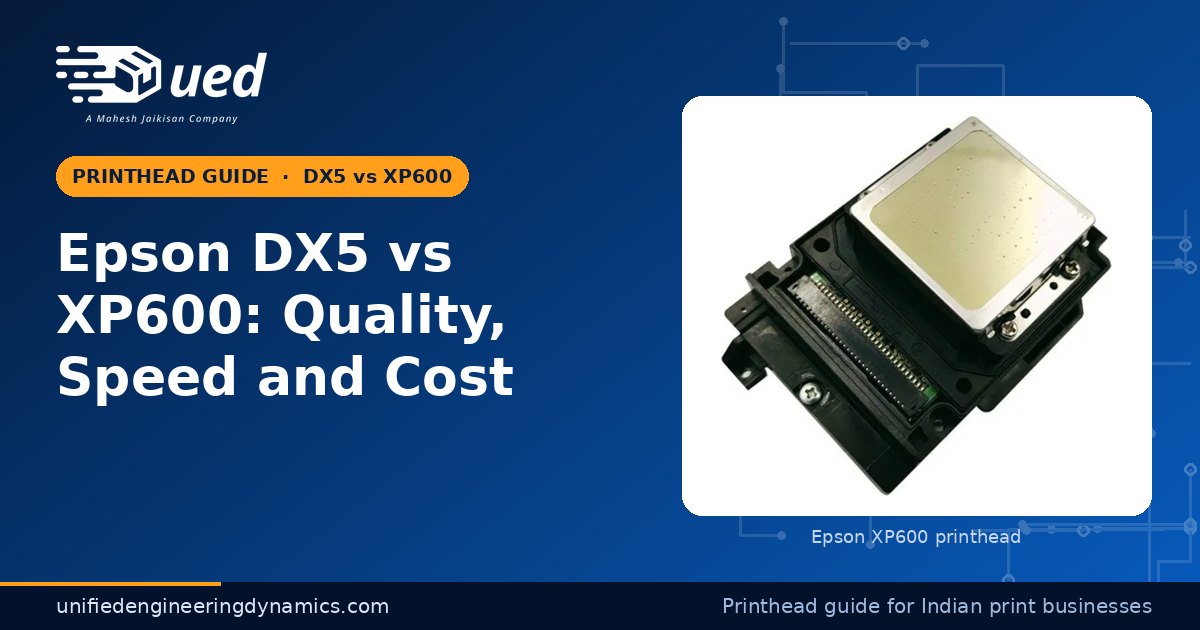
Table of Contents
The Two Heads in Brief
The DX5 is one of the most famous Epson heads in wide-format printing. It powered many solvent and eco-solvent printers from established brands and Chinese makers, and it built a reputation for sharp output and dependable life with eco-solvent ink. Epson has since moved on to newer heads, and sellers describe the DX5 as discontinued. Our guide to DX4, DX5, DX6 and DX7 heads covers the DX family history.
The XP600 comes from Epson’s Expression Premium XP-600 desktop printer and is also called DX9 or DX11. Chinese machine makers adopted it because it is cheap and widely available, and it is now the most common head in entry eco-solvent and DTF printers in India.
How to Identify Your Head
- Check the label and part number on the head and its packaging.
- Count the nozzle rows on a nozzle check print: eight rows usually indicate a DX5, six rows an XP600.
- Check the configured head type in the printer’s control software.
- Look at the head board model on the carriage.
- Ask your machine supplier for the original configuration.
Colour Configurations
| Configuration | DX5 | XP600 |
|---|---|---|
| CMYK with doubled rows | Common: 2 rows per colour | Partial: only some colours doubled |
| Six-colour (CMYK + LC + LM) | Possible, with extra rows spare | Common in photo and sublimation machines |
| Eight-colour | Possible | Not possible on one head |
| CMYK + white | Possible | Common in DTF machines |
Two rows per colour in CMYK is part of why DX5 machines print consistent solids: if one nozzle weakens, the other row helps cover it, and each pass carries more nozzles per colour.
DX5 vs XP600: Specification Comparison
| Specification | Epson DX5 | Epson XP600 |
|---|---|---|
| Nozzles | 1,440 (8 rows × 180) | 1,080 (6 rows × 180) |
| Nozzle resolution | 180 npi per row, 360 npi over 2 rows | 180 npi per row, 360 npi over 2 rows |
| Maximum colours per head | 8 | 6 |
| Nozzles per colour in CMYK mode | Typically 360 (2 rows per colour) | Fewer; depends on channel assignment |
| Droplet size (seller specs) | Variable, about 1.5–21 pl quoted | Variable; small minimum drop |
| Viscosity range (seller specs) | About 4–5 mPa·s | About 3–5 mPa·s |
| Size and weight (seller specs) | About 106 × 49.7 × 41.7 mm, 97 g | Smaller, lighter module |
| Original design | Wide-format solvent and eco-solvent printers | Desktop water-based printer |
| Availability | Discontinued; limited stock | Widely available |
| Price in India | About ₹84,000–₹1,08,000 | About ₹38,000 |
DX5 figures come from Indian and overseas seller listings, such as KingJet and Compsysco, which publish 1,440 nozzles in 8 lines of 180. Droplet and frequency figures vary between listings, so treat them as approximate.
Print Quality
Both heads print at the same nozzle pitch, so the basic resolution is the same. In practice the DX5 has a strong reputation for sharp text, clean lines and smooth gradients in eco-solvent work, helped by two rows per colour in CMYK mode and a design made for solvent-based inks. The XP600 also prints fine detail and is excellent for its price, especially in DTF and photo-style stickers. With good profiles and calibration, most customers cannot tell the difference on typical vinyl and sticker jobs. The DX5 edge shows more on long runs, where it keeps quality more consistently.
Speed
The DX5 has 1,440 nozzles against 1,080, a third more. In a CMYK configuration, it puts two full rows behind each colour, so each pass lays more ink per colour. For the same pass mode and carriage speed, a DX5 machine is usually somewhat faster per head than an XP600 machine. However, many XP600 machines use two heads to make up the difference, and an i3200 machine is far faster than either.
| Machine type | Relative speed |
|---|---|
| 1 × XP600 | Entry level |
| 1 × DX5 | Higher than a single XP600 |
| 2 × XP600 | Similar to or above a single DX5 |
| 1 × i3200-E1 | Much higher than DX5 or XP600 |
Our guide to Epson i3200 vs DX5 compares the DX5 with Epson’s modern production head.
Solvent Resistance and Head Life
This is where the DX5 earns its reputation. It was designed for solvent and eco-solvent inks, so its materials cope with those inks well, and DX5 heads often run for a long time in well-kept eco-solvent printers. The XP600 was designed for water-based ink, so eco-solvent ink is harder on it. With good ink and daily care, an XP600 still gives useful service, but it is generally treated as a more consumable part that is replaced more often.
| Factor | DX5 | XP600 |
|---|---|---|
| Designed for eco-solvent ink | Yes | No; adapted |
| Typical life in eco-solvent use | Longer with good care | Shorter; more frequent replacement |
| Replacement cost | High | Low |
| Replacement availability | Limited | Easy |
For running cost planning, see our guide to printhead running cost and lifespan in India.
Locked, Unlocked and Decoders
DX5 heads are sold in different versions often called first locked, second locked and unlocked. Locked heads need a matching decoder card or a board that supports them, while unlocked heads can be fitted without a decoder. Sellers such as KingJet list part numbers like F186000 and F187000 and state whether a decoder is needed. Before buying a DX5, confirm which version your machine needs, or you may receive a head your board cannot use. XP600 heads are generally simpler in this respect, although you should still confirm compatibility with your board.
DX5 vs XP600: Price in India
| Head | Price seen | Source |
|---|---|---|
| Epson DX5 | ₹1,08,000 | UED store |
| Epson DX5 | ₹84,000 | IndiaMART listing |
| Epson XP600 | ₹38,000 | UED store |
DX5 prices have risen as stock has become scarce. Prices change often, so get a quotation before buying. Very cheap DX5 heads are often refurbished, pulled from old machines or not genuine. Our printhead price list covers other heads too.
Can You Replace a DX5 With an XP600?
Not by swapping the head. The DX5 and XP600 need different head boards, cables, carriage mounting, firmware and settings. Converting a DX5 machine to XP600 or i3200 means a new board kit, new carriage parts, new dampers and full calibration. It is possible, and board makers sell conversion kits, but it is a significant job. For many owners, the choice is between buying another DX5 head, converting to a newer head, or replacing the machine.
| Option | Pros | Cons |
|---|---|---|
| Buy a new DX5 head | No change to machine or settings | High price, limited stock, risk of non-genuine heads |
| Convert to XP600 | Cheap, easy-to-find heads | Shorter head life, conversion cost, possible speed loss |
| Convert to i3200 | Much faster, modern head | Higher conversion cost; needs suitable kit |
| Replace the machine | New warranty, modern electronics | Highest upfront cost |
Our guide to board kit conversion explains how head upgrades work, and our fire board compatibility guide covers DX5, XP600 and i3200 boards.
DX5 vs XP600 by Application
| Application | Better fit | Notes |
|---|---|---|
| Vinyl stickers and signage (existing machine) | DX5 | Keep it running while heads are available |
| New budget eco-solvent printer | XP600 | Low entry cost and easy spares |
| DTF transfers | XP600 | Standard head in small DTF printers |
| High-quality photo prints on eco-solvent media | DX5, or i3200 for new machines | DX5 known for consistent quality |
| Production volume | Neither; choose i3200 | Far higher speed and life |
Running Cost Over a Year
A simple way to compare is to estimate how many heads you replace per year and add ink and maintenance costs. A DX5 head costs roughly two to three times as much as an XP600, but in eco-solvent use it often lasts longer. If an XP600 machine needs heads replaced several times a year because of heavy use, the savings shrink. If use is light and the ink is good, an XP600 is very economical. Track your own replacement history and ink use to decide; there is no universal answer.
Board Systems and Software
DX5 machines use older board generations that may be harder to repair today, while XP600 machines use current Hoson, Senyang and BYHX kits with wide support. When a DX5 machine’s main board or head board fails, finding a matching replacement can be as hard as finding a head. This is another reason many owners plan a conversion or replacement before the machine fails. RIP software such as Maintop supports both heads through the correct printer driver; our Maintop RIP setup guide covers driver selection.
Troubleshooting Common Faults
| Symptom | Likely cause | First check |
|---|---|---|
| Missing nozzles in one colour | Clog or air in damper | Normal cleaning, check damper |
| Head not recognised after replacement | Locked head or wrong board setting | Confirm locked or unlocked version and head type |
| Weak colour or misfiring | Head voltage incorrect | Check voltage settings for the new head |
| Banding | Step calibration or weak nozzles | Nozzle check, then step calibration |
| New head fails quickly | Faulty head board | Test the board before fitting another head |
Our guide to head voltage settings explains why correct voltage matters for both heads.
Caring for Each Head
- Both: daily nozzle checks, clean capping and wiping, good filters and genuine ink.
- DX5: protect it carefully, as replacements are expensive and scarce; avoid aggressive cleaning and keep spare dampers.
- XP600: avoid harsh, low-quality eco-solvent ink; keep the machine capped when idle and maintain stable room conditions.
Our guide to printer dampers covers one of the most important protection parts.
Planning Ahead if You Run a DX5
If your shop depends on a DX5 printer, plan before the head fails rather than after. A sudden failure during a busy season can stop production for days while you search for a genuine head at a fair price.
- Record the head part number, locked or unlocked version and board model.
- Get current quotations for a genuine DX5 head and for a conversion kit.
- Price a replacement i3200 or XP600 machine for comparison.
- Decide in advance which option you will choose when the head fails.
- Protect the current head with good ink, fresh dampers and gentle cleaning.
- Back up RIP profiles and printer calibration values.
Environment Matters for Both
Dust, heat and very dry air shorten the life of both heads. Keep the printer in a clean room away from direct sunlight, avoid fans blowing across the carriage and cap the head whenever the printer is idle. Use a UPS, stabiliser and proper earthing; power surges damage head boards and heads alike. Our guide to power fluctuation and earthing explains protection.
Buying Genuine Heads
Because DX5 stock is limited, refurbished and fake heads are common. Buy from established suppliers, check packaging and labels, ask about the locked or unlocked version, confirm warranty terms and test with a nozzle check after fitting. Our guide to buying genuine printheads in India lists warning signs.
Spares Worth Keeping
Keep spare dampers, a capping station, wiper blades, a head cable and approved cleaning fluid. These inexpensive parts often fix problems that look like head failure, and they protect an expensive DX5 head from avoidable damage.
Common Mistakes
- Buying a cheap DX5 online that turns out to be refurbished or locked for a different board.
- Trying to fit an XP600 into a DX5 carriage without a conversion kit.
- Using cheap ink in an XP600 eco-solvent machine and losing heads quickly.
- Comparing only head prices and ignoring head life and downtime.
- Waiting until the DX5 fails completely before planning a replacement.
Example Decision
A Lucknow sign shop runs a ten-year-old DX5 eco-solvent printer that still prints well, but one colour is weakening. A genuine replacement DX5 costs about ₹1 lakh. The owner compares this with a conversion kit and with a new i3200 machine. Because volumes have grown, the shop buys a new i3200 printer for production and keeps the DX5 running for small jobs until its head finally fails. A smaller shop with light volume might instead choose an XP600 machine as a low-cost replacement.
Further reading: Wikipedia’s article on Seiko Epson covers the company behind both heads.
Key Takeaways
- The DX5 has 1,440 nozzles and up to 8 colours; the XP600 has 1,080 nozzles and up to 6.
- The DX5 was built for eco-solvent ink and is known for quality and long life.
- The XP600 is cheap, widely available and standard in budget eco-solvent and DTF machines.
- DX5 heads cost about ₹84,000–₹1,08,000; XP600 heads about ₹38,000.
- The heads are not interchangeable without a board and carriage conversion.
- For new production machines, the i3200 outperforms both.
Our Verdict
In the DX5 vs XP600 decision, the DX5 is the better head and the XP600 is the better buy for a new budget machine. If you own a DX5 printer, protect the head and plan ahead, because replacements are expensive and scarce. If you are buying new, choose an XP600 machine for low-volume and DTF work, or an i3200 machine for production. Match the head to your volume, buy genuine and keep up daily maintenance.
For most new buyers in India today, the practical path is clear: start with an XP600 machine if budget is tight and volume is light, and move to i3200 when orders grow. For DX5 owners, the best investment is careful maintenance now and a clear replacement plan for later.
Frequently Asked Questions
Is the DX5 better than the XP600?
In print consistency and life with eco-solvent ink, the DX5 is generally better. The XP600 is much cheaper and easier to find, which makes it the common choice for new budget machines.
Can I fit an XP600 head in a DX5 printer?
Not directly. It needs a conversion kit with a different head board, cables, carriage parts and settings.
What is the DX5 printhead price in India?
Listings show about ₹84,000 to ₹1,08,000 for a DX5. XP600 heads cost about ₹38,000. Prices change, so get a quotation.
Is the Epson DX5 discontinued?
Sellers describe the DX5 as discontinued, which is why stock is limited and prices are high.
What does locked or unlocked DX5 mean?
Locked DX5 heads need a matching decoder or board, while unlocked heads can be fitted without a decoder. Confirm which version your machine needs.
Which head is faster, DX5 or XP600?
Per head, the DX5 is usually faster in CMYK because it has more nozzles per colour. Two-head XP600 machines can match or exceed a single DX5.
Should I replace my DX5 machine with an i3200 machine?
If your volume has grown or DX5 heads are hard to source, an i3200 machine offers much higher speed and modern support.
