



Updated: October 2026
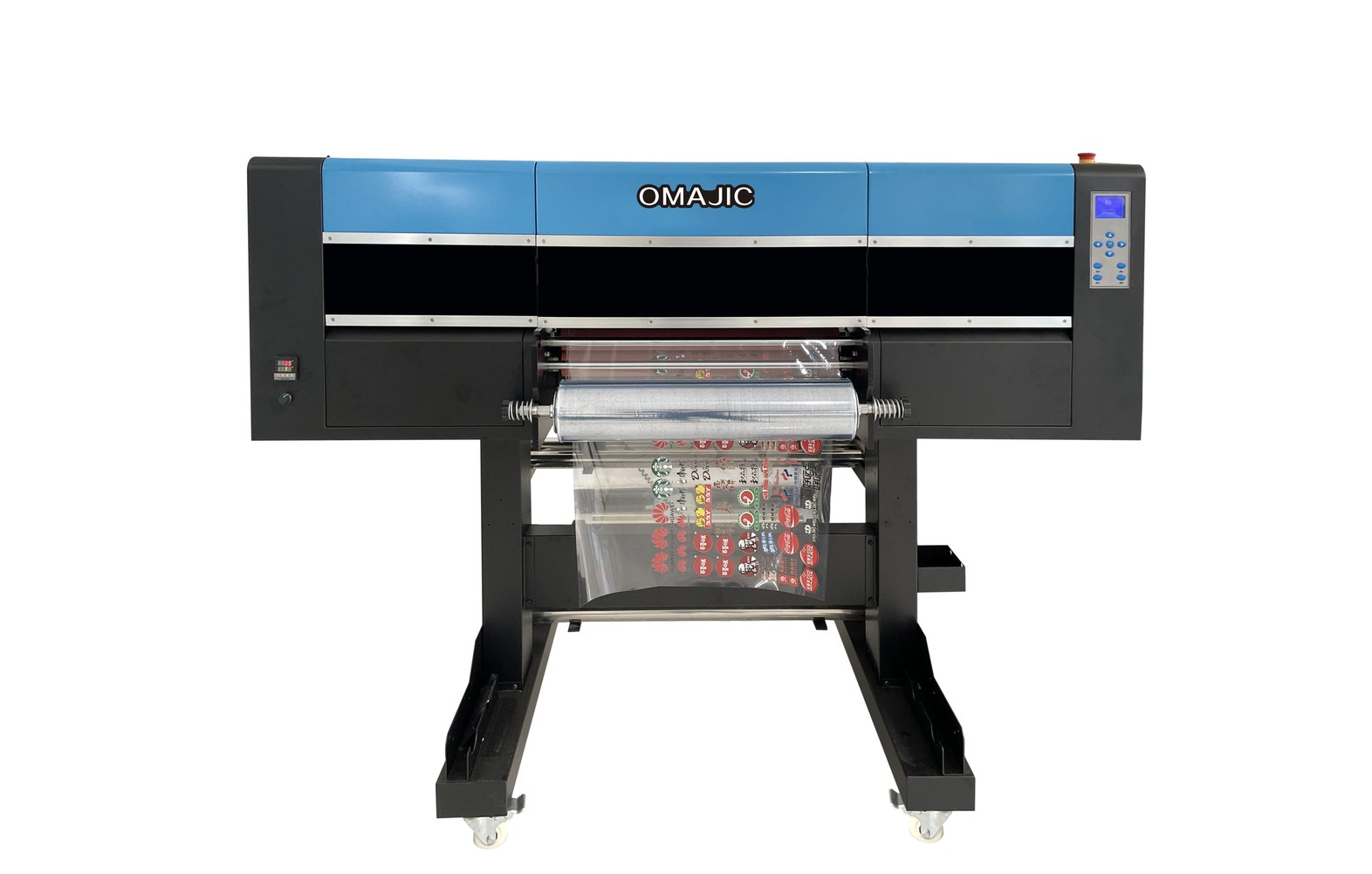
Direct answer: UV DTF (UV Direct-to-Film) is a sticker-making printing method. A UV printer lays UV-curable ink – CMYK plus white, sometimes varnish – onto a special adhesive A-film, and a laminator sandwiches a transparent B-film on top. You then cut the design out, press this sticker onto almost any hard surface at room temperature, peel off the carrier film, and the graphic stays permanently bonded. No heat press, no coating, no flat object needed – which is exactly why it is taking over bottle, metal, glass and gift-item printing in India.
The UV DTF Process in 5 Steps
| Step | What happens | Equipment |
|---|---|---|
| 1. Design | artwork prepared, white layer marked in RIP software | computer + RIP |
| 2. Print on A-film | UV ink is printed and instantly cured by LED lamp | UV DTF printer |
| 3. Laminate B-film | transfer film laminated over the printed A-film | cold laminator (manual or auto) |
| 4. Cut and press | sticker cut out, positioned and pressed on the item | scissors plus a squeegee |
| 5. Peel | carrier film removed slowly – graphic remains on the item | – |
What UV DTF Sticks On – and Where It Belongs
| Item | UV DTF result | Notes |
|---|---|---|
| Steel bottles and tumblers | excellent | curved surfaces are fine – sticker bends around the shape |
| Glass tumblers, jars, awards | excellent | no coating needed – the direct-sublimation-on-glass problem disappears |
| Metal sheets, nameplates, trophies | excellent | premium finish with white under-layer |
| Acrylic keychains, photo frames | very good | smooth, scratch-tolerant surface favourite |
| Wooden plaques, coated ceramic, uncoated mugs | very good | works where sublimation fails |
| T-shirts, fabric, garments | not suitable | fabric jobs belong to What Is DTF Printing? or sublimation |
| Flex banners, large signage sheets | not suitable | those need UV roll or flatbed machines |
UV DTF vs UV Flatbed – the Confusion Worth Killing First
A UV flatbed prints directly on the object placed inside the machine – wonderful for phone cases, boards and flat sheets, but the object must fit the bed and lie flat. UV DTF prints stickers that you carry to the object – curved bottles, corners, assembled products and items too big for any bed all work instantly. Serious personalised-gift units keep both: flatbed for high-volume flat items, UV DTF for everything odd-shaped. Budget-first buyers start with UV DTF because machine sizes are smaller and prices friendlier (est.) – see the UV flatbed price guide to compare against the direct-print route and the UV DTF printer guide for the sticker route.
UV DTF vs Sublimation on the Same Mug
| Point | Sublimation | UV DTF |
|---|---|---|
| Surface needed | poly-coated blank only | almost any smooth hard surface |
| Equipment at press stage | mug press at 180-200 C | room-temperature hand press |
| Scratch resistance (est.) | coating-dependent | strong hardened UV layer |
| Unit consumable cost (est.) | lower (ink + paper) | higher (AB film) but no blank premium |
| Feel | inside-coating, flat feel | slight raised decal – premium sticker feel |
Setup Cost Snapshot (est.)
| Component | Role | Price band India (est.) |
|---|---|---|
| UV DTF printer (30 cm class) | prints on A-film with LED curing | Rs 1.9-3.5 lakh |
| UV DTF printer (60 cm class) | shop-grade rolls and speed | Rs 3.5-6.5 lakh |
| Cold laminator | applies B-film | Rs 8,000-45,000 |
| AB film + UV ink starter stock | consumable base | Rs 10,000-25,000 |
Model-level comparisons live in the UV DTF printer guide; if you are weighing flatbed against sticker route, the UV machine chooser walks the decision step by step.
Our Verdict
UV DTF is the missing half of the personalised-gift market: it prints on what sublimation cannot touch – uncoated steel, glass, wood, acrylic and metal – with room-temperature application and a durable cured-ink layer. Pair it with a sublimation press for coated goods or a flatbed for volume, and almost every gift item a customer brings in becomes printable. Browse the UV DTF printer range, compare against the UV flatbed range, study the UV DTF printer guide, and share the items you want to print on the contact page – we will tell you exactly which route fits those items and why.
FAQs – What Is UV DTF Printing? Hard-Surface Guide
Is UV DTF printing waterproof and durable outdoors?
Yes, substantially more than ordinary stickers – the UV ink layer is fully cured and scratch-tolerant. On bottles and metal, a properly applied UV DTF decal handles daily handling, hand-washing and weather for a long service life (est.); avoid dishwasher heat jets and strong solvents, which age any decal.
Can UV DTF stickers be applied to fabric or t-shirts?
No – UV DTF decals are designed for hard smooth surfaces. For garments the correct methods are fabric DTF, sublimation, HTV or screen printing. Applying UV DTF to cloth usually cracks quickly because the hardened ink layer does not flex like textile prints.
Do I need coated blanks for UV DTF like sublimation does?
No – that is the biggest advantage. UV DTF works on uncoated steel, glass, ceramic, acrylic, wood and metal, which removes the blank-sourcing headache and price premium of poly-coated stock. The surface only needs to be clean, dry and smooth.
Can UV DTF print on curved or irregular shapes?
Yes – because the output is a flexible sticker before application, it wraps around bottles, helmet curves and odd-shaped items. Very deep recesses or sharp compound curves can trap air, so press from centre outward with a squeegee and choose sticker sizes that respect the shape.
What is the difference between UV DTF and normal vinyl stickers?
A normal vinyl sticker is cut or eco-solvent-printed coloured material with weak fine detail. UV DTF carries full photographic CMYK plus white plus optional varnish in a hardened, scratch-resistant ink layer, and applies without a plotter-cutter step – so photographic branding, logos with gradients and metallic-look art are possible at sticker speed.
What is the real setup cost to start UV DTF printing in India? (est.)
A 30 cm class UV DTF printer with a manual laminator and starter AB film and ink typically lands between Rs 2.1 and 3.9 lakh all-in (est.). Volume shops choose 60 cm machines near Rs 4-7 lakh (est.). Film and ink cost roughly Rs 60-120 per A4-sized print area, so premium gift pricing absorbs it comfortably.
The Printing Method Clarity Series – more guides: What Is DTF Printing?, What Is Sublimation Printing?, What Is DTG Printing?, What Is HTV Printing?, Screen Printing for Beginners.
Buying and business reads: DTF printer price guide, sublimation machine price guide, cost per t-shirt math, DTF earning analysis.
Confused about which method your product needs? Send the item list on the contact page – we reply with the correct machine path, not the expensive one.
